$100 Oil, a Softer Economy, and a Nervous Bounce
Thursday’s selloff was not just another jittery geopolitical session. It was the moment investors had to treat the Iran conflict as a direct macro problem. U.S. stocks closed sharply lower as crude ripped higher, the Strait of Hormuz remained under threat, and traders began…
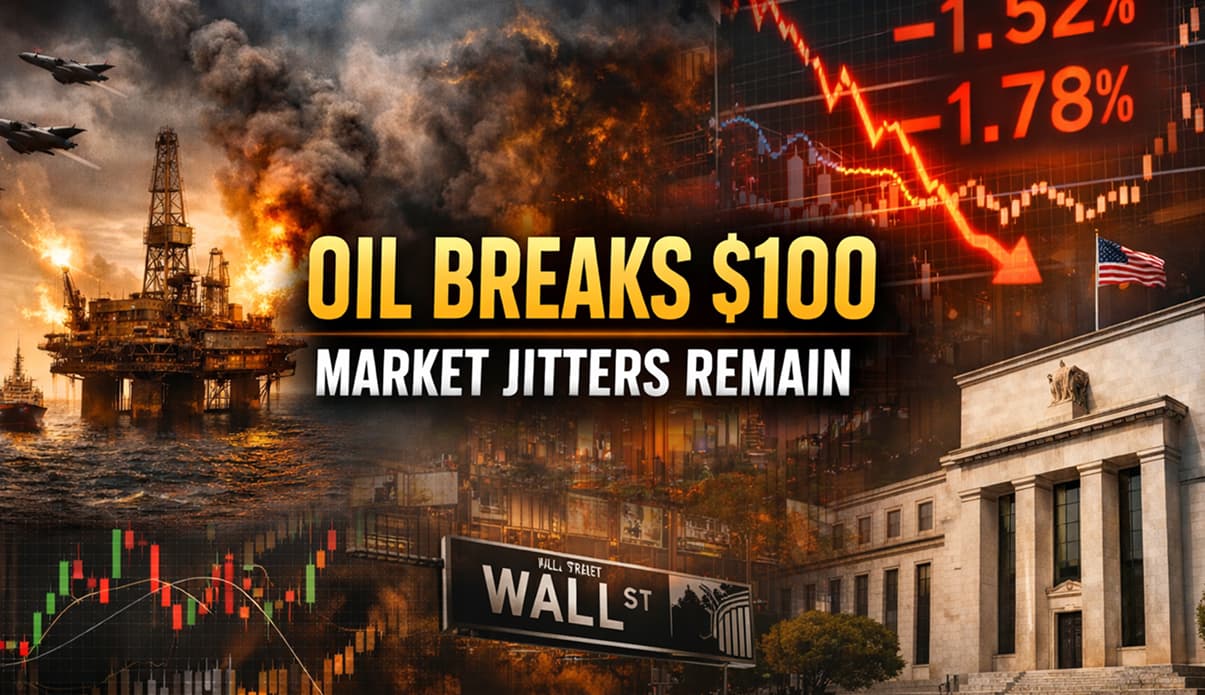
Thursday’s selloff was not just another jittery geopolitical session. It was the moment investors had to treat the Iran conflict as a direct macro problem. U.S. stocks closed sharply lower as crude ripped higher, the Strait of Hormuz remained under threat, and traders began repricing how much of this shock could bleed into inflation, growth, and Fed policy. The Dow fell 1.56%, the S&P 500 dropped 1.52%, and the Nasdaq lost 1.78%, while Brent settled at $100.46 a barrel and WTI at $95.70.
Since the market opened Friday morning, the mood has improved, but only in the most qualified sense. AP reported later in the morning that the S&P 500 was up 0.6%, the Dow was higher by 324 points, and the Nasdaq had gained 0.5% as oil eased off its highs. Reuters had earlier described the open as mixed, with the Dow up 11.4 points, the S&P 500 off 0.9 points, and the Nasdaq up 113.7 points. That tells you what this tape really is right now: less panic than Thursday, but nowhere close to confidence.
The economic data helped stop the bleeding, but they did not solve the bigger problem. January headline PCE rose 0.3% month over month and 2.8% year over year, while core PCE rose 0.4% on the month and 3.1% from a year earlier. At the same time, fourth-quarter GDP was revised down to 0.7%, which reinforces the idea that the economy is cooling even as elevated oil threatens to keep inflation sticky. That is not a clean backdrop for stocks. It is a stagflation-lite backdrop, and markets know it.
Stock of Interest Today: Klarna Group (KLAR)
Klarna is interesting today for a much simpler reason than a breakout chart or a flashy earnings beat. Someone with one of the best seats in the building just made a roughly $50 million bet on the stock. The company disclosed that chairman Michael Moritz bought 3,472,845 ordinary shares between March 3 and March 11 for about $49.9 million, while chief product and design officer David Fock bought 27,000 shares for about $388,552. Klarna also noted that some executives sold stock under pre-arranged Rule 10b5-1 trading plans, so this is not a one-direction insider story. Still, a chairman writing that size of check into a battered stock gets attention for a reason.
What makes the setup more interesting is that Klarna still sits in an awkward place with the market. Reuters reported in February that the company swung to a fourth-quarter loss and issued weaker-than-expected 2026 guidance, sending the shares down 23% in early trading. Reuters company data also shows Klarna generated $3.509 billion in 2025 revenue but posted a net loss of $294 million. That leaves investors with a familiar fintech tension: the business is big enough to matter, but not yet steady enough to earn easy trust.
That tension is still visible in the valuation gap. Klarna shares were trading at $15.91 in late morning U.S. trading Friday, while MarketWatch showed an average analyst target of $21.65. That gap does not prove the stock is mispriced, but it does show how unresolved the debate still is. The market is valuing Klarna like a company that has more to prove, while analysts still see meaningful upside if execution improves and the credit picture holds together.
The macro backdrop makes the stock more interesting, not less. In a market where oil is elevated, the dollar is acting like a haven, and Fed easing is being pushed further out, investors are becoming less patient with narrative-heavy companies. Klarna is still exposed to consumer-credit and funding risks, which is the obvious catch. But insider buying of this size suggests at least one highly informed shareholder thinks the market’s pessimism has gone too far. In a selective tape, that kind of signal matters.
Current price: $15.91
Analyst target: $21.65
Five Market Themes
Friday’s rebound has not erased the logic of Thursday’s selloff. The market is still trying to price a world where oil stays high enough to complicate inflation, while growth data is already starting to soften. That is why the recovery in stocks feels tentative. It is being built on relief, not resolution.
The key thing to watch now is whether investors treat Friday’s bounce as the start of stabilization or just a pause after a violent repricing. Oil has pulled back from its intraday extremes, but it remains well above where it was before the conflict escalated. That leaves the same pressure points in place: energy, inflation expectations, the dollar, and the Fed.
1) Trump’s oil rhetoric changed the market’s read on policy
One of the most important signals this week was political, not economic. Trump said the United States benefits when oil prices rise because it is the world’s largest oil producer, while also making clear that stopping Iran from developing nuclear weapons takes priority over the oil-price fallout. Markets generally assume that a sharp rise in gasoline prices will create pressure for de-escalation. Those remarks weakened that assumption and made a longer stretch of energy stress easier to imagine.
2) The Strait of Hormuz is still the hinge point
The market keeps coming back to Hormuz because that is where the macro risk becomes real. Reuters reported that the International Energy Agency described the current disruption as the largest supply shock in the history of oil markets. Even with some easing in prices on Friday, investors are still trading the possibility that this bottleneck lasts longer than policymakers can offset. That is why crude pulling back a bit has not brought real calm with it.
3) The Fed has been repriced, even after the inflation data
Friday’s data were good enough to prevent another leg down in stocks, but not good enough to restore the easy rate-cut story. Reuters reported that traders had sharply reduced expectations for 2026 easing as the war pushed oil higher and inflation worries intensified. Even after the PCE report, the message remained that the Fed has less room to move than markets thought it had just a couple of weeks ago. Higher energy is doing some of the tightening for them.
4) Oil below $100 is still expensive enough to matter
It is tempting to treat Friday’s pullback in crude as a sign the scare is fading. That is too generous. Reuters reported Brent at $99.19 on Friday, still about 37% above where it traded before the war began. In other words, oil no longer needs to be making fresh highs every hour to keep pressuring the market. It just has to stay elevated long enough for investors to rethink inflation, margins, and the rate path.
5) The dollar is still behaving like the cleanest hedge
The foreign-exchange market is telling a simple story. Reuters reported the dollar index at 100.32 after the data, while the euro remained under pressure. That is not what a fully relaxed market looks like. A firmer dollar alongside elevated oil and restrained rate-cut expectations suggests investors are still reaching for protection, even as equities recover some ground. Stocks may be bouncing, but the defensive trades have not gone away.
Bottom Line
The market got a little relief this morning. It did not get an escape route. Thursday’s selloff showed how quickly a war-driven oil shock can hit stocks, rates, and inflation expectations all at once. Friday’s rebound showed investors are still willing to buy when the data are not disastrous. But with crude still elevated, the economy slowing, and the Fed boxed in more than it was at the end of February, this still looks like a fragile bounce in a market that has not solved its real problem.
Sources:
- https://www.reuters.com/business/view-pce-inflation-report-meets-expectations-gdp-is-soft-markets-rally-2026-03-13/
- https://www.reuters.com/business/wall-st-futures-subdued-middle-east-unrest-fuels-inflation-worries-data-awaited-2026-03-13/
- https://apnews.com/article/74bf078b7e40b6a0d38033c9fe29a87b
- https://www.reuters.com/markets/companies/KLAR.N/
- https://www.reuters.com/business/swedens-klarna-surpasses-1-billion-fourth-quarter-revenue-us-growth-speeds-up-2026-02-19/
- https://investors.klarna.com/News--Events/news/news-details/2026/Klarna-Accelerates-U-S--Growth-and-Delivers-1bn-Revenue-Driven-by-Rapid-Banking-Service-Adoption/
- https://investors.klarna.com/News--Events/news/news-details/2026/Klarna-Board-Chair-Michael-Moritz-Acquires-3-47-Million-Shares-for-50-Million/default.aspx
- https://www.marketwatch.com/investing/stock/klar/analystestimates
- https://www.reuters.com/business/finance/wall-st-week-ahead-investors-await-fed-rate-outlook-iran-war-keeps-markets-edge-2026-03-13/
- https://www.reuters.com/world/china/global-markets-wrapup-1-2026-03-13/
Market Munchies and Mode Mobile communications are for informational purposes only, and are not a recommendation, solicitation, or research report relating to any investment strategy, security, or digital asset. All investments involve risk including the loss of principal and past performance does not guarantee future results.
Any information contained in this commentary does not purport to be a complete description of the securities, markets, or developments referred to in this material. The information has been obtained from sources considered to be reliable, but we do not guarantee that the foregoing material is accurate or complete. There is no guarantee that any statements or opinions provided herein will prove to be correct.