7 Shark Tank success stories (and what anyone can learn from them)
There are two ways to watch Shark Tank : as comfort TV, or as a crash course in how real-world winners actually get made. The pitches are dramatic, the sound effects are ridiculous, and someone always says “I like you… but I’m out.” But underneath the theatre is a very…
There are two ways to watch Shark Tank: as comfort TV, or as a crash course in how real-world winners actually get made. The pitches are dramatic, the sound effects are ridiculous, and someone always says “I like you… but I’m out.” But underneath the theatre is a very practical machine: a national spotlight that can turn a decent product into a household name overnight, sometimes even when the deal doesn’t happen. The “success stories” tend to look different on the surface (socks! sponges! seafood trucks!), but the same handful of forces keep showing up: a product people understand in five seconds, a reason to buy again and again, and a distribution path that doesn’t rely on miracles. Here are seven Shark Tank wins, and the plain-English lessons that anyone can learn from them.
1) Scrub Daddy: When the “boring” product becomes the household habit
On paper, Scrub Daddy sounds like a punchline: a smiling sponge. On screen, it was instantly obvious why it worked. Founder Aaron Krause didn’t need a long explanation. The product showed its value in seconds, and Lori Greiner treated it like the kind of consumer item that can quietly take over kitchens everywhere, investing $200,000 for 20%. The hidden superpower here is not novelty, it’s repeat behavior. A sponge isn’t a once-a-decade purchase. It’s a small, low-friction buy that gets replaced, recommended, added to carts, and gifted in that “wait, try this” way. Scrub Daddy became a QVC staple and expanded broadly through major retailers, and Reuters has reported the company’s revenue topped $220 million in 2023. That’s the boring part that makes the story exciting: supply chains, packaging, shelf space, and staying power.
Lesson: Simple products can scale like crazy when (1) the demo is instant, (2) the product is bought repeatedly, and (3) there’s a real path to mass distribution.
2) Bombas: A mission that helped the brand (without breaking the business)
Bombas walked into the Tank with premium socks and a one-for-one donation promise. The pitch had heart, but the Sharks still cared about the basics: pricing, margins, and whether the promise would become a long-term weight on the business. Daymond John did the deal for $200,000 in exchange for 17.5%. What makes Bombas stand out is that the mission wasn’t just tacked on. It was part of the brand’s identity, and the product was positioned as premium enough to support that identity. The story was easy to repeat (“buy one, give one”), which matters because the most valuable marketing message is the one customers remember accurately. And unlike a lot of feel-good concepts, Bombas didn’t stay small. Investopedia reports the company surpassed $2 billion in sales in 2025. That suggests something important: the mission helped demand, but demand still depended on product quality and a price point that could carry the promise.
Lesson: Cause-driven brands can grow fast when the mission amplifies the product instead of replacing it, and when pricing supports the promise over the long run.
3) Cousins Maine Lobster: Brand clarity can beat early numbers
Cousins Maine Lobster showed up early in its journey, and the Sharks weren’t shy about skepticism. The numbers were modest, the valuation drew heat, and it could’ve easily ended as a polite pass. Instead, Barbara Corcoran leaned into what the business could become, putting in $55,000 for 15%. The bet wasn’t “lobster.” It was a concept people instantly understood: a premium treat with a clear origin story, packaged in a format that could show up anywhere. Food trucks helped the brand go to the customer first, and later expansion (including franchising) helped it scale beyond a single neighborhood. The “how big did it get?” update is the part that makes the early debate feel almost quaint. QSR Magazine reported Cousins Maine Lobster has surpassed $1 billion in sales. That’s not because lobster is trendy forever. It’s because the brand is legible, the experience is replicable, and the business model can multiply.
Lesson: Early-stage brands can outrun early numbers when the story is clear, the format is repeatable, and expansion doesn’t require reinventing the business every time.
4) Squatty Potty: “Weird” wins when it solves a real problem—and marketing removes the awkwardness
Squatty Potty sits in the rare category of products that make people laugh, then immediately make people think, “Wait… that actually makes sense.” Lori Greiner invested (as reported by Forbes) $350,000 for 10%, and Forbes pegged the company’s 2015 revenue at $18.7 million. The real inflection point was what happened after the deal: the brand didn’t run away from the awkwardness. It weaponized it. The now-famous unicorn campaign didn’t just get attention, it changed the tone of the category. That’s the key: some products need “permission” before people will talk about them, buy them, or recommend them. Squatty Potty didn’t just sell a stool, it created a socially acceptable way to share the idea. Once that happens, word-of-mouth stops being a nice bonus and starts being a growth engine.
Lesson: In uncomfortable categories, a brand’s story can be the unlock. If the marketing makes the topic easy to share, demand can move much faster than anyone expects.
5) Bantam Bagels: The real win is getting into the right places
Bantam Bagels is a reminder that Shark Tank is the trailer, not the movie. The on-air deal (Lori Greiner, $275,000 for 25%) created attention, but the lasting value came from distribution. Fortune reported Bantam struck a nationwide deal to place products in more than 7,770 Starbucks stores. That’s the kind of partnership that changes a company’s calendar overnight. Suddenly production, logistics, and consistency matter as much as branding. It’s not just “make a great product,” it’s “make a great product a million times in a row.” Then came the exit chapter. Lancaster Colony (via its Marzetti business) acquired Bantam Bagels with a $34 million base purchase price, according to a PR Newswire release. The headline number matters, but the bigger point is strategic fit: an established food company buying something that already proved it belonged in a mainstream channel.
Lesson: For consumer businesses, distribution partnerships often matter more than virality. Getting into the right channel can do more than any single marketing moment.
6) Simply Fit Board: The power of a one-sentence demo
Simply Fit Board is so simple it almost dares people to underestimate it. Stand on it, twist, feel it. That’s the whole pitch, and that’s exactly why it worked: the product does the explaining. After the episode aired, the demand spike was immediate. Business Insider reported the company made $1.25 million in 24 hours, then went on QVC and sold out in six minutes, later reaching $9 million in sales in seven months. Those are “the demo is the marketing” numbers. This is the opposite of a product that needs a ten-slide deck. It fits performance marketing, TV retail, social clips, and live demos in stores. It’s also relatively easy to ship, store, and understand, which quietly removes a lot of friction from growth.
Lesson: The easier a product is to understand in 10 seconds, the more places it can be sold. Clarity multiplies marketing channels.
7) Ring (then DoorBot): The “no deal” that still got a billion-dollar ending
Not every Shark Tank success story includes a handshake on the carpet. Ring’s founder, Jamie Siminoff, pitched DoorBot and left without a deal, rejecting Kevin O’Leary’s terms. The immediate outcome looked like failure. The longer story turned into a masterclass in timing, persistence, and category change. The pitch still delivered something valuable: awareness. It also gave the founder feedback and pressure-testing that mattered once the product kept evolving. The world changed quickly afterward, too. Smart home adoption grew, cameras got cheaper, and consumers became far more comfortable putting security tech on their front doors. In 2018, Amazon agreed to buy Ring in a deal Reuters reported valued the company at more than $1 billion. That’s the plot twist Shark Tank is built for: the thing that didn’t close on screen still became the big outcome.
Lesson: A “no” isn’t always a verdict. Sometimes it’s just early, and the category hasn’t caught up yet.
Why Shark Wheel might be the next big Shark Tank success story
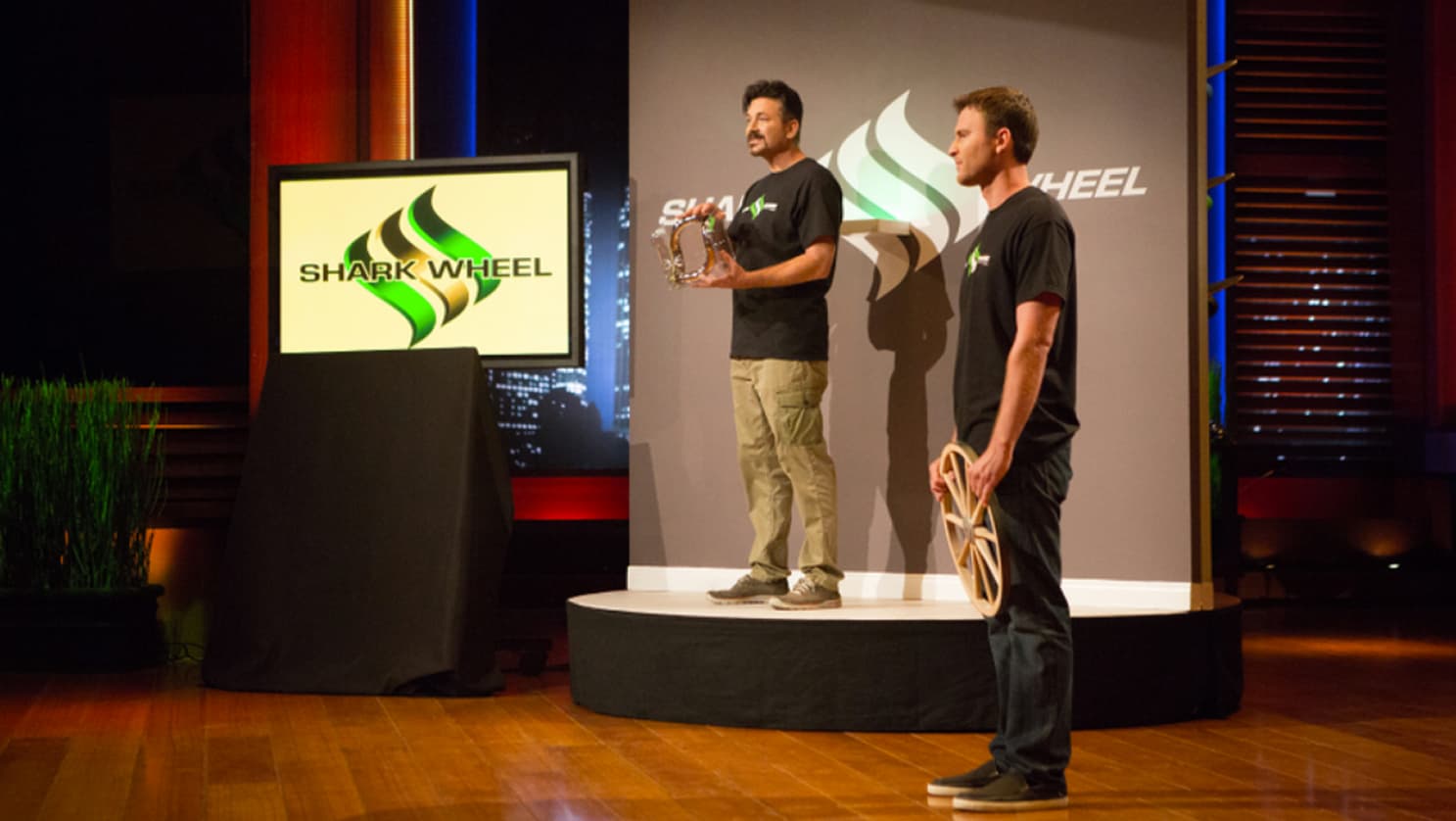
Shark Wheel has always been a “wait… what?” product: a wheel that looks square-ish (really a sine-wave shape), built to handle rougher terrain with less slipping and better control. The company frames the advantage as a design that channels debris and reduces hydroplaning while maintaining grip. On Shark Tank, the founders (David Patrick and Zack Fleishman) landed a three-Shark deal that’s widely summarized as $225,000 for 7.5% equity with a royalty component, with GoPro founder Nick Woodman appearing as the guest shark on the episode. So why might Shark Wheel be positioned for a bigger second act now?
1) The product isn’t just a skateboard wheel anymore
The most interesting part of Shark Wheel in 2026 is that it’s increasingly an industrial wheel company that started with consumer products. The brand’s own materials point to applications across luggage, material handling, and farming. And unlike a lot of “we could do everything” startups, Shark Wheel has a very specific expansion lane that’s gotten real institutional backing.
2) The company appears to be actively funding growth
Shark Wheel has been running crowdfunding efforts, and a Regulation Crowdfunding filing associated with the company lists recent revenue figures in the millions (with losses as the business invests and scales). That’s not “overnight unicorn” territory, but it is the profile of a company still in the arena, still building, and trying to turn a design advantage into multiple product lines.
3) The best Shark Tank winners don’t stay in one box
Scrub Daddy didn’t stay a sponge. Bombas didn’t stay socks. Ring didn’t stay DoorBot. The breakout pattern is: start with one product people love, then expand into adjacent categories where the brand already has permission to exist. Shark Wheel’s permission is “better motion over messy terrain.” That’s a surprisingly large universe, especially as warehouses, last-mile delivery, mobility devices, and industrial equipment keep modernizing.
Shark Wheel is currently eyeing an IPO and is raising capital through a convertible note, allowing investors to earn interest while they wait for a triggering event that converts into equity at a fair market valuation. For more information on how you can invest, click here.
Bottom line
The throughline across these stories isn’t genius. It’s clarity. The biggest Shark Tank wins usually come from products people understand quickly, buy repeatedly, and can find easily. Some win because they’re unforgettable (Squatty Potty). Some win because they’re useful (Scrub Daddy). Some win because a mission becomes a shortcut to trust (Bombas). And a few win because they survive long enough for the world to catch up (Ring). That’s the real magic trick: not being flashy, being repeatable.
Sources
- https://papers.ssrn.com/sol3/papers.cfm?abstract_id=3897430
- https://papers.ssrn.com/sol3/papers.cfm?abstract_id=3657391
- https://www.businessinsider.com/scrub-daddy-is-shark-tank-biggest-success-2015-4
- https://abcnews.go.com/blogs/business/2014/03/sponge-soaks-up-shark-tank-success-sales-balloon-to-18m
- https://www.entrepreneur.com/starting-a-business/bombas-is-the-most-successful-shark-tank-brand-heres/464309
- https://www.businessinsider.com/shark-tank-bombas-didnt-take-investor-insults-personally-2018-8
- https://www.inc.com/magazine/201611/kris-frieswick/barbara-corcoran-shark-tank-investments.html
- https://www.businessinsider.com/shark-tank-cousins-maine-lobster-advice-barbara-corcoran-2017-6
- https://www.forbes.com/pictures/efhg45iflf/squatty-potty/
- https://fortune.com/2016/09/07/bantam-bagels-starbucks/
- https://www.prnewswire.com/news-releases/lancaster-colony-acquires-bantam-bagels-llc-300735125.html
- https://www.businessinsider.com/successful-companies-shark-tank-2021-5
- https://www.geekwire.com/2018/amazons-1b-deal-acquire-ring-probably-biggest-miss-shark-tank-history/
- https://abc.com/news/147c1f90-34fd-4610-8d81-362ca33eba0d/category/706923
- https://abc7.com/post/shark-tank-business-from-lake-forest-reinvents-the-wheel/725437/
- https://www.theatlantic.com/technology/archive/2013/06/this-guy-reinvented-the-wheel-by-turning-it-into-a-cube/276705/
- https://patents.google.com/patent/US20140132059A1/en
- https://patents.justia.com/assignee/shark-wheel-inc
- https://papers.ssrn.com/sol3/papers.cfm?abstract_id=3897430
Disclaimer: This is a paid advertisement for Shark Wheel. This investment is speculative, illiquid, and involves a high degree of risk, including the possible loss of your entire investment.
Market Munchies and Mode Mobile communications are for informational purposes only, and are not a recommendation, solicitation, or research report relating to any investment strategy, security, or digital asset. All investments involve risk including the loss of principal and past performance does not guarantee future results.
Any information contained in this commentary does not purport to be a complete description of the securities, markets, or developments referred to in this material. The information has been obtained from sources considered to be reliable, but we do not guarantee that the foregoing material is accurate or complete. There is no guarantee that any statements or opinions provided herein will prove to be correct.