A Father and Daughter Just Pleaded Guilty to Selling 200 Fake Paintings. The Art World's Dirty Secret Is That This Keeps Happening.
The painting arrived looking entirely plausible. A young woman introduced herself as Karolina Bankowska and presented New York art dealer Robert Rogal with what she described as a family heirloom — a framed work signed by Andrew Wyeth, resembling the watercolor landscapes the…
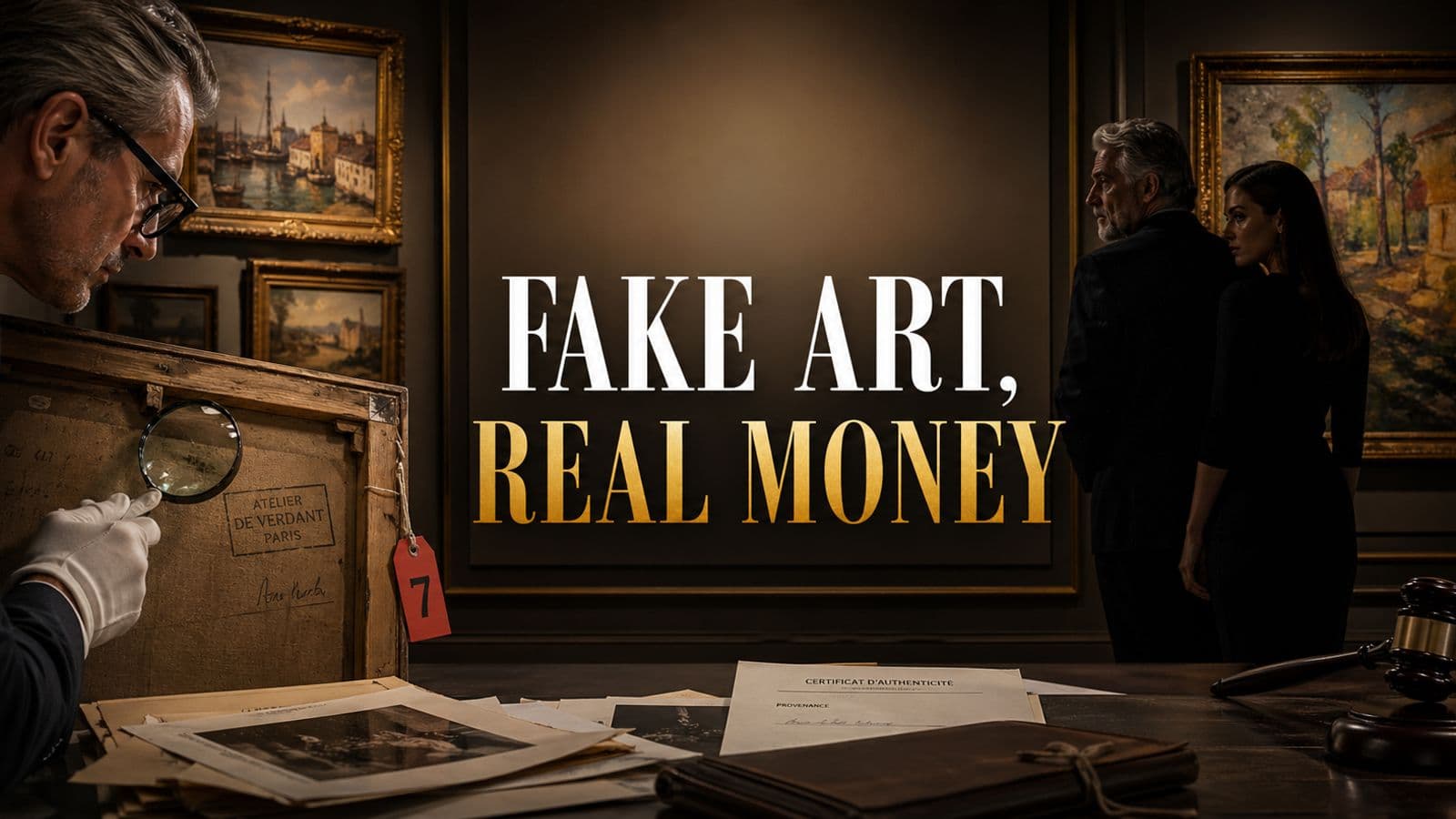
The painting arrived looking entirely plausible.
A young woman introduced herself as Karolina Bankowska and presented New York art dealer Robert Rogal with what she described as a family heirloom — a framed work signed by Andrew Wyeth, resembling the watercolor landscapes the celebrated artist had completed early in his career. Rogal accepted it on consignment, figuring it might fetch $20,000 to $30,000 at auction. The provenance, he later recalled, was "a little fuzzy." But she seemed credible. It was not an obvious counterfeit.
It was, in fact, a fake. One of at least 200 of them.
On Tuesday, Bankowska, 26, and her father Erwin Bankowski, 50, of New Jersey, pleaded guilty in federal court to running a multi-year scheme to sell forged paintings to galleries, auction houses, and private collectors across New York City. The fakes included works purportedly by pop-art icons like Andy Warhol and Banksy, as well as highly lucrative counterfeits of American landscape painter Richard Mayhew and Indigenous artist Fritz Scholder — names whose significance to the case becomes clear as the legal details emerge. Bankowska told the court "my conduct was wrong and I am guilty." Her attorney said his client had placed more than $1 million in escrow. Through a Polish interpreter, Bankowski apologized and his attorney said his client had "regrettably made a terrible decision in an effort to support his family."
How the Scheme Worked
The mechanics of the Bankowski operation were, in their own way, a study in the art world's structural vulnerabilities.
Rather than attempting to place work at the highest-end auction houses — Sotheby's or Christie's, where authentication scrutiny is most rigorous — the scheme targeted mid-market galleries, private dealers, and smaller auction venues. These are the venues where the business moves faster, the staff is smaller, and the institutional resources for in-depth forensic authentication are more limited.
Bankowska played the role of the reluctant seller — a young woman offloading family pieces rather than a professional dealer pushing inventory. That framing matters in the art world. The implied narrative of an inherited work carries a social credibility that a commercial pitch does not. It discourages the kind of hard scrutiny that a professionally presented consignment might attract.
The forgeries themselves were competent without being flawless. The fake Wyeth that Rogal received had a gallery stamp on the back listing a year of 1976 but including a zoning address number that had been phased out in 1962 — a detail that eventually raised flags. The stamp bore the name and address of M. Knoedler & Co., one of New York's oldest and most esteemed galleries, which closed in 2011 under a cloud of its own forgery scandal.
The operation was also more geographically distributed than it might appear. Rather than painting the fakes themselves, the Bankowskis outsourced production to an unnamed artist in Poland, commissioning the physical forgeries while focusing their own efforts on the distribution side: fabricating provenance documentation, applying period-appropriate gallery stamps, and managing the sales process in New York. It was, in structure, a cross-border commercial enterprise — a supply chain of fraud, with manufacturing in one country and retail in another.
The Expert's Verdict: This Is Not Unusual
The response from art crime specialists was consistent and pointed.
"The only unusual thing about this case is that the forgers got caught," said Erin Thompson, a professor of art crime at the City University of New York. "People think of the art world as a genteel place full of cultured people who just want to share the wonder of beautiful art."
The implication of that sentence does not require spelling out. It rarely is.
The scale of art forgery in global markets is genuinely difficult to quantify, because the incentive structure of the industry works against disclosure. A gallery or auction house that discovers it sold a fake has little to gain and much to lose from publicizing the fact. Collectors who realize they have been duped frequently prefer quiet resolution over public acknowledgment. The Swiss Fine Art Expert Institute estimated in 2014 that up to 50% of all artwork circulating in the market was either misattributed or forged — a figure that has been disputed as overstated, but which the art fraud community has never convincingly disproved.
The more conservative estimate, cited by multiple legal scholars, is that forgeries represent somewhere between 10% and 20% of the secondary art market by volume. On a global art market worth approximately $65 billion annually, even the lower end of that range represents billions of dollars in fraudulent transactions moving through an industry that has historically policed itself.
The Knoedler Shadow
The gallery stamp on the fake Wyeth was not the first time Knoedler's name has appeared in an art forgery scandal. It was the defining one.
For nearly two decades, Knoedler — founded in 1846 and one of the most prestigious commercial galleries in New York — sold approximately 60 fake paintings attributed to Abstract Expressionist masters including Mark Rothko, Jackson Pollock, Willem de Kooning, and Robert Motherwell. The works had been created by Pei-Shen Qian, a Chinese artist working out of Queens, and were channeled through a purported dealer named Glafira Rosales, who provided fabricated provenance stories to match each piece. The gallery generated roughly $80 million in sales from the fakes. It closed in 2011 after the scheme unraveled, ending 165 years of business. Former director Ann Freedman maintained she had no knowledge of the fraud and was not criminally charged.
The Knoedler case established what the Bankowski case reconfirms: the art market's authentication process has three pillars — forensic analysis, provenance research, and connoisseurship — and all three can be defeated by a sufficiently patient and well-prepared forger. Forensic analysis can be evaded by sourcing period-appropriate canvases, paints, and frames. Provenance research depends on documentation that can be fabricated. Connoisseurship — the trained eye of an expert — is the most subjective pillar of all, and the one most susceptible to the influence of a compelling story.
The Knoedler fakes were eventually caught because of anachronistic pigments: Pigment Yellow 74, a synthetic compound not available before the 1950s, turned up in paintings supposedly created in the 1940s. The detail is a useful reminder that forgeries usually fail on the smallest physical inconsistency — the kind that the naked eye cannot see and that buyers without access to laboratory analysis have no way to detect independently.
What This Means for Collectors and Investors
The art market has long been treated as an alternative asset class by high-net-worth investors seeking diversification, inflation hedging, and portfolio returns uncorrelated with public equities. The $65 billion global art market is largely unregulated, operates with minimal standardized disclosure requirements, and has historically been resistant to the transparency norms that govern other alternative investments.
That combination creates a structurally favorable environment for fraud. Unlike equities, bonds, or real estate, there is no central registry of authentic artworks, no standardized authentication protocol with legal standing, and no mandatory disclosure requirement when a work's attribution is disputed. The buyer bears essentially all of the risk of acquiring a forgery, and legal recourse is expensive, slow, and uncertain.
The legal standard is demanding: under U.S. law, copying an artwork or an artist's style is not inherently illegal. Replicating an artist's signature is not per se unlawful as long as no false representations are made. Criminal liability attaches only when a work is affirmatively represented as authentic — meaning that a sophisticated scheme, carefully worded, can stay in legally ambiguous territory for years before a prosecution becomes viable.
The Bankowski case contains one significant exception to that general pattern, and it is the detail that art law specialists found most notable. Among the scheme's most profitable single transactions was a forged work purportedly by Richard Mayhew — a celebrated American landscape painter — that sold for $160,000. More legally consequential, however, were forgeries attributed to Fritz Scholder, a prominent Luiseño artist and one of the most recognized figures in contemporary Native American art. Those charges triggered the Indian Arts and Crafts Act, a federal truth-in-advertising statute that makes it explicitly illegal to falsely represent artwork as Native American-made. Unlike the legally ambiguous territory that governs most art fraud, IACA violations carry specific criminal penalties and do not depend on proving the buyer's reliance on misrepresentation in the same way general fraud charges do. The Scholder forgeries, in other words, gave federal prosecutors a cleaner and more direct legal hook than the rest of the scheme provided.
For investors treating art as a meaningful asset allocation, the Bankowski case is a reminder that the due diligence standards applied to other alternative investments do not automatically transfer to the art world. Independent forensic authentication, written warranties of authenticity with clear representations of liability, and chain-of-custody documentation are not standard features of art transactions. They are optional, and most buyers do not insist on them.
They probably should.
The Broader Pattern
What makes the Bankowski scheme notable is not its sophistication. It was, by the standards of major art fraud cases, relatively modest in scale. What makes it notable is that it worked as long as it did — reportedly several years — targeting the mid-market sector of the industry, the one where most art transactions actually happen, with forgeries good enough to defeat casual inspection by professionals.
Thompson's observation cuts to the heart of it: the industry's self-image as a cultured, trust-based enterprise is itself a vulnerability. The social dynamics of the art world — the deference to apparent expertise, the reluctance to publicly question a seller's credibility, the desire not to be seen as unsophisticated — create exactly the conditions that skilled fraudsters exploit.
The Bankowski guilty pleas are a case closed. The conditions that made the scheme possible are not.
Sources
- NPR — "How a father and daughter duped NYC's art world with fake Warhols and Banksys": https://www.npr.org/2026/04/30/g-s1-119482/how-a-father-and-daughter-duped-nycs-art-world-with-fake-warhols-and-banksys
- Center for Art Law — "When Imitation is Not Flattery: Art Fakes, Forgeries, and the Market They Fool": https://itsartlaw.org/art-law/when-imitation-is-not-flattery-art-fakes-forgeries-and-the-market-they-fool/
- Center for Art Law — "Infamous Piracy: How the Lucrative Market for Forgeries is Transforming the World of Fine Art": https://itsartlaw.org/art-law/infamous-piracy-how-the-lucrative-market-for-forgeries-is-transforming-the-world-of-fine-art/
- NYU Journal of Intellectual Property & Entertainment Law — "Risky Business: Fraud, Authenticity, and Limited Legal Protections in the High Art Market": https://jipel.law.nyu.edu/risky-business-fraud-authenticity-and-limited-legal-protections-in-the-high-art-market/
- National Law Review — "(In)Authentic: The Importance of Due Diligence in the Art Market": https://natlawreview.com/article/inauthentic-importance-due-diligence-art-market
- VW Art — "Famous Art Forgery Scandals and Fake Paintings in the Art Market": https://www.vwart.com/post/famous-art-forgery-scandals-and-fake-paintings-in-the-art-market
- WINS Society — "How Blockchain Could Save the Art Market from Fraud": https://www.winsociety.org/how-blockchain-could-save-art-market-fraud/
- Britannica — "Art Fraud": https://www.britannica.com/topic/art-fraud
- Mariana Custodio — "The 5 Biggest Art Frauds in Art History": https://marianacustodio.com/the-5-biggest-art-frauds-in-contemporary-art-history/
Market Munchies and Mode Mobile communications are for informational purposes only, and are not a recommendation, solicitation, or research report relating to any investment strategy, security, or digital asset. All investments involve risk including the loss of principal and past performance does not guarantee future results.
Any information contained in this commentary does not purport to be a complete description of the securities, markets, or developments referred to in this material. The information has been obtained from sources considered to be reliable, but we do not guarantee that the foregoing material is accurate or complete. There is no guarantee that any statements or opinions provided herein will prove to be correct.