A Relief Rally With an Asterisk: What the Quarter-End Bounce Is Really Saying
After Monday’s close, the market still looked tired, defensive, and very aware that oil had become the main character again. The S&P 500 finished lower, the Nasdaq fell harder, and the broader tape was still digesting the reality of a quarter that Reuters described as Wall…
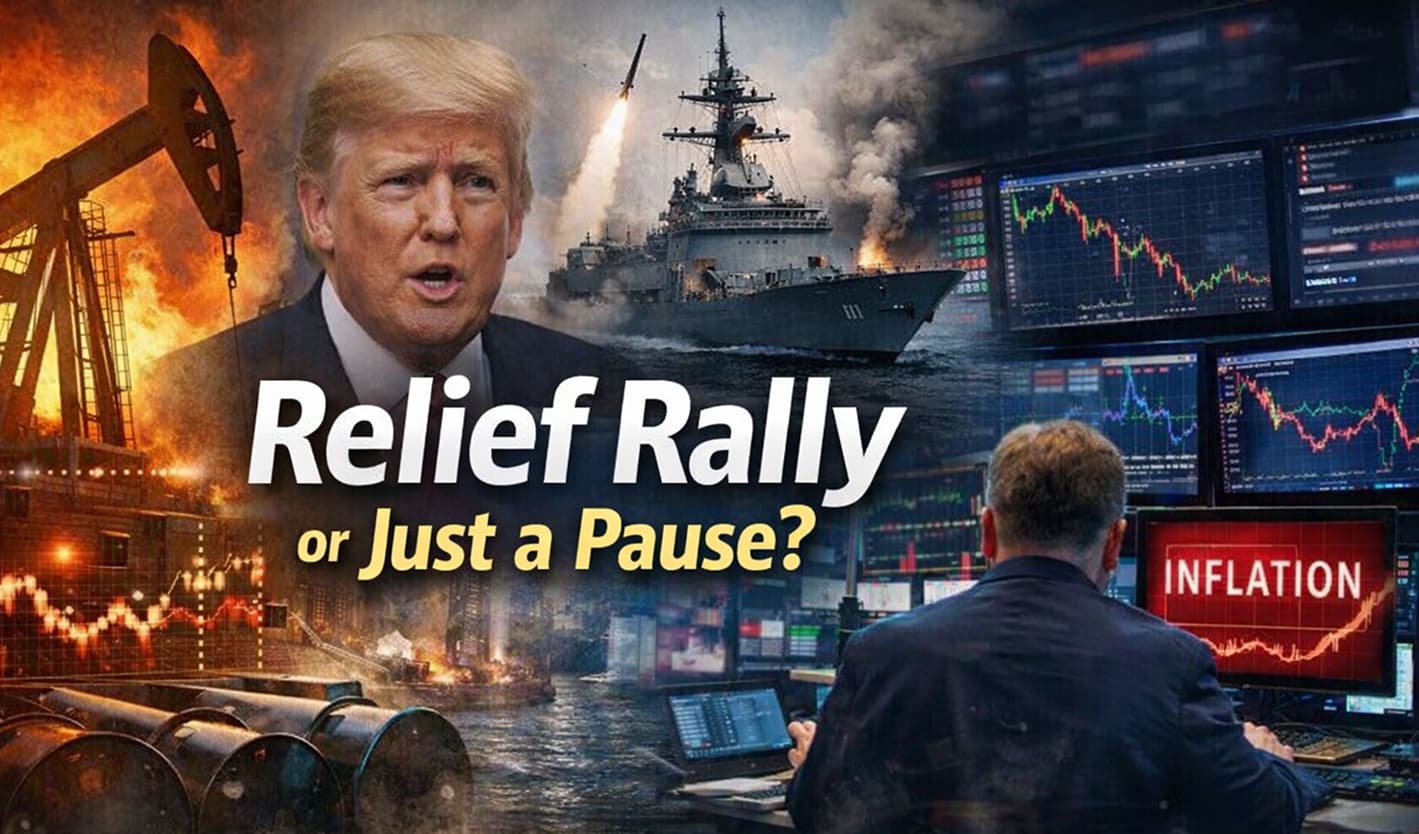
After Monday’s close, the market still looked tired, defensive, and very aware that oil had become the main character again. The S&P 500 finished lower, the Nasdaq fell harder, and the broader tape was still digesting the reality of a quarter that Reuters described as Wall Street’s worst since 2022. By Tuesday morning, though, the mood had shifted. Stocks opened sharply higher as oil stopped surging and traders latched onto fresh hopes that the Iran conflict might not escalate into a longer, more economically damaging campaign.
That shift matters, but it needs to be read carefully. The spark for the bounce was a report, relayed by Reuters from The Wall Street Journal, that President Trump told aides he would be willing to wind down the war without first reopening the Strait of Hormuz. That is not the same thing as a ceasefire, a diplomatic breakthrough, or a clean reopening of global energy flows. It is better understood as a sign that Washington may be willing to settle for a narrower endgame than markets had feared.
That is why Tuesday’s early strength looks more like relief than resolution. The morning rally was helped by steadier oil, falling Treasury yields, and U.S. data that came in better than expected, including consumer confidence and job openings. At the same time, public rhetoric from Washington stayed aggressive, with Defense Secretary Pete Hegseth warning that the next few days would be decisive and Trump still pressing allies to take a harder line around the strait. In other words, the market is trading a less bad scenario, not a clearly good one.
Stock of Interest Today: PROCEPT BioRobotics (PRCT)
PROCEPT BioRobotics stands out because it is the rare growth story that still has a concrete product, a real installation base, and a market that does not depend on abstract AI narratives to justify itself. The company’s Aquablation therapy is an FDA-cleared robotic treatment for benign prostatic hyperplasia, or enlarged prostate, and management spent 2025 turning that clinical niche into a more meaningful commercial footprint.
The latest numbers give the bullish case real substance. PROCEPT reported full-year 2025 revenue of $308.1 million, up 37% year over year, and ended the year with 718 robotic systems installed in the United States, up 42% from the prior year. It also guided for 2026 revenue of $390 million to $410 million and gross margin of about 65%, while finishing 2025 with $289.5 million in cash, cash equivalents, and restricted cash. That does not make the stock risk-free, especially after its earnings stumble earlier this year, but it does mean investors are looking at a company with real growth, a healthy balance sheet, and a product that is already proving it can scale commercially.
What makes PRCT interesting right now is that it sits at the intersection of growth and selectivity. In a quarter where investors punished expensive stories and anything that looked even slightly narrative-driven, PROCEPT still offers a cleaner setup than many of the market’s more crowded themes. It is not cheap in the old-fashioned sense, but by the standards of growth med-tech it looks more grounded than the kind of names that command a premium simply for being adjacent to a trend. If the market starts rewarding execution over hype again, PRCT has a case.
Current price: $26.05Analyst expectation: $30.44
Five Market Themes to Watch
The easiest mistake today is to read the bounce as a reset. It is not. The cleaner way to think about the market right now is that it is translating geopolitics into oil, oil into inflation, and inflation into equity multiples. That chain has not been broken. It has only become a little less severe for the moment.
1) Washington may be signaling a narrower endgame
The biggest reason markets are stronger this morning is the possibility that the White House is aiming for a more limited definition of success. If traders believe the administration no longer sees reopening the Strait of Hormuz as an immediate precondition for winding down the conflict, that lowers the odds of an even bigger military escalation and helps explain the quick shift in overnight sentiment.
But this is still a fragile read. Reuters noted it could not independently verify the Wall Street Journal report, and Tuesday’s public messaging from U.S. officials remained confrontational. That leaves investors trading a rumor-shaped easing of risk, not an actual settlement. It is enough to support a bounce. It is not enough to make that bounce durable on its own.
2) The quarter that just ended did real damage
Even if Tuesday finishes well, the bigger backdrop is still ugly. Reuters reported that the S&P 500 was closing out its worst quarter in four years, driven by inflation fears, uncertainty around the Iran war, and renewed anxiety about how higher energy costs could change the Fed outlook. Monday’s session was also a reminder of how fragile the tape had become: the market opened with some optimism, lost it quickly, and ended with the same uneasy tone that has defined the past several weeks.
That matters because technical damage does not disappear in one morning. Five weeks of selling, broken leadership, and a sharp repricing in rate expectations tend to leave scars. What traders are watching now is not whether the market can bounce, but whether it can hold a bounce without immediately handing control back to oil.
3) The four-to-six week timeline changes the market’s math
One of the most important details in the overnight reporting was the idea that a full mission to reopen the strait could push the conflict beyond the White House’s preferred four-to-six week window. That matters because markets are always trying to estimate not just how bad an event is, but how long it lasts. A shorter campaign, even an ugly one, is easier to discount than a drawn-out military and energy crisis.
In practice, that means investors are re-pricing duration risk. A strategy focused on degrading Iran’s naval and missile capacity may still be highly destabilizing, but it reads as more finite than an open-ended mission to fully restore maritime traffic. That is one reason Tuesday’s tone improved so quickly after Monday’s close. The market is trying to decide whether it just saw the outline of a limit.
4) The tone is better, but it is still headline-driven
Deutsche Bank’s Henry Allen said the market tone had become “decidedly more positive” overnight, and that is clearly true in a narrow sense. Stocks opened higher, breadth improved, and the early leadership included the kinds of cyclical and rate-sensitive names that usually benefit when panic backs off.
Still, this is not the kind of optimism investors should confuse with conviction. The move is being driven by one report, one change in perceived war aims, and one temporary pause in oil’s upward march. Markets can keep rallying on that kind of setup for a while, but they can reverse on it just as quickly. This remains a tape where one headline can undo several hours of calm.
5) Oil is still the referee
If there is one variable that matters more than everything else right now, it is crude. AP’s Tuesday market coverage put it plainly: oil has been dictating Wall Street’s sharp swings since the war began. The reason is obvious. Higher crude threatens household budgets, corporate margins, freight costs, inflation expectations, and the Fed path all at once. That is too many channels of pressure for equities to simply shrug off.
That is also why today’s rally deserves some skepticism even as it looks better on the screen. The market does not need oil to crash in order to stabilize, but it probably does need crude to stop acting like a live geopolitical referendum. As long as Brent and WTI remain elevated and every development around the Strait of Hormuz can jolt the energy complex, equities are going to struggle to build anything that feels solid.
Bottom Line
The market is bouncing because the worst-case scenario looks a little less immediate than it did 24 hours ago. That is meaningful. It is also not the same as safety. Monday’s close showed just how much damage this quarter has already done, and Tuesday’s open is showing how eager investors still are to buy any sign that the conflict might stay contained. The problem is that containment has not been secured, only imagined. For now, that is enough for a rally. Whether it is enough for a real turn higher depends on the same thing it has depended on for weeks: oil calming down, war risk staying capped, and investors finding a reason to believe that this was more than a brief exhale.
Sources:
- https://apnews.com/article/wall-street-stocks-dow-nasdaq-800109b3445f87f30865196e08363576
- https://www.reuters.com/business/finance/sp-500-heads-worst-quarter-since-2022-iran-war-rate-worries-rattle-wall-street-2026-03-31/
- https://www.reuters.com/world/us/trump-tells-aides-he-is-willing-end-iran-war-without-reopening-hormuz-wsj-2026-03-31/
- https://apnews.com/article/stock-markets-war-oil-trump-iran-84a7c46b51b3583f743c8da6a40d36ac
- https://ir.procept-biorobotics.com/news-releases/news-release-details/procept-biorobotics-reports-fourth-quarter-2025-financial
- https://www.procept-biorobotics.com/healthcare-providers/reimbursement-for-aquablation-therapy
- https://www.accessdata.fda.gov/cdrh_docs/pdf24/K240200.pdf
- https://ca.finance.yahoo.com/quote/PRCT/
- https://www.barrons.com/livecoverage/stock-market-news-today-033126
- https://www.marketwatch.com/livecoverage/s-p-500-nasdaq-dow-jones-rise-donald-trump-iran-war-strait-of-hormuz/card/s-p-500-set-to-climb-as-trump-reportedly-considers-ending-war-without-reopening-strait-of-hormuz-q3k6pN83aLZhqksVmw9S
- https://www.reuters.com/business/energy/oil-prices-jump-after-yemeni-houthis-attack-israel-widening-iran-conflict-2026-03-29/
Market Munchies and Mode Mobile communications are for informational purposes only, and are not a recommendation, solicitation, or research report relating to any investment strategy, security, or digital asset. All investments involve risk including the loss of principal and past performance does not guarantee future results.
Any information contained in this commentary does not purport to be a complete description of the securities, markets, or developments referred to in this material. The information has been obtained from sources considered to be reliable, but we do not guarantee that the foregoing material is accurate or complete. There is no guarantee that any statements or opinions provided herein will prove to be correct.