A Special Forces Soldier Just Made $400,000 Betting on a Classified Military Operation. Prediction Markets Have a Problem.
Between December 27, 2025, and January 2, 2026, Master Sergeant Gannon Ken Van Dyke placed 13 bets on Polymarket totaling $33,034. He bet "yes" on contracts asking whether U.S. forces would be in Venezuela by January 31, whether Nicolás Maduro would be out of office by January…
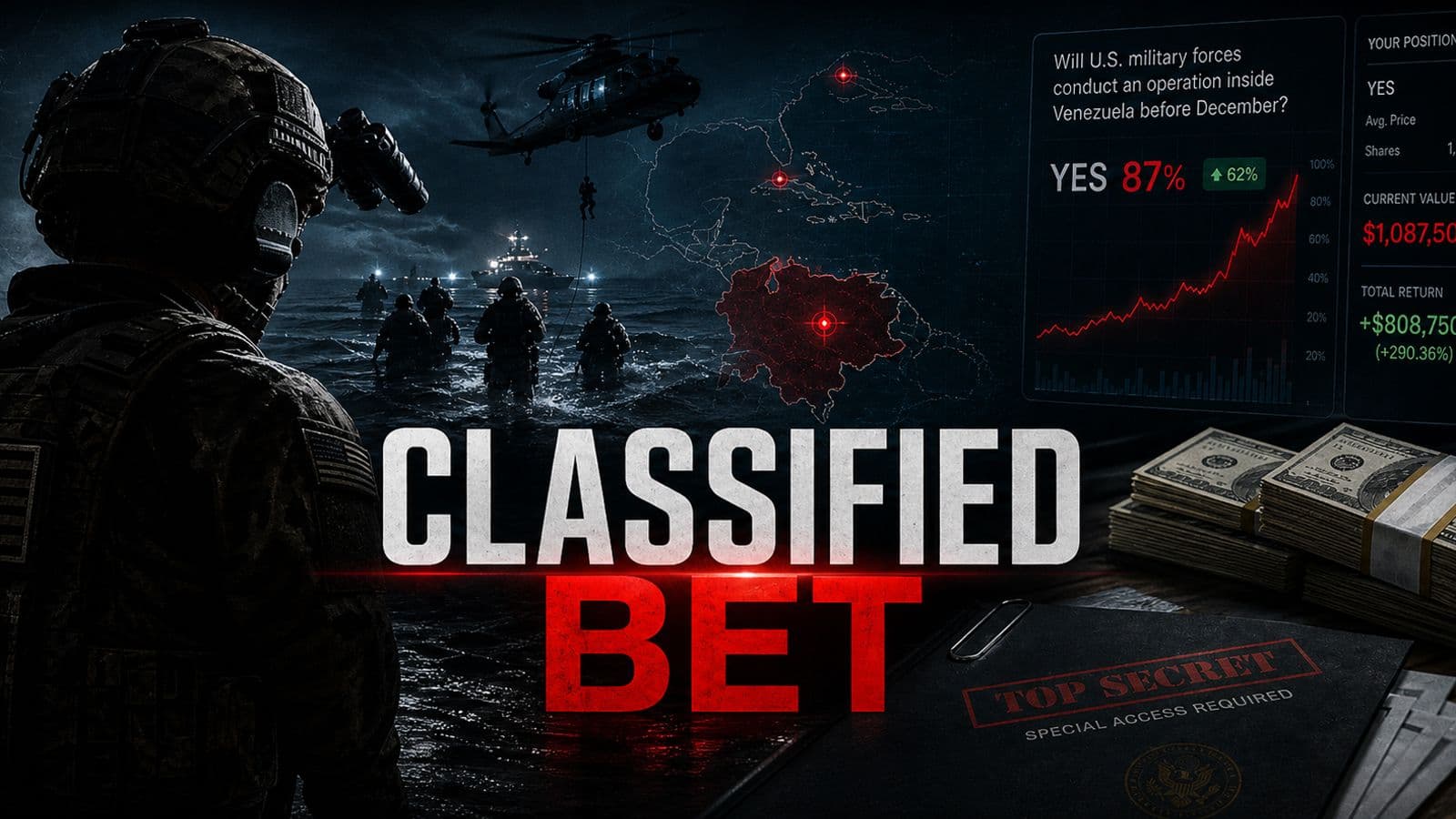
Between December 27, 2025, and January 2, 2026, Master Sergeant Gannon Ken Van Dyke placed 13 bets on Polymarket totaling $33,034. He bet "yes" on contracts asking whether U.S. forces would be in Venezuela by January 31, whether Nicolás Maduro would be out of office by January 31, and whether the U.S. would invoke the War Powers Act against Venezuela by that date.
On January 3, 2026, U.S. forces captured Maduro at his residence in Caracas in a predawn raid. Van Dyke was part of the team that brought Maduro out of Venezuela. A photograph uploaded to his Google account shows him on the cargo ramp of what appears to be a military transport aircraft at sunrise, in military fatigues, carrying a rifle, standing alongside three other operators.
Van Dyke walked away with $409,881 — a 12x return on a one-week bet. Last Thursday, he was arrested.
What Van Dyke Is Accused Of
Van Dyke, 38, of Fayetteville, North Carolina, was a Master Sergeant in U.S. Army Special Forces stationed at Fort Bragg — one of the bases that housed the personnel who planned and executed Operation Absolute Resolve, the classified mission to capture Maduro. According to the DOJ indictment, he participated in the planning and execution of the operation from approximately December 8, 2025, through January 5, 2026. He had access to classified nonpublic information about the mission at the time he placed every single bet.
He created his Polymarket account on December 26 — one day after accessing the platform using a VPN to disguise his location as being outside the United States. He funded the account, began trading, escalated his position dramatically as the operation approached, and then executed a layered cash-out designed to obscure the money's origins.
The same day Trump announced the successful capture publicly, Van Dyke withdrew the majority of his $409,881 in winnings from his Polymarket account and routed most of the proceeds into a foreign cryptocurrency vault — a non-custodial wallet outside U.S. regulatory reach. From there, the funds were transferred into a newly created online brokerage account opened specifically to receive them. The DOJ described the sequence plainly: cryptocurrency vault first, then brokerage account, then normal-looking investment activity. It is a textbook layering step — the second stage of money laundering, where illicit funds are moved through accounts and jurisdictions to sever the link to their origin.
When news outlets and online investigators began drawing attention to a "mystery trader" who had made a massive return on Maduro-related contracts — matching the exact amounts in the indictment — Van Dyke asked Polymarket to delete his account, falsely claiming he had lost access to the email address. He also changed the email registered to his cryptocurrency exchange account to a new address he had created the previous month. The paper trail he left behind — his personal email for the original account, the photograph on his Google account, the timing of the withdrawals — was, in prosecutors' words, a trail that led directly to him.
He is charged with three counts of violating the Commodity Exchange Act (maximum ten years per count), one count of wire fraud (maximum twenty years), and one count of making an unlawful monetary transaction (maximum ten years). The Commodity Futures Trading Commission filed a parallel civil complaint seeking restitution, disgorgement, and civil monetary penalties.
"Prediction markets are not a haven for using misappropriated confidential or classified information for personal gain," said Jay Clayton, U.S. Attorney for the Southern District of New York. "Those entrusted to safeguard our nation's secrets have a duty to protect them and our armed service members, and not to use that information for personal financial gain."
This Is Not an Isolated Case
Van Dyke is the first person charged in the United States for suspected Polymarket insider trading. He is not the first person charged anywhere.
In February 2026, Israeli authorities arrested several people and charged two on suspicion of using classified information to place bets on Polymarket related to military operations in Iran. The cases followed a pattern similar to the Van Dyke indictment: unusual trading volumes in specific geopolitical contracts in the hours or days before a classified operation, followed by a massive payout, followed by attempts to conceal identity.
The day before the Van Dyke charges were announced, Kalshi — Polymarket's primary U.S.-based competitor — revealed it had fined and suspended three users who were allegedly candidates in the 2026 midterm elections, for trading in markets related to their own races. The insider trading problem in prediction markets is not a Van Dyke problem. It is a structural problem that Van Dyke happened to make vivid.
The Fundamental Tension in the Prediction Market Model
Here is where the Van Dyke case intersects with something genuinely philosophically interesting — and practically concerning — for everyone who has been treating prediction market odds as credible signal generators.
Prediction markets are celebrated precisely because insiders are supposed to improve their accuracy. The theory, long articulated by academic economists, is that people with genuine information — insiders — have a financial incentive to trade that information into the market, moving prices toward the truth. A soldier who knows a military operation is about to happen, betting on the relevant contracts, theoretically makes the market more accurate for everyone watching.
Polymarket's own CEO, Shayne Coplan, expressed this view explicitly to Axios last November. He called it "super cool" that the platform "creates this financial incentive for people to go and divulge the information to the market," including insiders. The implicit argument: the market benefits from insider information even if it is classified or confidential, because it improves price discovery.
Van Dyke's indictment is the legal system's direct rejection of that argument. U.S. Attorney Clayton's statement made the principle explicit: classified government information is not a private asset that its holder can monetize. The fact that doing so improves market accuracy is not a defense. The Commodity Exchange Act's prohibition on trading on material nonpublic information applies to prediction markets the same way securities laws apply to stock trades — and a special forces soldier's access to classified operational information is, in the eyes of the law, exactly equivalent to a corporate insider's access to an unannounced merger.
What This Means for Prediction Markets as an Investment Tool
Market Munchies has covered prediction markets throughout 2026 as a forecasting tool — citing their odds on Iran peace talks, Fed rate moves, and geopolitical outcomes as signal generators that sophisticated investors were watching alongside traditional data.
The Van Dyke case does not invalidate that use case. But it complicates it in a specific way.
If prediction market prices are being moved by insiders with access to classified or confidential information, two things are simultaneously true: the prices are more accurate than they would be without insider information, and they are produced by activity that is illegal and that the DOJ is now actively prosecuting. For a retail investor using Polymarket odds to calibrate the probability of a Hormuz deal or a military escalation, the question is no longer just "does this market have good information?" It is also "is some of that information classified, and does the DOJ's enforcement of insider trading rules make the market less accurate over time?"
The answer to the first question is almost certainly yes — prediction markets attract insiders precisely because they create financial incentives for information disclosure. The answer to the second question depends on whether the Van Dyke prosecution deters future insider trading or simply pushes it underground, to wallets and accounts even harder to trace.
Polymarket's response to the Van Dyke case was notably swift. The company said it identified the suspicious trading itself, referred the matter to the DOJ, and cooperated with the investigation. Polymarket's chief legal officer posted on X: "It's not anonymous — you will be found just like this guy." The platform published enhanced market integrity rules in March, specifically prohibiting trades based on legally confidential information and banning people with authority to affect an outcome from participating in related markets.
Those rules are a meaningful step. They are also, by definition, rules that are enforced after the fact — after the trade has been placed, after the market price has moved, and after the insider has already profited. Van Dyke's trades moved Maduro-related contract prices in the days before the raid. Anyone watching those prices saw a signal. Whether that signal should be trusted going forward depends on whether the regulatory framework can keep up with the opacity of decentralized, offshore platforms that the DOJ is still learning how to police.
The Political Subplot
The Van Dyke case lands in a politically charged environment for prediction markets.
Donald Trump Jr. is an advisor to both Polymarket and Kalshi. The Trump administration approved Polymarket to begin offering trades for American customers, though its U.S.-facing site is not yet fully operational. The offshore Polymarket site — where Van Dyke traded using a VPN — operates outside U.S. regulatory reach, which is why it can legally offer markets on war and military operations that would be prohibited under federal law domestically.
Trump himself, when asked about Van Dyke's arrest, said: "That's like Pete Rose betting on his own team. You know the whole world, unfortunately, has become somewhat of a casino. I was never much in favor of it, I don't like it conceptually." That is a notably ambivalent statement from a president whose son is an advisor to the two largest prediction market platforms and whose administration just authorized the domestic expansion of one of them.
The regulatory posture of the CFTC — which filed the civil complaint against Van Dyke and which regulates prediction markets — will be the variable that determines whether this case accelerates or delays prediction markets' integration into mainstream American investing. Democrats have already urged the CFTC to rein in prediction market sports betting and insider trading. The Van Dyke case gives them a concrete example to point to.
Sources
- DOJ — "U.S. Soldier Charged With Using Classified Information To Profit From Prediction Market Bets": https://www.justice.gov/opa/pr/us-soldier-charged-using-classified-information-profit-prediction-market-bets
- NPR — "U.S. soldier charged with insider trading over Maduro's ouster": https://www.npr.org/2026/04/23/nx-s1-5797957/maduro-raid-charges-polymarket-insider
- CNBC — "DOJ: Soldier charged with using classified info for Polymarket bets on Venezuela": https://www.cnbc.com/2026/04/23/doj-soldier-polymarket-bets-venezuela-maduro.html
- CNN — "US special forces soldier arrested after allegedly winning $400,000 on Maduro raid": https://www.cnn.com/2026/04/23/politics/us-special-forces-soldier-arrested-maduro-trade
- NBC News — "U.S. soldier charged with betting on Maduro raid on Polymarket": https://www.nbcnews.com/business/business-news/soldier-charged-over-maduro-raid-bet-rcna341710
- TIME — "Soldier Charged With Insider Trading on Polymarket": https://time.com/article/2026/04/24/soldier-charged-insider-trading-polymarket-van-dyke-maduro-capture-trump/
- Washington Post — "U.S. soldier charged for bets on Maduro's capture": https://www.washingtonpost.com/national-security/2026/04/23/polymarket-soldier-maduro-bet-charges/
- Al Jazeera — "US soldier charged with using Polymarket to bet on Nicolas Maduro abduction": https://www.aljazeera.com/economy/2026/4/26/us-soldier-charged-with-using-polymarket-to-bet-on-nicolas-maduro-abduction
- Axios — Polymarket CEO comments on insider trading (cited via CNN): https://www.cnn.com/2026/04/23/politics/us-special-forces-soldier-arrested-maduro-trade
- Kalshi — Announcement of fines and suspensions for election candidate users (cited via Al Jazeera): https://www.aljazeera.com/economy/2026/4/26/us-soldier-charged-with-using-polymarket-to-bet-on-nicolas-maduro-abduction
Market Munchies and Mode Mobile communications are for informational purposes only, and are not a recommendation, solicitation, or research report relating to any investment strategy, security, or digital asset. All investments involve risk including the loss of principal and past performance does not guarantee future results.
Any information contained in this commentary does not purport to be a complete description of the securities, markets, or developments referred to in this material. The information has been obtained from sources considered to be reliable, but we do not guarantee that the foregoing material is accurate or complete. There is no guarantee that any statements or opinions provided herein will prove to be correct.