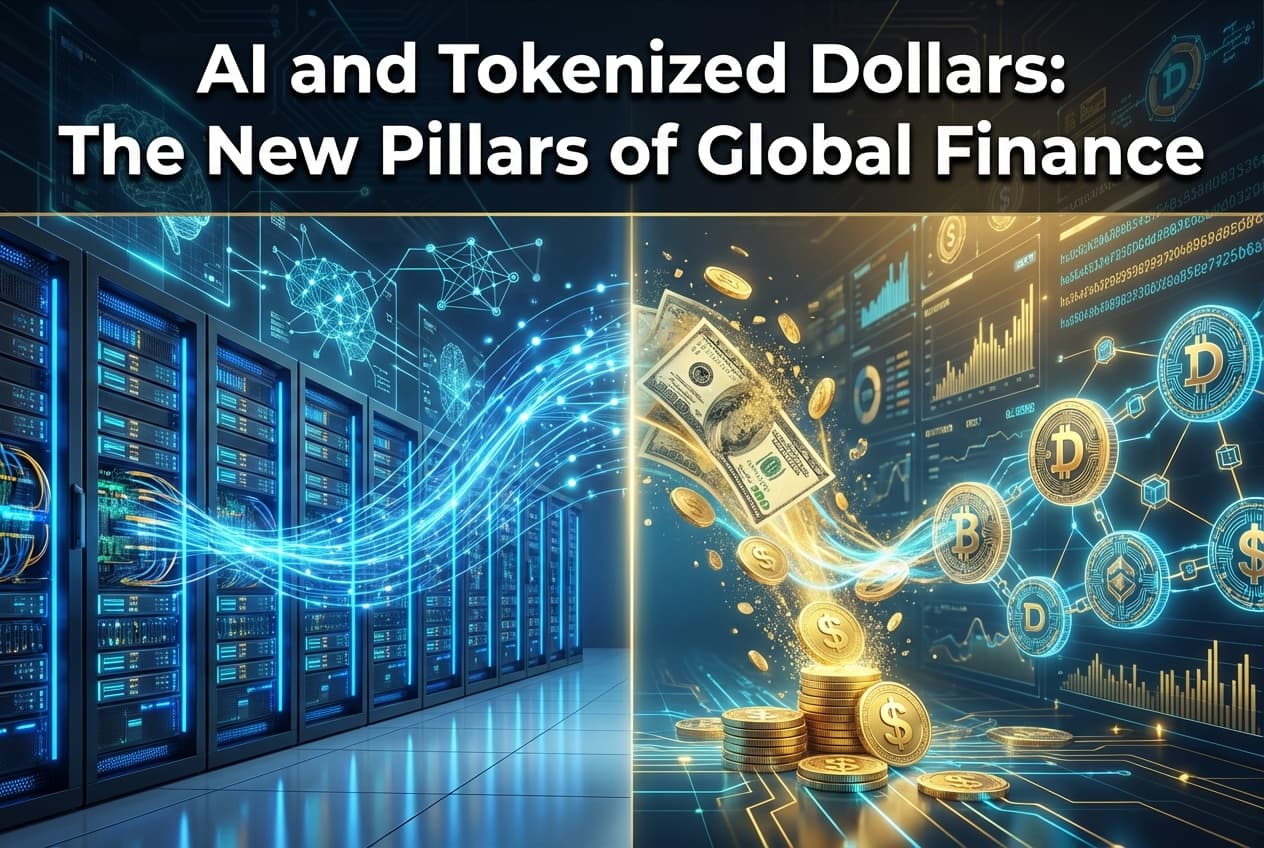
AI and Tokenized Dollars: The New Pillars of Global Finance
🏛️ Governments Eye AI Compute as Strategic Infrastructure Artificial intelligence data centers are becoming just as critical to national interests as oil reserves, according to industry experts. Maja Vujinovic, CEO of Digital Assets at FG Nexus, told Cryptonews that…
🏛️ Governments Eye AI Compute as Strategic Infrastructure
Artificial intelligence data centers are becoming just as critical to national interests as oil reserves, according to industry experts. Maja Vujinovic, CEO of Digital Assets at FG Nexus, told Cryptonews that governments will start treating GPU capacity and energy-backed compute as strategic infrastructure in 2026. This shift reflects growing recognition that AI capabilities now determine economic competitiveness. Countries with cheap energy access, advanced chip supplies, and stable regulatory policies are positioning themselves to dominate. Some governments are likely to launch national compute-credits that allocate GPU capacity similar to how central banks manage currency reserves. For investors, this means the geopolitical landscape is transforming from questions about who builds the best AI models to who can secure the most power and compute resources to run them at scale.
⚡ The New OPEC: Energy and Chips Replace Oil Cartels
Unlike traditional commodity markets, the AI compute race won't produce a single OPEC-style cartel, according to Vujinovic. Instead, power will concentrate where chips, energy, and execution speed converge. The United States remains dominant in large-scale AI workloads, while the UAE and Saudi Arabia are emerging as critical players because they can align capital, power, and permitting faster than Western economies. Taiwan and South Korea hold strategic positions due to their advanced chip manufacturing capabilities, though geopolitical uncertainty clouds their long-term outlook. The key difference from oil is speed. Compute capacity can move and scale much faster than physical commodities, making this competition more dynamic than traditional resource cartels. Corporations are already locking in multi-year power deals the way airlines hedge fuel costs, as data centers now consume approximately 4.4% of total U.S. electricity with projections reaching 12% by 2028.
💰 AI Workloads Shift from Cost Center to Yield Engine
Most companies currently treat AI spending as a cost, but 2026 will mark the emergence of AI-denominated yield as a new financial category. Vujinovic predicts the first wave of AI income products will appear, including revenue-sharing instruments backed by inference usage, fine-tuning demand, and compute resale. Funds, treasuries, and institutional investors will start treating AI workloads like digital export products with predictable cash flows, similar to how data storage and cloud SaaS became investable asset classes a decade ago. The yield will standardize around familiar metrics including GPU-hours, performance benchmarks, uptime reliability, and revenue reconciled against tamper-resistant logs and hardware-level verification. Third-party audits will verify that workloads actually ran on approved infrastructure. The open question isn't whether this model works, according to experts, but how quickly auditors and institutional buyers treat AI workloads like any other revenue-generating infrastructure asset with transparent cash flows.
💵 Stablecoins Become Parallel Settlement Rails for Global Finance
Dollar-pegged stablecoins like Tether's USDT and Circle's USDC, along with tokenized U.S. Treasuries, are rapidly becoming a parallel settlement layer for global finance. These instruments won't replace traditional banking systems, but they will handle a meaningful share of cross-border and institutional flows. Stablecoins now move more value annually than Visa, with an estimated $33 trillion in transactions during 2025, according to Bloomberg data. Tokenized Treasuries have grown into a multi-billion-dollar market in just a few years. Vujinovic expects the inflection point in 2026 to be psychological rather than technical. For CFOs, treasury managers, and fintech companies, using on-chain dollars for settlement and liquidity will stop being considered crypto and just become normal, faster plumbing. Adoption accelerates once on-chain money settles in minutes instead of days, offers real-time visibility, and integrates with existing treasury systems through regulated custodians. Even as stablecoins take on more settlement volume, traditional infrastructure like SWIFT won't disappear. Instead, SWIFT's role will evolve toward standards, compliance, and governance, becoming less about moving money and more about coordinating trust between institutions across different rails.
🤖 AI Agents Gain Economic Autonomy with Built-In Guardrails
Autonomous AI agents will absolutely have wallets in 2026, but they'll operate with guardrails similar to junior employees with spending limits, audit logs, and kill switches, according to Mau Ledford, cofounder and CEO of Sogni AI. Ben Goertzel, CEO of SingularityNET and the Artificial Superintelligence Alliance, said AI agents are already operating as first-class economic participants in small ways. This year will see AI agents with wallets buying data, paying for compute, and negotiating simple contracts. However, better identity systems, reputation frameworks, spending limits, and security protocols are still needed to prevent agents from being hijacked or behaving unpredictably. For 2026, expect bounded autonomy rather than full self-sovereign AI citizens. Ryan Li, CEO of AI Surf, said artificial intelligence will feel less like a standalone product and more like something embedded directly into crypto tools and apps people already use. Domain-specific AI platforms like Claude for coding or Manus for long-tail tasks are gaining traction because they move beyond text generation to perform specific jobs better. Specialization matters more in crypto because it's a noisy, complex environment where real money is at stake, and by year-end most crypto users will interact with AI in some form without even thinking about it.
🎯 What This Means for Investors and Traders
The convergence of AI infrastructure and tokenized dollars represents a fundamental shift in how global finance operates. For investors, the implications are clear. Companies and countries that secure energy-compute infrastructure now will hold strategic advantages similar to nations with oil reserves in the 20th century. The emergence of AI-denominated yield creates new asset classes for institutional portfolios, while stablecoins and tokenized Treasuries offer faster settlement and real-time treasury management. Traders should monitor which regions are locking in multi-year power deals and GPU capacity commitments as indicators of future competitive positioning. The psychological shift from viewing on-chain dollars as experimental to treating them as operational infrastructure will unlock trillions in cross-border flows. Meanwhile, AI agents with bounded economic autonomy will create new markets for data, compute, and specialized services. This isn't about replacing traditional finance, but rather building a parallel system that handles speed, transparency, and programmability better than legacy rails. Investors positioned early in energy-backed compute infrastructure, stablecoin-native platforms, and AI-adjacent services stand to capture meaningful value as these trends accelerate through 2026 and beyond.
Sources
https://cryptonews.com/exclusives/how-ai-and-tokenized-dollars-will-anchor-the-2026-global-economy/ https://174powerglobal.com/blog/digital-infrastructure-energy-solutions-for-ai-data-centers/ https://www.ainvest.com/news/era-energy-amp-digital-strategic-expansion-ai-centric-data-centers-2510/ https://cryptonews.com/exclusives/tether-freezes-3-3b-in-tokens-as-new-data-shows-30x-gap-with-usdc/ https://cryptonews.com/exclusives/ai-agents-breaking-bad-can-we-stop-them/
Market Munchies and Mode Mobile communications are for informational purposes only, and are not a recommendation, solicitation, or research report relating to any investment strategy, security, or digital asset. All investments involve risk including the loss of principal and past performance does not guarantee future results.
Any information contained in this commentary does not purport to be a complete description of the securities, markets, or developments referred to in this material. The information has been obtained from sources considered to be reliable, but we do not guarantee that the foregoing material is accurate or complete. There is no guarantee that any statements or opinions provided herein will prove to be correct.
Get fresh insights, breaking news, and hidden gems in the world of crypto—delivered straight to your inbox with our Crypto Cookies newsletter. Don't miss out—sign up now and get your first bite of insider knowledge!