AI, Chips, and Valuations: Why Tech Stocks Feel Different to Investors
You Can Sense the Shift—Even Before the Charts Load You open your trading app expecting the usual tech swagger. Instead, tech stocks look… tense. Not collapsing. Not euphoric. Just awkwardly quiet, like a party where everyone’s realized the music might stop soon. So here’s the…
You Can Sense the Shift—Even Before the Charts Load
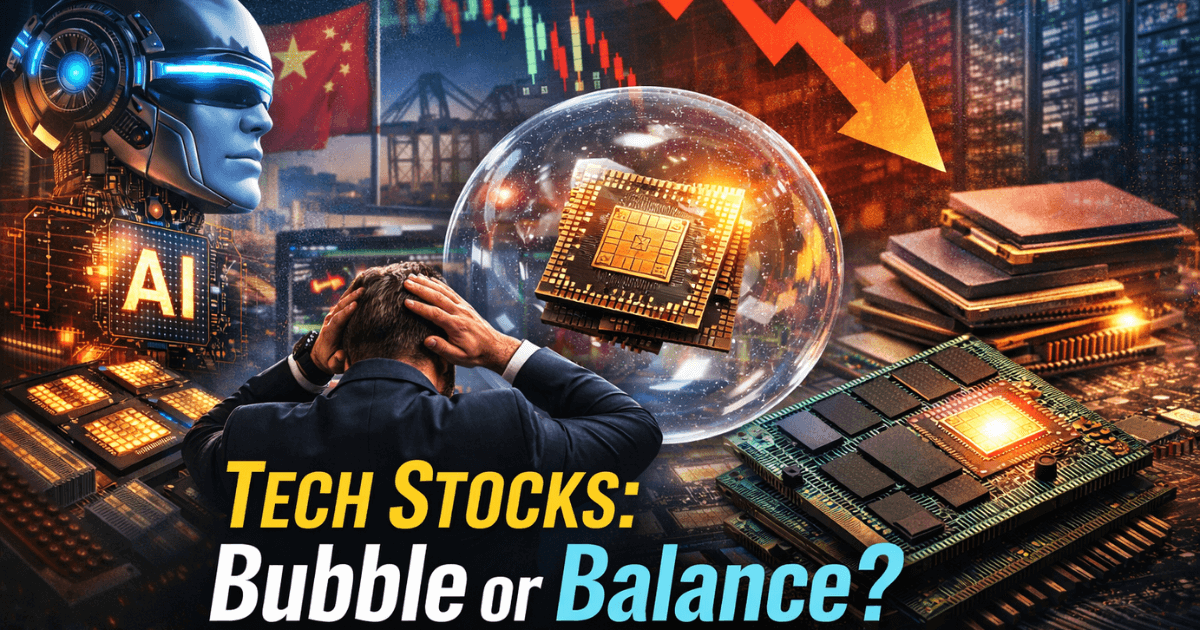
You open your trading app expecting the usual tech swagger. Instead, tech stocks look… tense. Not collapsing. Not euphoric. Just awkwardly quiet, like a party where everyone’s realized the music might stop soon. So here’s the real investor question worth asking: are tech stocks sliding because the AI story is breaking—or because it’s entering a more serious, regulated, supply-constrained phase? Recent moves around tech stock regulation, AI chip export controls, semiconductor stock volatility, and AI stock valuation risks suggest the answer leans toward maturity, not meltdown.
When Export Rules Start Steering Tech Stocks
AI Chip Export Controls Are Now a Market Variable
Semiconductors are traded on innovation cycles and earnings calls. Today, chip export policy and geopolitics sit right beside revenue forecasts. Restrictions on China tech exports have forced companies like Nvidia to operate under layered approvals, licensing rules, and compliance uncertainty. Even approved shipments can stall once customs, inspections, or political signaling come into play. Markets don’t hate regulation. Markets hate unpredictability. For investors tracking how export rules affect tech stocks, the result shows up as sharper swings, shorter rallies, and faster pullbacks across the semiconductor sector. Investor Radar: Export controls rarely erase demand. They reshape supply chains, pricing power, and regional exposure, which feed directly into semiconductor market analysis.
AI Productivity Gains Sound Huge—Because They Are
AI and Labor Productivity Are Colliding
A recent AI productivity gains report estimates AI could unlock $4.5 trillion in U.S. labor productivity, touching nearly every industry and profession. Lawyers research faster. Doctors document less. Analysts like you scan more data in less time. The key detail often missed: AI adoption boosts productivity by augmenting tasks, not wiping out roles overnight. That nuance matters for long-term tech investing. Nearly every job now carries some level of AI exposure, which explains why AI adoption productivity data keeps appearing on earnings calls and investor decks. Smart Capital Signal: Productivity windfalls tend to reward platform builders, enterprise software, and AI infrastructure demand, not every AI ticker with a buzzword in the name.
Why Bearish AI Investment Risks Are Back in Conversation
Valuations Are Being Asked to Show Receipts
After years of AI enthusiasm, analysts have started stress-testing assumptions. Growth still looks strong—but expectations are even stronger. In downside scenarios, certain AI names show dramatic valuation compression if revenue growth slows or margins disappoint. Those warnings aren’t predictions. They’re reminders that AI investment risks rise when prices sprint ahead of profits. High multiples demand flawless execution. Tactical Insight: AI exposure still belongs in a diversified portfolio. Paying any price for growth no longer does. Semiconductor stock volatility reflects that recalibration.
The Memory Chip Shortage Nobody Loves Talking About
Global Memory Supply Is the Quiet Constraint
AI runs on compute. Compute runs on memory. That chain creates a very real bottleneck. A persistent global memory supply shortage means data centres now absorb a growing share of DRAM, NAND, and high-bandwidth memory. There is a lower supply of consumer hardware flows, pushing prices higher and stretching production timelines. Manufacturers like Micron Technology are investing heavily, but fabs don’t appear overnight. Semiconductor supply chain trends remain tight, even as AI demand surges. Supply Chain Reality Check: Hardware constraints can delay revenue, even when demand looks unstoppable. The impact of the memory chip shortage shows up quietly, then all at once.
Where Long-Term Tech Investing Stands Now
Growth Isn’t Gone—Discipline Has Arrived
Tech stocks aren’t broken. AI momentum hasn’t vanished. Semiconductors still anchor modern economies. What changed is the tone. Regulation now influences earnings models. Supply chains influence timelines. Valuations influence patience. Semiconductors and geopolitics have become inseparable. Capital increasingly flows toward companies that execute well under pressure rather than those that rely solely on narrative momentum. Portfolio Compass: The strongest tech investments often emerge after expectations cool, not when optimism peaks.
A Calmer Way to Think About AI Stocks
Let the Future Prove Itself
Recent tech market behavior doesn’t signal the end of innovation. It signals a transition from hype to accountability. AI will continue shaping productivity. Chips will remain essential. Regulation will stay involved. Investors who stay selective, valuation-aware, and supply-chain-literate tend to fare better over full cycles. Sometimes the smartest move isn’t chasing every AI rally. Sometimes it’s letting earnings, infrastructure, and policy align first—then buying with confidence.
Sources
- Reuters — China’s customs agents told Nvidia’s H200 AI chips are not permitted to enter the country.
- Associated Press — U.S. gives conditional approval for Nvidia H200 exports to China.
- Reuters — China limits Nvidia H200 chip purchases to special circumstances
- Reuters — Nvidia says no upfront payment is required for H200 chips
- PR Newswire — Cognizant’s “New Work, New World 2026” report on AI and jobs
- World Economic Forum — AI could handle $4.5 trillion in U.S. work, reshaping roles
Market Munchies and Mode Mobile communications are for informational purposes only, and are not a recommendation, solicitation, or research report relating to any investment strategy, security, or digital asset. All investments involve risk including the loss of principal and past performance does not guarantee future results.
Any information contained in this commentary does not purport to be a complete description of the securities, markets, or developments referred to in this material. The information has been obtained from sources considered to be reliable, but we do not guarantee that the foregoing material is accurate or complete. There is no guarantee that any statements or opinions provided herein will prove to be correct.