AI Whiplash, CPI Relief: Markets Reprice Reality
This past week didn’t feel like a clean trend so much as a live stress test. Investors walked in expecting the usual: AI momentum, strong-ish growth, and a market that keeps floating as long as nothing surprises it. Instead, the surprises showed up right on schedule: a sharp…
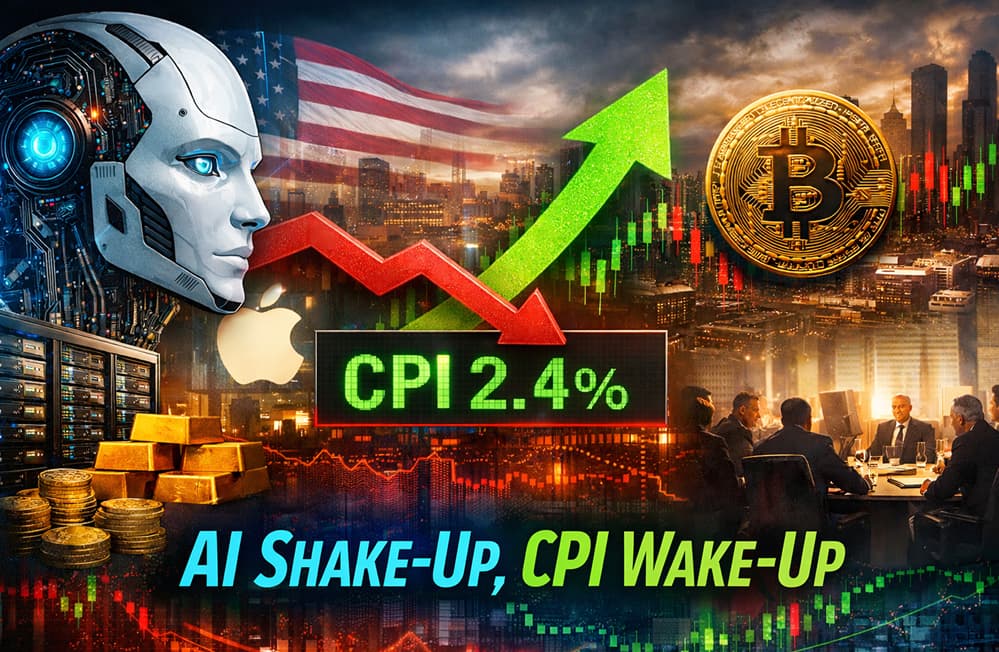
This past week didn’t feel like a clean trend so much as a live stress test. Investors walked in expecting the usual: AI momentum, strong-ish growth, and a market that keeps floating as long as nothing surprises it. Instead, the surprises showed up right on schedule: a sharp risk-off move on Thursday, followed by a CPI print on Friday that eased the pressure without fully clearing the fog.
Heading into Saturday morning (Feb. 14), the takeaway is not “everything is fine” or “everything is broken.” It’s that the market is shifting from a story-driven phase to a scoreboard-driven one. When that happens, timelines matter, balance sheets matter, and macro data stops being background noise. It becomes the plot.
And the AI trade, specifically, is entering the part that’s harder to price: the consequences. Not just the upside of new demand, but the knock-on effects that make whole categories feel suddenly less durable than they looked a year ago.
AI Anxiety Hit the Market Where It Hurts: Certainty
Thursday was a reminder that markets don’t need “bad news” to sell off. They just need rising uncertainty in the places that were priced for perfection. U.S. stocks fell broadly, with the S&P 500 down 1.6% and the Nasdaq down 2%. Even after a big down day, the S&P 500 still finished close to record territory, which tells you how crowded the optimism trade had become.
The nuance here matters: this wasn’t a verdict on AI. It was the market realizing AI is not a single trade anymore. It’s a force that can compress margins, accelerate competition, and change the value of moats that used to look unbreakable. When investors can’t clearly map “who wins” versus “who gets quietly disrupted,” they don’t patiently wait for clarity. They reduce exposure.
That’s why the selling felt indiscriminate in spots. The market wasn’t neatly rotating from one theme to another. It was pulling risk off the table and resetting the price of confidence.
Friday’s CPI Print Calmed the Room (Without Solving Everything)
Then Friday delivered the week’s most important stabilizer: inflation data that ran cooler than expected. The CPI rose 0.2% in January on a seasonally adjusted basis, and the all-items index increased 2.4% over the last 12 months. Core CPI (excluding food and energy) rose 2.5% over the past year.
That combination matters because it supports the idea that disinflation is continuing, even if it’s bumpy. It also gives the market space to believe the next big move in rates is more likely down than up. Not immediately, not automatically, and not without conditions—but the direction of travel matters for valuations.
At the same time, parts of the inflation basket still tell a very 2026 story: some costs are easing, while others remain stubborn. One detail that keeps popping up in the macro conversation is electricity. Even with month-to-month movement, year-over-year electricity prices have been running hot, a reminder that the AI buildout isn’t just an equity narrative—it shows up as real demand in the real economy.
Big Tech’s New Valuation Input: Shipping Speed
One of the quieter shifts this cycle is that “great company” is no longer enough. “Great company, on time” is what gets paid. That’s why Apple’s stumble this week landed so hard. Shares slid about 5% in a single session amid concerns that key AI upgrades tied to Siri are arriving later than the market expected, triggering a roughly $200B market-cap hit.
This isn’t about a single feature. It’s about perception: if the market thinks AI is compressing product cycles and raising consumer expectations faster than incumbents can respond, then delays stop being cosmetic. They become a valuation variable.
In other words, execution speed is now part of the multiple. When the market is nervous, it rewards the companies that look like they can ship, scale, and defend their ecosystem without slipping on timelines.
Macro Data Took Back the Controls
This week also featured a familiar regime change: narrative markets give way to data markets. On Thursday, yields moved as investors braced for Friday’s inflation read. On Friday, the inflation print itself dictated the tone.
That matters because data-driven markets behave differently. They are less forgiving. They’re also less easily “talked into” a trade. When inflation, rates, and growth expectations are steering, investors start caring more about earnings quality, balance-sheet resilience, and visibility.
It’s not that themes disappear. It’s that themes stop being enough on their own. AI is still the dominant force. But this week showed that macro can still veto the mood whenever it wants.
The Consumer: Still Spending, Increasingly Financed
The consumer picture remains resilient at the surface, but the financing layer is getting louder. The latest consumer credit data showed total consumer credit rising at a 5.7% seasonally adjusted annual rate in December, a notable pickup.
Meanwhile, household debt keeps grinding higher. Total household debt rose to $18.8T in Q4 2025, and credit card balances climbed to $1.28T. Delinquencies ticked up too, with 4.8% of outstanding debt in some stage of delinquency.
The story isn’t “the consumer is breaking.” It’s that the margin for error narrows when more spending is carried by revolving credit and when delinquency trends start creeping in the wrong direction. If growth slows even modestly, the stress doesn’t arrive all at once—it shows up first in payments, then in lending standards, then in sentiment.
Lending Conditions: Not Tightening… But Not Exactly Loose
Bank lending surveys added another layer to the “fine, but fragile” setup. In the latest Senior Loan Officer survey, banks reported expecting lending standards to remain basically unchanged for most loan categories, while demand is expected to strengthen across all categories.
That’s constructive for growth, but it’s not a green light for complacency. “Unchanged standards” can still mean borrowing costs remain meaningful, and stronger demand often reflects businesses preparing for investment needs they can’t defer forever.
The interesting wrinkle is what banks expect on credit quality: mixed outlooks depending on loan category, with concern showing up in pockets of consumer credit even if top-line conditions remain stable. That’s exactly how late-cycle risk tends to build—quietly, unevenly, and in places most investors ignore until they can’t.
Labor: Stable Enough to Support Growth, Not Hot Enough to Reignite Inflation
On the labor front, stability continues to do a lot of work for the soft-landing narrative. Across the OECD area, the unemployment rate has been hovering around 5.0% in recent readings, a sign of steady employment conditions at the aggregate level.
In the U.S., January’s jobs report was strong enough to keep “hard landing” fears in check, with payroll growth coming in above expectations and the unemployment rate holding around the low 4% range.
The market implication is straightforward: stable hiring supports spending and reduces recession odds, but it also means the Fed can afford to be cautious. Strong labor plus cooling CPI is the combination risk assets want. The problem is that the market tends to price that combo as if it will persist effortlessly. This week was a reminder that it rarely does.
Risk Thermometers: Crypto Flinched, Gold Stayed Bid
Crypto continues to behave like the market’s emotional early-warning system. Bitcoin traded lower into Friday ahead of the CPI print, with traders watching inflation for confirmation that rate relief is still on the table.
Gold, meanwhile, reacted exactly the way you’d expect when inflation cools and rate-cut expectations revive: it jumped sharply on Friday, posting a strong daily gain.
Taken together, it’s a clean snapshot of the current regime. High-beta assets still wobble when the room gets tense. Defensive hedges still attract capital even when the data is “good.” The market is not panicking—but it’s not relaxing either.
The Rotation That Keeps Getting Stronger: From Hype to Infrastructure
One of the most durable “grown-up AI” angles is the shift away from pure excitement and toward capacity: power, data centers, and compute supply. That’s why the market keeps circling companies with energy access and real estate-like economics tied to AI demand.
The best example is the broader trend of former crypto infrastructure being repurposed for AI workloads—because power contracts and industrial footprints are suddenly premium assets again. And the capital flowing into that buildout has been enormous, with major investments aimed at expanding data center capacity and securing long-term supply.
This is the part of the AI cycle that looks less like a gold rush and more like industrial policy. Owning the bottlenecks can be more valuable than guessing which app wins.
Geopolitics Stayed Quiet, But It Didn’t Leave the Frame
Finally, the Munich Security Conference running Feb. 13–15 kept global security and tech governance in focus through the weekend. Markets rarely trade directly on conference agendas, but they do absorb the background message: geopolitical risk remains a persistent variable, not a one-off shock.
When geopolitics is elevated, risk premia don’t vanish easily. That interacts with everything else: energy pricing, supply chains, defense spending, and the broader appetite for duration and leverage.
It’s another reason markets can rally on good CPI and still feel tense beneath the surface.
Bottom Line
This week didn’t end the AI story. It made it harder—and more interesting. Thursday showed how quickly confidence can unwind when disruption stops being theoretical. Friday showed how quickly markets can stabilize when inflation cooperates.
Heading into Feb. 14, the bigger shift is that the market is demanding proof again: proof of execution, proof of durable margins, proof that the consumer can keep carrying the economy without slipping, and proof that cooling inflation isn’t a one-print miracle. The easy phase of the cycle was believing in the future. The next phase is pricing what that future costs.
Sources
- https://apnews.com/article/220441c8c229d1b7e1beeacd502988fe
- https://www.bls.gov/news.release/cpi.htm
- https://www.bls.gov/news.release/pdf/cpi.pdf
- https://www.reuters.com/business/us-stocks-futures-edge-higher-data-eases-economic-worries-2026-02-12/
- https://www.reuters.com/business/us-consumer-prices-rise-less-than-expected-january-2026-02-13/
- https://www.marketwatch.com/story/apple-sees-200-billion-market-cap-wipeout-as-stock-slides-on-ai-fears-88917cc0
- https://www.federalreserve.gov/releases/g19/current/
- https://www.newyorkfed.org/newsevents/news/research/2026/20260210
- https://www.newyorkfed.org/microeconomics/hhdc
- https://www.federalreserve.gov/data/sloos/sloos-202601.htm
- https://www.oecd.org/en/data/insights/statistical-releases/2026/01/labour-market-situation-updated-january-2026.html
- https://www.oecd.org/content/dam/oecd/en/data/insights/statistical-releases/2026/2/unemployment-rates-oecd-02-2026.pdf
- https://www.ft.com/content/a369333a-41b5-4e55-8e6e-cb04bb0f2e9f
- https://www.reuters.com/world/india/gold-silver-rise-near-one-week-lows-bargain-hunting-2026-02-13/
- https://www.barrons.com/articles/bitcoin-xrp-ether-cryptos-inflation-e5791bb9
- https://www.reuters.com/legal/transactional/coreweave-acquire-crypto-miner-core-scientific-2025-07-07/
- https://www.reuters.com/technology/nvidia-invests-2-billion-coreweave-expands-partnership-2026-01-26/
- https://securityconference.org/en/https://securityconference.org/en/msc-2026/agenda/
Market Munchies and Mode Mobile communications are for informational purposes only, and are not a recommendation, solicitation, or research report relating to any investment strategy, security, or digital asset. All investments involve risk including the loss of principal and past performance does not guarantee future results.
Any information contained in this commentary does not purport to be a complete description of the securities, markets, or developments referred to in this material. The information has been obtained from sources considered to be reliable, but we do not guarantee that the foregoing material is accurate or complete. There is no guarantee that any statements or opinions provided herein will prove to be correct.