AI’s Double-Edged Boom: From Nvidia’s China Ban to TikTok’s U.S. Pivot, Who Really Wins?
🚀 The AI Gold Rush Just Got Complicated Every boom casts a shadow. Artificial intelligence is reshaping markets, politics, and trade—but not always in investors’ favour. Beijing just enforced an AI chip ban in China on Nvidia’s RTX Pro 6000D , the WTO is warning of AI…
🚀 The AI Gold Rush Just Got Complicated
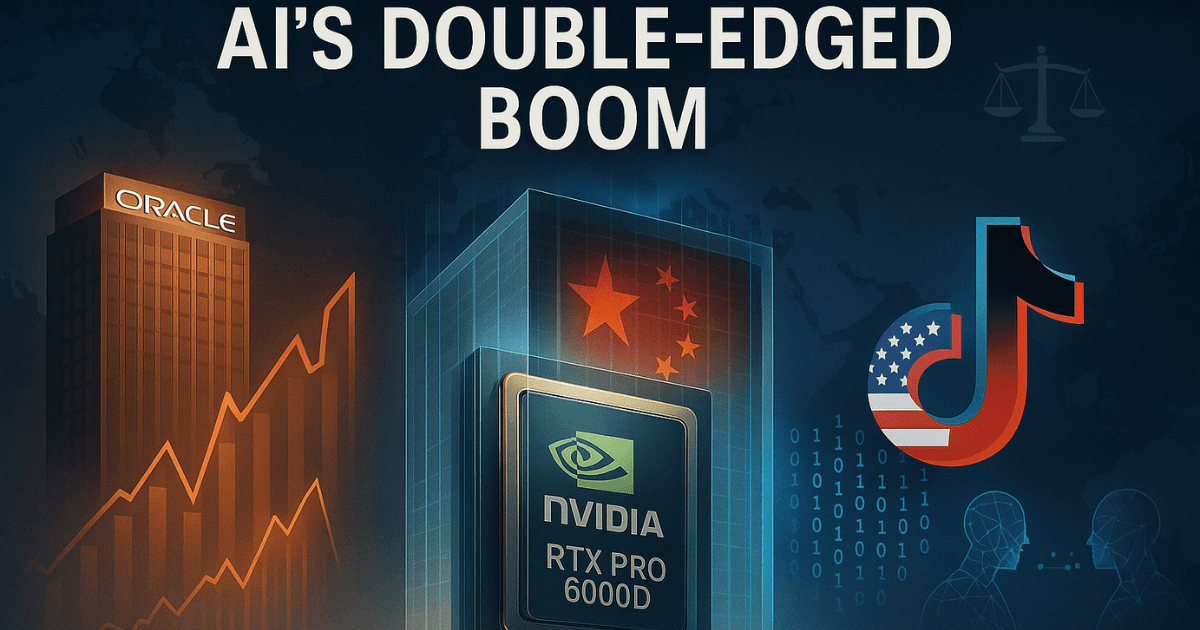
Every boom casts a shadow. Artificial intelligence is reshaping markets, politics, and trade—but not always in investors’ favour. Beijing just enforced an AI chip ban in China on Nvidia’s RTX Pro 6000D, the WTO is warning of AI inequality risks, and even Oracle’s trillion-dollar AI-fueled equity rally in Asia has reignited bubble talk. Meanwhile, TikTok’s U.S. operations sale shows how regulation can redraw the U.S.-China tech regulatory map, and virtual agent economies hint at digital markets beyond human oversight. Adding Goldman Sachs’ caution over AI investment valuation risk and potential cloud hardware spending slowdown, the picture becomes clear: the feast is rich, but not every diner leaves satisfied.
🌏 A New Front in the Chip Wars
When Beijing tells its giants to back away from Nvidia RTX Pro 6000D, investors should take notice. The Cyberspace Administration of China (CAC) instructed firms like Alibaba and ByteDance to halt purchasing or testing the chip. Orders already in motion? Canceled. Nvidia’s stock dipped, illustrating how a single domestic semiconductor sovereignty move can rattle markets. Beijing’s intent is clear: to elevate homegrown chipmakers like Huawei and Cambricon, thereby reducing reliance on U.S. hardware. This is no longer just business; it’s a real-time geopolitical tech decoupling. Smart Capital Signal: Nvidia’s China revenue is shrinking while Chinese chipmakers gain home-field advantage. Investors must map two parallel tech ecosystems, not one.
📈 AI Could Boost GDP—But Not for Everyone
The World Trade Organization (WTO) recently modelled the trade impact of AI. Projections indicate that trade volumes will increase by 34–40% and global GDP will rise by 12–13% by 2040. However, here’s the rub: without upgrades in digital infrastructure and regulatory reform, developing economies face an infrastructure gap that could leave them at a disadvantage. Under baseline scenarios, income growth is ~8% for poorer nations, versus 14–15% for wealthier states. Ngozi Okonjo-Iweala summed it up: “AI has the potential to widen inequalities unless we act collectively.” Tactical Insight: Institutional investors will favor nations that bridge the infrastructure gap in developing economies. Expect capital to chase markets that align governance, connectivity, and AI regulation.
💻 Oracle’s Rally and Asia’s AI High
Oracle’s stock didn’t just climb—it rocketed ~36% in one session, driven by AI cloud contracts, pushing it toward the trillion-dollar mark. The Oracle AI rally in Asia triggered copycat gains, with Japan’s SoftBank surging ~9%, while Taiwan, South Korea, and China also rode the momentum. But whispers of the “B” word—bubble—are growing louder. Analysts worry that AI-fueled equity markets are pricing future profits too far ahead. Investor Radar: Momentum is tempting, but balance matters—hedge exposure between hyperscalers driving AI investment valuations and reliable sectors like infrastructure and utilities.
📱 TikTok’s U.S. Rebrand Deal
The sale of TikTok's U.S. operations is shaping up as a geopolitical case study. Washington and Beijing agreed on terms for transferring U.S. control:
- Board control: Six of seven seats for Americans, one for the U.S. government.
- Data oversight: Oracle to manage U.S. user security.
- Algorithm licensing: Still unresolved—ByteDance’s role in algorithm design is the sticking point.
The divestment deadline is extended to December 16, 2025. Strategic Cue: Beyond TikTok itself, this is a warning that U.S.-China tech regulation is no longer theory—it’s precedent. Tech firms straddling borders face structural valuation risks when political mandates reshape ownership.
🤖 The Rise of “Virtual Agent Economies”
A new paper examines the emergence of virtual agent economies—digital markets operated by autonomous AI. These aren’t science fiction: agents are already transacting, coordinating, and sometimes outcompeting humans in scale and speed. Benefits include efficiency and optimisation. But the risks are serious: systemic fragility, inequality, and opaque algorithmic decisions. Left unchecked, these sandbox systems could pressure traditional economies. Investor Compass: Regulators will soon tackle agent-to-agent trade. Early exposure to startups in this domain could yield high rewards before Wall Street piles in.
⚠️ Goldman Sachs Flags AI Investment Risk
Goldman Sachs has cautioned that if hyperscalers reduce capital expenditures, the risk of AI investment valuation becomes a real concern. Billions poured into AI infrastructure may not yield proportional revenues, raising the spectre of an AI spending slowdown that would ripple through cloud hardware and semiconductors. Capital Guardrail: Watch Amazon, Microsoft, and Alphabet. If they trim budgets, the domino effect could pull valuations down across the AI hardware supply chain.
🥂 Final Reflection: The AI Feast Is Spicy—But Not Free
Investors are being served a complex menu. China’s Nvidia chip ban signals a shift toward domestic semiconductor sovereignty. The WTO’s AI inequality risks show the limits of global growth. The Oracle AI rally in Asia highlights both opportunity and overheating. The sale of TikTok's U.S. operations sets a blueprint for U.S.-China tech regulation. And whispers of AI investment slowdown risk echo through the sector. Closing Note: The AI-fueled equity market boom is dazzling, but smart investors will watch regulation as closely as revenue. Balance enthusiasm with scepticism, and you’ll stay at the table long after others choke on the spice.
📚 Sources
- Reuters – China tells tech firms to stop buying Nvidia chips
- Financial Times – China bars Nvidia’s RTX Pro 6000D in major tech firms
- WTO – World Trade Report 2025
- Financial Times – WTO warns AI may widen inequality
- Reuters – Oracle’s surge lifts Asia markets
- Reuters – TikTok US operations transfer deal
- Politico – TikTok algorithm licensing issue
- arXiv – Virtual Agent Economies
- Goldman Sachs – AI and data center demand
Market Munchies and Mode Mobile communications are for informational purposes only, and are not a recommendation, solicitation, or research report relating to any investment strategy, security, or digital asset. All investments involve risk including the loss of principal and past performance does not guarantee future results.
Any information contained in this commentary does not purport to be a complete description of the securities, markets, or developments referred to in this material. The information has been obtained from sources considered to be reliable, but we do not guarantee that the foregoing material is accurate or complete. There is no guarantee that any statements or opinions provided herein will prove to be correct.
Hungry for the latest in crypto? 🍪
Get fresh insights, breaking news, and hidden gems in the world of crypto—delivered straight to your inbox with our Crypto Cookies newsletter. Don’t miss out—sign up now and get your first bite of insider knowledge!