AI’s Hidden Cost: Why the Artificial Intelligence Boom Now Runs on Electricity
When the AI Gold Rush Meets the Power Grid Imagine you’re an investor watching the artificial intelligence boom unfold. Every earnings call mentions it. Every tech CEO promises bigger models, faster chips, and smarter software. Markets celebrate. Semiconductor stocks soar. Data…
When the AI Gold Rush Meets the Power Grid
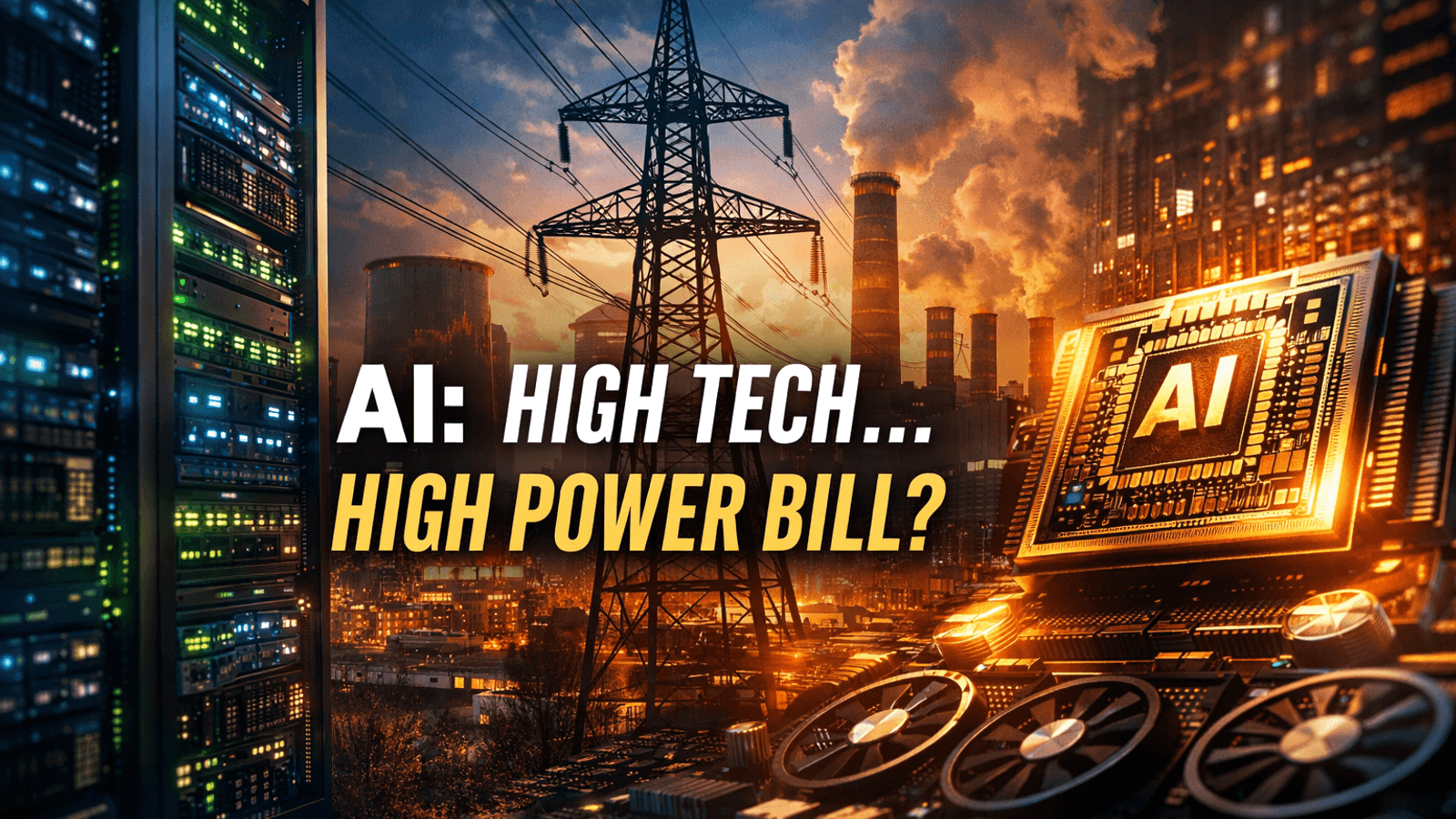
Imagine you’re an investor watching the artificial intelligence boom unfold. Every earnings call mentions it. Every tech CEO promises bigger models, faster chips, and smarter software. Markets celebrate. Semiconductor stocks soar. Data centers multiply across the globe. Then a quiet question begins to surface. What powers all of this? Not hype. Not code. Electricity. Behind the scenes, the global race to build AI infrastructure is turning into one of the most energy-intensive industrial expansions in modern history. Data centers are growing larger, GPUs are running hotter, and semiconductor factories are consuming more electricity than ever. Suddenly, the AI revolution looks less like a pure software story and more like a massive infrastructure project. For investors paying attention, that shift changes the entire investment thesis.
The AI Energy Problem Investors Can’t Ignore
Why AI Data Centers Are Power Monsters
Artificial intelligence doesn’t live in the cloud. It lives in data centers packed with specialized chips, cooling systems, and high-speed networking equipment. The scale is staggering. A modern AI training data center can require hundreds of megawatts of power, roughly equivalent to the electricity used by tens of thousands of homes. GPU racks built for large AI models often consume six to ten times as much power as traditional server hardware. Energy demand from data centers has already climbed dramatically. The International Energy Agency (IEA) projects that global data center electricity consumption could more than double by 2026, reaching over 1,000 terawatt-hours—a demand surge roughly equivalent to adding the entire electricity consumption of Germany to the global grid in just four years. For power grids originally designed around households and factories, these new computing hubs are starting to look like unexpected industrial giants. Investor Radar: Rising electricity demand tied to AI infrastructure growth creates long-term opportunities in power generation, grid upgrades, and energy storage—not just technology stocks.
Big Tech’s $650 Billion AI Spending Race
Hyperscalers Are Building the Industrial Internet
The biggest tech companies are not slowing down. If anything, the arms race is accelerating. The four largest hyperscalers—Amazon, Microsoft, Alphabet, and Meta—are on track to spend well over $200 billion on capital expenditures in 2024 alone, the vast majority of which is dedicated to AI infrastructure. Some analysts predict this annual 'arms race' spending could scale toward $500 billion annually by the end of the decade as companies race to secure the power and chips necessary for AGI. Spending includes:
- Massive AI data centers
- Advanced GPU clusters
- High-speed networking hardware
- Power and cooling systems
- Semiconductor supply chains
Infrastructure spending of that magnitude begins to resemble national infrastructure projects rather than typical tech budgets. BlackRock CEO Larry Fink recently warned that the enormous investment wave could eventually create winners and casualties, noting that massive technology spending cycles often lead to consolidation once markets mature. From an investor perspective, the message is simple: the AI boom is real—but the capital requirements are enormous. Smart Capital Signal: Whenever technology transitions from software innovation to heavy infrastructure spending, new winners emerge across energy, industrial equipment, and semiconductor supply chains.
Semiconductor Stocks Are Feeling the Pressure
AI Chips Are Powerful—and Expensive to Run
Semiconductors sit at the center of the AI revolution. Companies producing advanced GPUs and AI accelerators are seeing extraordinary demand. Yet rising energy costs are quietly becoming part of the equation. Chip fabrication plants—known as fabs—already consume huge amounts of electricity and water. AI demand adds another layer of pressure as manufacturers push toward more advanced production processes. Meanwhile, the data centers running those chips require enormous cooling systems and energy infrastructure. Even small increases in electricity costs can ripple across profit margins when operations run at hyperscale. Investors who once viewed AI hardware purely through the lens of chip demand are now examining a broader picture: energy costs, supply chains, and infrastructure constraints. Tactical Insight: Semiconductor growth tied to AI remains strong. However, long-term profitability increasingly depends on energy efficiency, manufacturing scale, and infrastructure partnerships.
The New Bottleneck in the AI Economy
Power Grids May Decide the Next Phase of AI Growth
The history of technology often runs into unexpected limits. The early internet ran into bandwidth limits. Cloud computing faced data storage challenges. Electric vehicles depend on battery supply chains. Artificial intelligence appears to be running into constraints on power infrastructure. Large AI facilities require stable electricity, high-capacity transmission lines, and massive cooling systems. Local governments and utilities are already debating how quickly grids can expand to support new projects. Some regions welcome the investment. Others worry about environmental impact, energy pricing, and grid reliability. In short, the next chapter of the AI boom may depend less on algorithms and more on electricity. Strategic Takeaway: Investors tracking AI infrastructure trends should monitor energy markets, grid expansion, and power policy. Those factors may shape the pace of AI adoption as much as technological innovation.
The Quiet Ingredient Powering the AI Revolution
Final Reflection: The Infrastructure Behind the Hype
Artificial intelligence captures headlines with dazzling breakthroughs—chatbots, autonomous systems, generative media, and smarter software. Yet underneath the excitement sits a simple reality. Every AI model needs chips. Every chip needs data centers. Every data center needs electricity. That invisible chain connects technology innovation to real-world infrastructure. And infrastructure tends to move more slowly than hype cycles. For investors willing to look beyond the headlines, the story becomes clearer: the AI revolution isn’t just a digital transformation. It’s an industrial one. And, like every industrial boom before it, the quiet winners may not be only the companies writing the algorithms but also the ones supplying the power.
Sources
Market Munchies and Mode Mobile communications are for informational purposes only, and are not a recommendation, solicitation, or research report relating to any investment strategy, security, or digital asset. All investments involve risk including the loss of principal and past performance does not guarantee future results.
Any information contained in this commentary does not purport to be a complete description of the securities, markets, or developments referred to in this material. The information has been obtained from sources considered to be reliable, but we do not guarantee that the foregoing material is accurate or complete. There is no guarantee that any statements or opinions provided herein will prove to be correct.