Alphabet Won Big Tech Earnings Night. Here's Exactly Why — and What It Means for the AI Race.
Wednesday night's Big Tech earnings session was supposed to be a referendum on AI spending. Four Magnificent Seven companies reported within hours of each other — Alphabet, Meta, Microsoft, and Amazon — and investors delivered a clear verdict before Thursday's open. Alphabet…
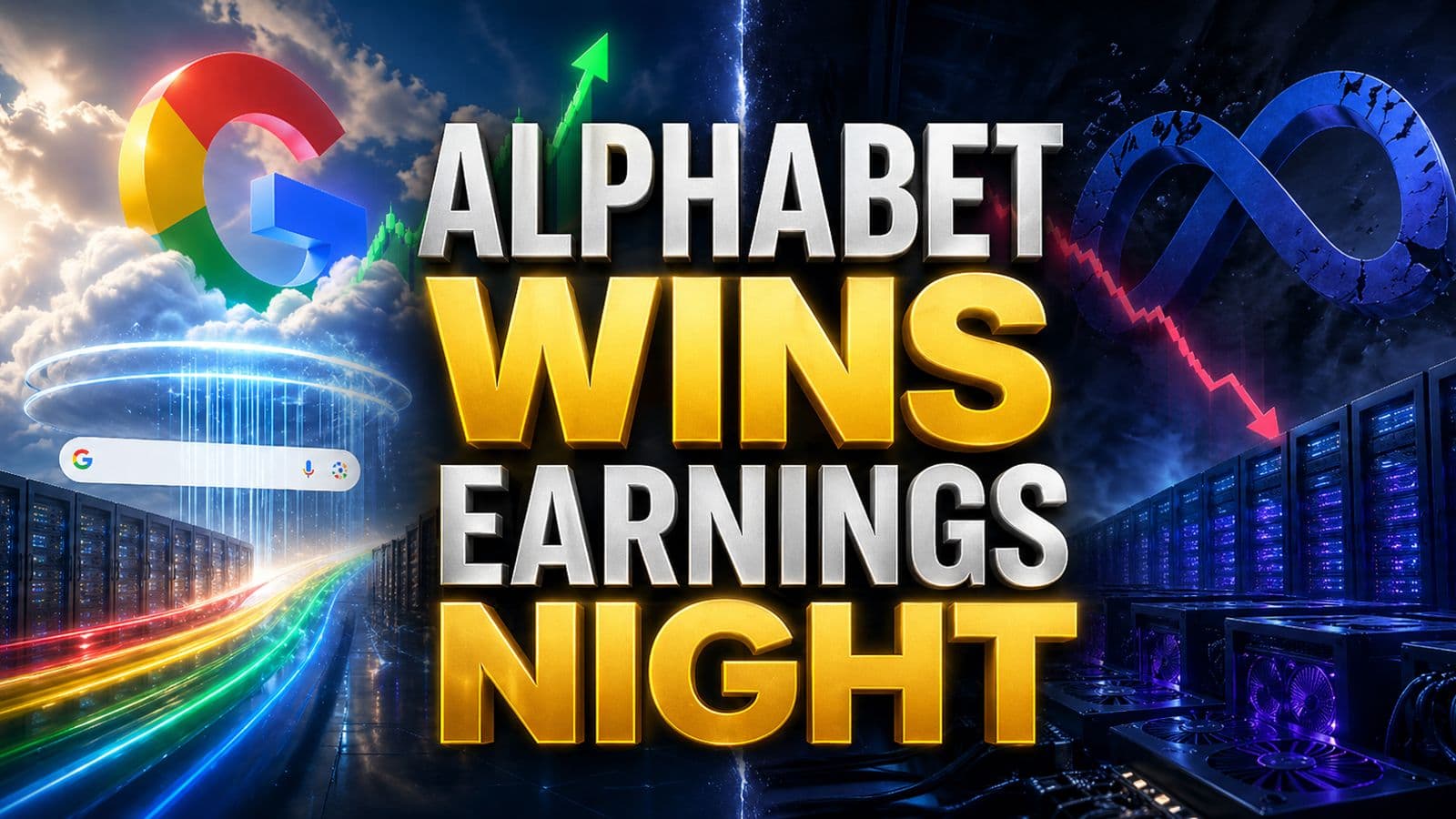
Wednesday night's Big Tech earnings session was supposed to be a referendum on AI spending. Four Magnificent Seven companies reported within hours of each other — Alphabet, Meta, Microsoft, and Amazon — and investors delivered a clear verdict before Thursday's open.
Alphabet won. Meta lost. The gap between them tells you everything that matters about where the AI trade is heading — but only if you read past the headline numbers on both.
The Numbers — With the Asterisks Applied Equally
Alphabet delivered a genuinely strong quarter — but the headline figures carry the same footnote applied to Meta below.
Revenue hit $109.9 billion, up 22% year over year, beating consensus of around $106.79 billion. Operating income grew 30% to $39.7 billion, with operating margin expanding two percentage points to 36.1%. Google Cloud revenues grew 63% to $20 billion — the strongest Cloud quarter in company history — with the backlog nearly doubling quarter on quarter to over $460 billion. Search revenue grew 19% to $60.4 billion. Shares rose in after-hours trading.
The headline net income of $62.6 billion included a $36.9 billion gain on equity securities that added $2.35 to diluted EPS and $28.7 billion to net income. Strip that one-time unrealized gain on Alphabet's non-marketable equity portfolio, and net income attributable to core operations was closer to $34 billion. The clean operating EPS is approximately $2.76 — not $5.11. This is the same accounting dynamic that inflated Meta's headline number, and it deserves equal treatment here.
What makes Alphabet's quarter genuinely impressive is the operating performance underneath it: 63% Cloud growth, 19% Search growth, margin expansion, and a $460 billion contracted backlog. Those numbers are real and durable, and they are what the market rewarded.
Meta beat on revenue and earnings — and still fell 7%.
Meta reported adjusted earnings per share of $10.44 on revenue of $56.31 billion, up 33%. Both figures came in above estimates. But as with Alphabet, the headline EPS requires a footnote: it was boosted by an $8.03 billion one-time income tax benefit tied to U.S. Treasury Notice 2026-7, which added $3.13 per share to the result. The clean EPS figure was $7.31 — still a solid beat against the $6.65 consensus, but not the headline number. The stock sank more than 6% after hours after Meta raised its 2026 capital expenditure guidance to between $125 billion and $145 billion, up from the prior $115 billion to $135 billion range, and disclosed a sequential decline in users. Meta attributed the user dip in part to "internet disruptions in Iran."
Why the Market Treated Them So Differently
The divergence in stock reactions is not about the earnings numbers. Both companies beat. The divergence is about what the market trusts right now — and what it does not.
Alphabet showed investors a specific, working feedback loop. Google Cloud's 63% growth was led by enterprise AI solutions and AI infrastructure. As CEO Sundar Pichai put it: "Our enterprise AI solutions have become our primary growth driver for cloud for the first time in Q1." That is not a future promise. It is a present revenue line growing at 63% year over year with a contracted backlog of $460 billion. The market can model that. It knows what to pay for it.
Meta raised its capex guidance by $10 billion on both ends of the range — to $125-$145 billion — while the primary revenue line is still advertising. The company is now guiding to nearly double what it spent on capex in 2025, and more than it spent in 2025 and 2024 combined. Zuckerberg's stated destination is "personal superintelligence for billions of people." The market understands the ambition. What it cannot yet model is the revenue line that justifies a capex bill of that magnitude.
The distinction is worth stating plainly: Alphabet is spending on AI and showing you the return in its cloud revenue. Meta is spending on AI and asking you to trust that the return is coming. That framing captures the current market dynamic — but it does not mean Meta is wrong. Alphabet spent years building cloud infrastructure before it produced the kind of revenue numbers it reported this week. Meta's current capex cycle could look exactly the same from the vantage point of 2028 or 2029.
The Search Bear Case Is Significantly Weakened
One of the most analytically significant elements of Alphabet's quarter is what it did to the narrative that has weighed on the stock for two years.
The bear case on Alphabet has centered on one fear: AI chatbots — specifically ChatGPT and its successors — would erode Google Search ad revenue by redirecting informational queries away from Google entirely. If people ask ChatGPT for answers instead of searching Google, Google's core business model eventually deteriorates.
Q1 2026 pushed back hard against that thesis. Search queries hit an all-time high. Search revenue grew 19%. Alphabet's AI Overviews feature — which embeds generative answers directly into Search results — appears to be increasing engagement rather than cannibalizing it. Management noted that AI Overviews is monetizing at a rate similar to traditional Search.
These are meaningful data points against the AI-disrupts-Search thesis. They are not a permanent refutation — a single quarter of strong search results does not eliminate a structural risk that plays out over years. But they materially reduce the probability that the bear case is already in motion.
The Capex Reality Check
The combined AI infrastructure spending commitments across the four companies that reported Wednesday are enormous — but the $700 billion figure that has circulated in some coverage overstates the combined number and deserves correction.
Alphabet updated its 2026 capex guidance to between $180 billion and $190 billion. Meta guided to $125 billion to $145 billion. Microsoft called for approximately $190 billion. Amazon's full-year capex figure will be clearer after its Thursday call, but analysts estimate roughly $100 billion to $110 billion based on Q1 run rates. The realistic combined figure across all four is closer to $595 billion to $635 billion — still an extraordinary number, and still historically unprecedented for a single year of infrastructure investment by four companies.
What matters for investors is less the aggregate figure and more the pattern of returns across the four companies. The market on Wednesday drew a clear distinction: cloud revenue growth justifies capex; advertising revenue growth alone, even at 33%, does not when the capex bill reaches $145 billion. That pattern held across all four reports. Alphabet and Amazon — both of which demonstrated AI revenue growth in their cloud businesses — were rewarded. Meta — whose AI spending is still ahead of its demonstrable AI revenue — was not.
What This Means for Investors
For investors holding Alphabet, Wednesday's result removes two significant overhangs. The Search disruption bear case is weakened by the query volume and revenue data. The Cloud growth acceleration, with a $460 billion backlog and enterprise AI as the primary growth driver for the first time, provides a multi-year revenue narrative that the market can underwrite. Investors should note, however, that the clean operating EPS of approximately $2.76 — not the headline $5.11 — is the right number to use in any forward modeling.
For investors holding Meta, the question Wednesday's result did not answer is the one that matters most: what does $145 billion in annual capex eventually produce in new revenue? The advertising business is performing well. Reels engagement is up. The MTIA custom chip roadmap with Broadcom offers a path to lower inference costs by 2027. None of that is happening fast enough to satisfy a market that is recalibrating its patience for AI infrastructure payback periods. But the structural argument for Meta's AI investment thesis remains intact — the capex cycle that looks expensive today could be the foundation of a dominant revenue stream by 2028. Alphabet looked the same way in 2022.
The broader market signal from Wednesday night is this: the AI trade has matured past the phase where spending ambition alone is rewarded. Investors now want evidence. Alphabet provided it through Cloud. Amazon provided it through AWS. Meta asked for more patience. Whether the market's current judgment on all three is correct will be determined not by this quarter's earnings calls, but by the revenue lines that follow.
Sources
- CNBC — "Alphabet (GOOGL) Q1 2026 earnings": https://www.cnbc.com/2026/04/29/alphabet-googl-q1-2026-earnings.html
- SEC EDGAR — "Alphabet Q1 2026 Earnings Release (Exhibit 99.1)": https://www.sec.gov/Archives/edgar/data/1652044/000165204426000043/googexhibit991q12026.htm
- InvestingLive — "Google smashes Q1 estimates with $109.9bn revenue. Cloud surges 63% past forecasts": https://investinglive.com/stocks/google-smashes-q1-estimates-with-1099bn-revenue-cloud-surges-63-past-forecasts-20260429/
- HeyGoTrade — "Alphabet Q1 2026 Earnings Reaction: Cloud, Search Ads & $185B AI Capex Bet": https://www.heygotrade.com/en/blog/alphabet-q1-2026-earnings-reaction/
- Bulios — "Alphabet Q1 2026: Revenue grows 22%, cloud adds +63%": https://en.bulios.com/status/263466-alphabet-q1-2026-revenue-grows-22-cloud-adds-63
- CNBC — "Meta Q1 2026 earnings report": https://www.cnbc.com/2026/04/29/meta-q1-earnings-report-2026.html
- SiliconANGLE — "Meta shares drop after-hours as capex guidance overshadows earnings beat": https://siliconangle.com/2026/04/29/meta-shares-drop-hours-capex-guidance-overshadows-first-quarter-beats/
- Fortune — "Meta just bumped its 2026 capex forecast up to as much as $145 billion for the AI boom — and investors flinched": https://fortune.com/2026/04/29/meta-zuckerberg-145-billion-ai-spending-roi/
- HeyGoTrade — "Meta Q1 2026 Earnings Reaction: Reels Monetization & MTIA Chip Roadmap": https://www.heygotrade.com/en/blog/meta-q1-2026-earnings-reaction/
- TradingKey — "Meta Platforms Q1 Net Profit Surged 61% Year-on-Year; Why Did Shares Sink Over 7% After Hours?": https://www.tradingkey.com/analysis/stocks/us-stocks/261840613-meta-q1-eps-interest-stock-ai-expenditure-tradingkey
- StockTitan — "Alphabet Q1 2026: Net income boosted by $37.7B gain on equity securities": https://www.stocktitan.net/sec-filings/GOOG/8-k-alphabet-inc-reports-material-event-99e4ee982355.html
- Yahoo Finance — "Alphabet tops Q1 estimates on strong Google Cloud growth": https://finance.yahoo.com/sectors/technology/article/alphabet-tops-q1-estimates-on-strong-google-cloud-growth-212244133.html
Market Munchies and Mode Mobile communications are for informational purposes only, and are not a recommendation, solicitation, or research report relating to any investment strategy, security, or digital asset. All investments involve risk including the loss of principal and past performance does not guarantee future results.
Any information contained in this commentary does not purport to be a complete description of the securities, markets, or developments referred to in this material. The information has been obtained from sources considered to be reliable, but we do not guarantee that the foregoing material is accurate or complete. There is no guarantee that any statements or opinions provided herein will prove to be correct.