Amazon Lands $38B OpenAI Cloud Contract as AI Infrastructure Wars Heat Up
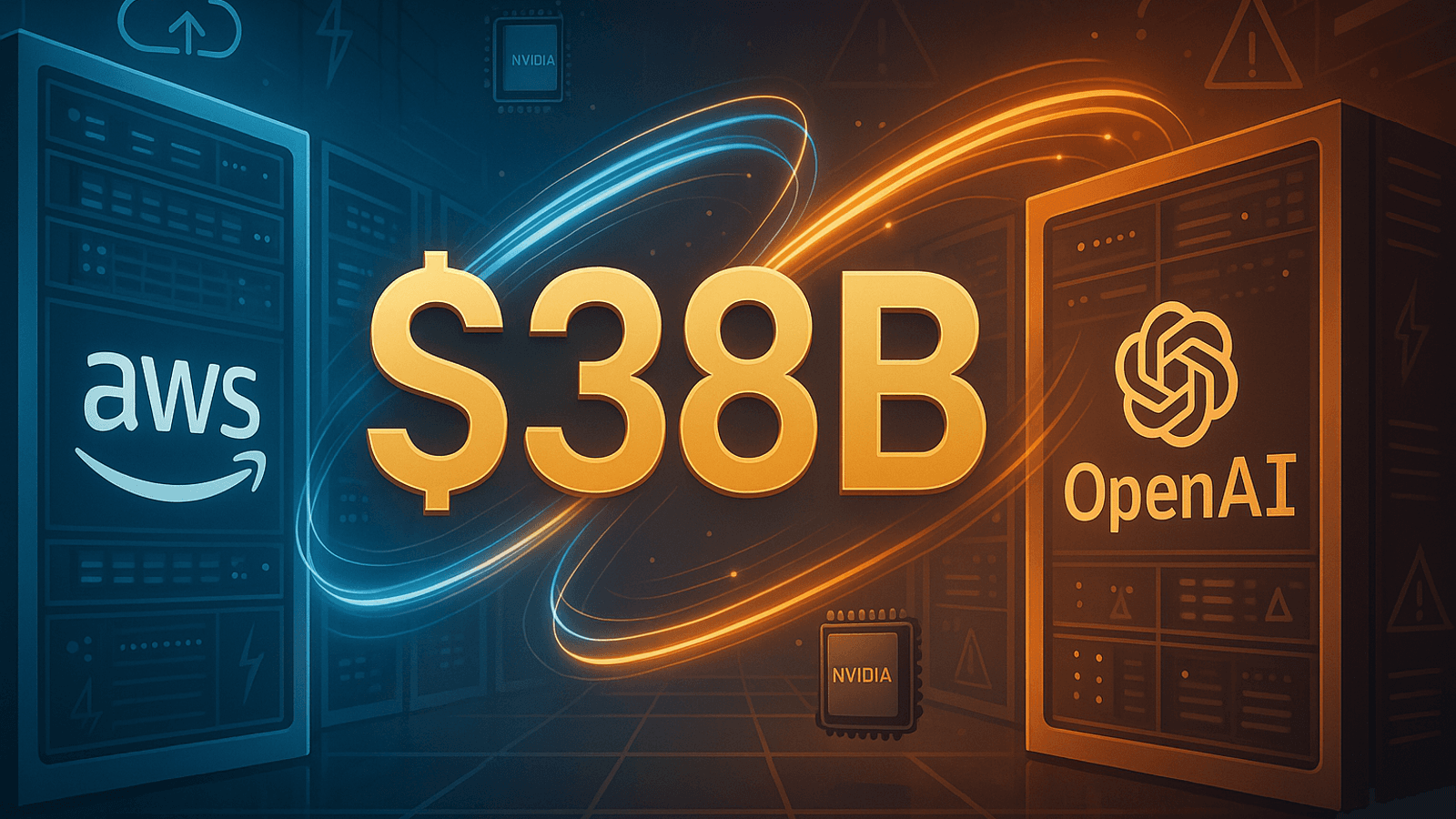
💰 The Deal Details OpenAI announced a $38 billion agreement with Amazon Web Services on November 3, marking one of the largest cloud computing contracts in history. The seven-year deal grants OpenAI access to thousands of Nvidia GPUs, including the cutting-edge GB200 and GB300…
💰 The Deal Details
OpenAI announced a $38 billion agreement with Amazon Web Services on November 3, marking one of the largest cloud computing contracts in history. The seven-year deal grants OpenAI access to thousands of Nvidia GPUs, including the cutting-edge GB200 and GB300 series Amazon EC2 UltraServers specifically optimized for AI compute. According to Amazon, this infrastructure can scale to tens of millions of CPUs for both training new models and running existing ones. OpenAI co-founder and CEO Sam Altman emphasized the strategic importance, stating that "scaling frontier AI requires massive, reliable compute" and that the partnership with AWS "strengthens the broad compute ecosystem that will power this next era and bring advanced AI to everyone." For investors tracking OpenAI's trajectory, this deal represents a significant commitment to scaling capacity beyond what any single cloud provider could offer alone.
🔄 Breaking Away from Microsoft
The AWS partnership marks a substantial shift from OpenAI's historical reliance on Microsoft for cloud infrastructure. For years, Microsoft served as OpenAI's primary compute provider, cementing a relationship that gave the Redmond giant exclusive access to OpenAI's models. However, recent restructuring has allowed OpenAI to pursue more flexible partnerships while maintaining its Microsoft relationship through 2032. The BBC characterized this as a move by OpenAI to "secure computing power" beyond its single-provider dependency. This diversification strategy reduces vendor lock-in risk and gives OpenAI negotiating leverage with multiple cloud providers. AWS CEO Matt Garman noted that "the breadth and immediate availability of optimized compute demonstrates why AWS is uniquely positioned to support OpenAI's vast AI workloads." For those tracking big tech competitive dynamics, this signals that exclusive partnerships in AI infrastructure may be giving way to multi-cloud strategies.
🏗️ The Trillion-Dollar Infrastructure Vision
The AWS deal is just one component of OpenAI's ambitious $1.4 trillion investment plan to expand infrastructure capacity. CEO Sam Altman has outlined plans to develop 30 gigawatts of power capacity, a staggering figure that provides crucial context: a single nuclear power plant typically generates about one gigawatt, while 30 gigawatts could power approximately 26 million homes for a year. OpenAI is not alone in this spending spree. Tech giants accelerated their AI capital expenditure in 2025, with Amazon increasing its capex forecast to $125 billion, up from a prior $118 billion estimate. Google, Meta, and Microsoft have similarly ramped up infrastructure spending. Amazon finance chief Brian Olsavsky told investors the company believes AI represents "a massive opportunity with the potential for strong returns on invested capital over the long term." For macro investors evaluating AI sector capital deployment, these figures represent the largest infrastructure buildout in tech history.
⚠️ The AI Bubble Question
Despite the optimistic spending projections, critics have raised concerns about a potential AI bubble, questioning whether valuations and capital expenditure align with actual demand and profitability. OpenAI's revenue reportedly exceeds $13 billion annually, with CEO Altman suggesting it is higher and could hit $100 billion to $200 billion by 2027 to 2030. However, the company continues to post substantial losses. Some analysts have pointed to circular relationships between OpenAI, Nvidia, and cloud providers as evidence that AI firm valuations may not reflect sustainable economics. The Guardian reported on concerns that the $3 trillion datacenter boom could be a bubble waiting to burst, though "there are few signs of it at the moment." For risk-conscious investors, the question remains whether AI companies can generate returns that justify their enormous infrastructure investments, or whether this represents speculative excess.
⚡ Energy and Environmental Considerations
The massive scaling of AI infrastructure carries significant energy and environmental implications that could pose regulatory and operational risks. According to DNV's recent analysis, AI power demand may grow tenfold by 2030, with data centers built for AI demanding exponentially more electricity than traditional facilities. A typical AI data center uses as much electricity as 100,000 households, while the largest facilities under development will consume 20 times more, according to the International Energy Agency. Beyond electricity consumption, communities near data centers have raised concerns about depleted water supplies for cooling systems, increased local electricity bills, and climate impacts if facilities rely on fossil fuel power plants. NPR reported that "people are concerned about data centers depleting local water supplies for their cooling systems, driving up electricity bills and worsening climate change." For ESG-focused investors and those tracking regulatory risks, these environmental challenges could become material constraints on AI infrastructure expansion.
🎯 What This Means for Markets and Investors
The immediate market reaction to the AWS-OpenAI deal demonstrates investor enthusiasm for AI infrastructure plays. Amazon's stock surged following the announcement, making founder Jeff Bezos approximately $10 billion richer in a single day. This reinforces the competitive positioning of major cloud providers, with AWS, Microsoft Azure, and Google Cloud vying for dominance in AI workloads. Nvidia continues to cement its position as the essential hardware provider, with its GB200 and GB300 series GPUs becoming the infrastructure backbone for frontier AI models. The deal also highlights an important strategic question: whether AI companies will consolidate around single cloud providers or pursue multi-cloud diversification strategies. OpenAI's approach suggests the latter, reducing dependency risk while accessing best-in-class capabilities from multiple vendors. For active traders and portfolio managers positioning for AI infrastructure growth, this signals that cloud providers, chip manufacturers, and power infrastructure companies may all benefit from the AI scaling wave, assuming demand materializes as projected and regulatory hurdles can be navigated.
Sources
https://crypto.news/openai-38b-cloud-deal-with-amazon-power-ai-models/ https://www.aboutamazon.com/news/aws/aws-open-ai-workloads-compute-infrastructure https://www.bbc.com/news/articles/cgqlzje32pjo https://www.reuters.com/business/microsoft-openai-reach-new-deal-allow-openai-restructure-2025-10-28/ https://www.cnbc.com/2025/10/31/tech-ai-google-meta-amazon-microsoft-spend.html https://finance.yahoo.com/news/sam-altman-says-openai-revenue-213319780.html https://www.theguardian.com/technology/2025/nov/02/global-datacentre-boom-investment-debt https://www.axios.com/2025/10/07/ai-power-cost-demand-future https://www.forbes.com/sites/maryroeloffs/2025/11/03/jeff-bezos-becomes-10-billion-richer-as-amazons-openai-deal-boosts-stock/
Market Munchies and Mode Mobile communications are for informational purposes only, and are not a recommendation, solicitation, or research report relating to any investment strategy, security, or digital asset. All investments involve risk including the loss of principal and past performance does not guarantee future results.
Any information contained in this commentary does not purport to be a complete description of the securities, markets, or developments referred to in this material. The information has been obtained from sources considered to be reliable, but we do not guarantee that the foregoing material is accurate or complete. There is no guarantee that any statements or opinions provided herein will prove to be correct.
Hungry for the latest in crypto? 🍪
Get fresh insights, breaking news, and hidden gems in the world of crypto—delivered straight to your inbox with our Crypto Cookies newsletter. Don’t miss out—sign up now and get your first bite of insider knowledge!