Banking Billions, Open Finance, and Stablecoin Shockwaves—Where Smart Money Should Look Next
💡 Banks Hold Steady, Stablecoins Push Forward Global finance isn’t standing still—it’s rewiring itself in plain sight. U.S. bank net income Q2 2025 hit nearly $70 billion, proving that the incumbents aren’t going quietly. Across the Atlantic, regulators are turbocharging open…
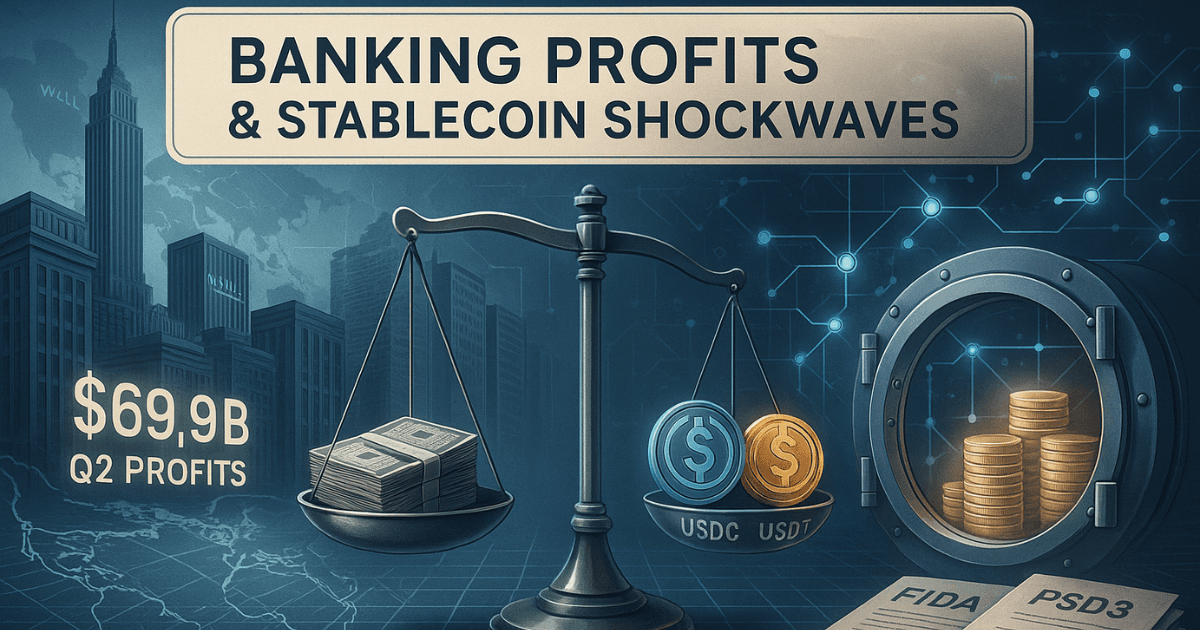
💡 Banks Hold Steady, Stablecoins Push Forward
Global finance isn’t standing still—it’s rewiring itself in plain sight. U.S. bank net income Q2 2025 hit nearly $70 billion, proving that the incumbents aren’t going quietly. Across the Atlantic, regulators are turbocharging open finance EU-UK frameworks, such as FIDA regulation and PSD3 open finance, thereby widening the gates for data and innovation. And in the background? Stablecoins in banking and blockchain in finance are quietly reshaping the plumbing of money itself. This isn’t just quarterly noise—it’s structural. The old guard is still collecting dividends, but new frameworks and modern finance infrastructure are rewriting the rulebook. For investors, the real story isn’t who won last quarter, but who’s designing the system everyone else will have to play in.
📈 U.S. Banks Deliver Solid Net Income Amid Shifting Winds
The numbers are in: U.S. banks collectively posted $69.9 billion in net income in Q2 2025. On the surface, that’s a modest 1% dip compared to the prior quarter. The culprit? Elevated provisions tied to the Capital One–Discover merger, which temporarily ate into the sector’s bottom line. But step back, and the picture looks sturdier. The FDIC reported a return on assets of 1.13%, just slightly below the trend. Strip away those one-off merger expenses, and the big banks are showing stronger upward momentum. Goldman Sachs and JPMorgan Chase were the poster children for resilience. Goldman pulled off a 20% year-on-year net profit jump (to $3.5 billion), while JPMorgan rode markets’ optimism with investment banking fees up 7% and trading revenues climbing 15%. As one analyst quipped, “JPMorgan isn’t just riding the yield curve—it’s surfing it.” Smart Capital Signal: Investors should view the headline U.S. bank net income Q2 2025 as conservative. Underlying strength—especially in trading, deposits, and advisory—points to a still-profitable sector with momentum left in the tank.
🔓 Europe & UK Push the Boundaries of Open Finance
If open banking cracked the door, open finance in the EU and UK is busy flinging it wide open. Across the EU, the Financial Data Access (FIDA regulation is advancing through negotiations. Its goal? To give consumers and businesses broader rights to share data—not just payments, but also pensions, insurance, and investments. Combine that with PSD3 open finance and the Payment Services Regulation (PSR), and you’ve got the blueprint for a modern finance infrastructure built on transparency and interoperability. The UK is following a similar path, although it lacks the same legislative momentum at present. For fintechs, it’s a buffet of opportunities: richer APIs, broader datasets, and the ability to build services that go far beyond checking balances. For incumbents, it’s a gentle nudge—or a shove, depending on your perspective—toward innovation. Tactical Insight: Investors in fintech, open finance trends, and data-driven platforms should keep a close eye on regulatory milestones. Once frameworks like the FIDA regulation are in place, the playing field could tilt in favour of agile firms with the technology to capitalise quickly.
🪙 Stablecoins Meet Crowdfunding—A New Funding Playbook
Crowdfunding has always been a mix of creativity and chaos. High fees, trust gaps, clunky transparency. Enter a new proposal: blockchain crowdfunding, built on stablecoin crowdfunding models and tokenization. A recent arXiv study outlined how smart contracts can automate compliance, reduce transaction fees, and enable investors to monitor funds in real-time. Imagine backers watching their contributions flow on-chain—like a glass-walled vault, visible to all. Case studies demonstrate that transaction costs have fallen below 3%, representing a significant improvement over traditional platforms. This model also unlocks tokenization in crowdfunding, enabling secondary liquidity. Instead of pledges being locked away, tokenized contributions could be traded. It’s crowdfunding with a liquidity twist—a Kickstarter that doesn’t end when the campaign does. Investor Radar: Early movers who understand the blockchain in finance rails here could tap into an entirely new funding infrastructure—transparent, global, and liquid.
💳 The Rise of “Banking 2.0” via Stablecoins
Stablecoins are no longer an exotic footnote—they’re at the centre of Banking 2.0 stablecoins. The GENIUS Act stablecoin legislation in the U.S. established the first comprehensive framework for issuing, holding, and integrating payment stablecoins into the mainstream financial system. Institutions aren’t standing on the sidelines. JPMorgan is already trialling crypto-backed loans, while PayPal lets customers pay directly with crypto balances. The result? A system where stablecoins in banking and traditional finance aren’t rivals—they’re co-authors of the next chapter in money. But opinions diverge. The Financial Times insists stablecoin regulation is forcing finance to modernise. Moody’s warns of slower-burning risks: lower deposit bases and reduced fee income over time. Meanwhile, the Bank for International Settlements (BIS) sounds almost parental, cautioning that unchecked stablecoins could erode monetary sovereignty and spark capital flight in emerging economies. Strategic Cue: Stablecoins in banking may well be the bridge asset of our generation—useful, regulated, and inevitable. The smart investor won’t just speculate on coins; they’ll scan for institutions building modern finance infrastructure around them.
🌍 Final Words: Beyond the Balance Sheet: Where Smart Capital Flows Next
The signals all point in one direction: finance is entering a hybrid era—where banks, fintechs, and stablecoins aren’t rivals, but reluctant partners in a bigger transformation. The profits prove banks are sturdy. The regulations prove that open finance EU UK is unstoppable. And the blockchain in finance rails proves money is already halfway digital. For investors, the trick isn’t to chase the flashiest headline. It’s to track the frameworks—the GENIUS Act stablecoin, the FIDA regulation, the PSD3 open finance rules, and the pilot projects now laying foundations for global liquidity and trust. That’s where tomorrow’s winners will quietly scale. Put: while others squint at earnings tables, smart money is reading the blueprints of a new financial system.
Sources:
- FDIC Quarterly Banking Profile Q2 2025
- Reuters – U.S. bank sector sees profit dip
- Times of India – Goldman Sachs Q2 Earnings
- Investors.com – JPMorgan Stock
- Taylor Wessing – EU Journey to Open Finance
- UK Finance – Future of Open Banking
- arXiv – Blockchain & Stablecoin Integration for Crowdfunding
- Financial Times – Stablecoins & Finance
- MarketWatch – Stablecoins & Bank Profits
- BIS Warning on Stablecoins
Market Munchies and Mode Mobile communications are for informational purposes only, and are not a recommendation, solicitation, or research report relating to any investment strategy, security, or digital asset. All investments involve risk including the loss of principal and past performance does not guarantee future results.
Any information contained in this commentary does not purport to be a complete description of the securities, markets, or developments referred to in this material. The information has been obtained from sources considered to be reliable, but we do not guarantee that the foregoing material is accurate or complete. There is no guarantee that any statements or opinions provided herein will prove to be correct.