Banks vs. Crypto: The Stablecoin Yield Fight That Could Derail Landmark U.S. Legislation
💰 The Fight Over Your Stablecoin Returns A quiet but consequential battle is playing out in Washington, and it could reshape how millions of crypto users earn money on their stablecoins. At the center of it is a deceptively simple question: should platforms be allowed to pay…
💰 The Fight Over Your Stablecoin Returns
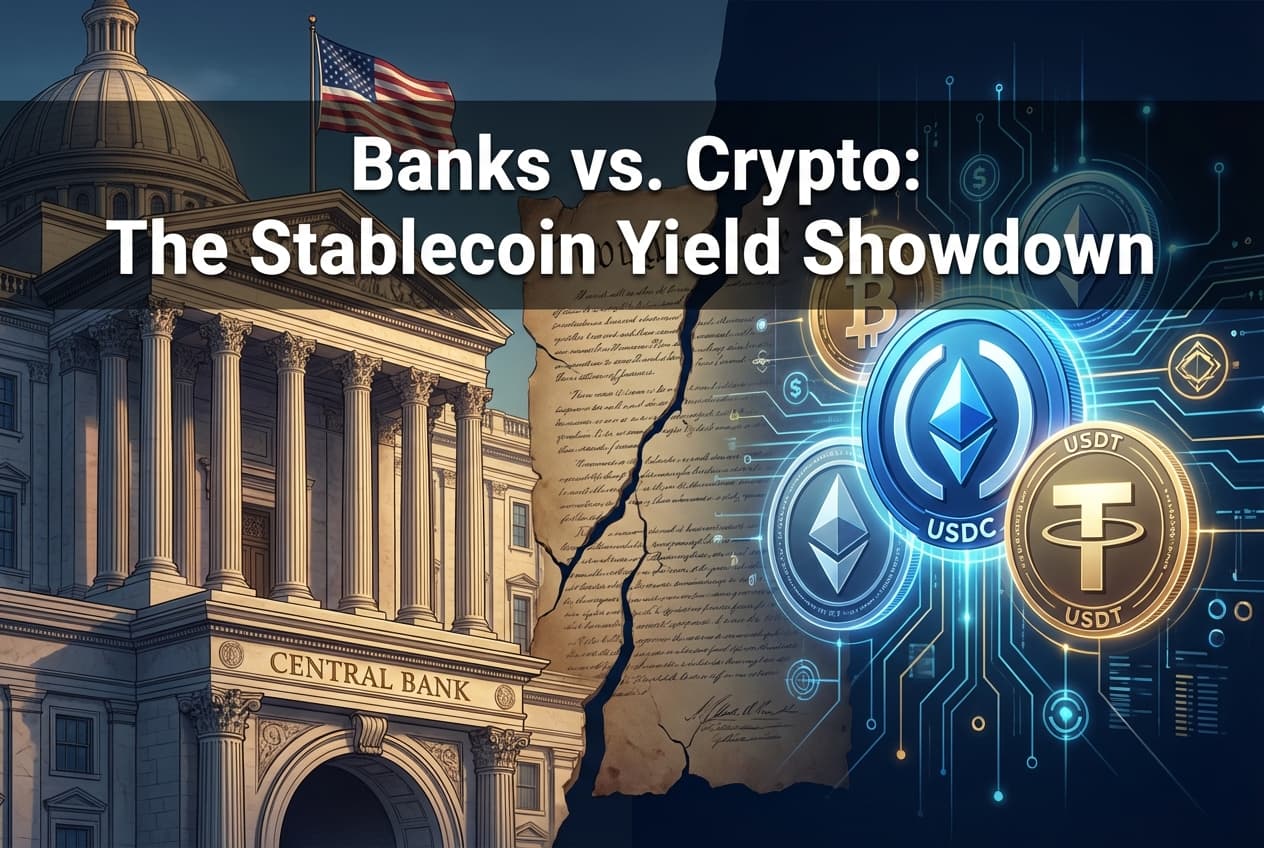
A quiet but consequential battle is playing out in Washington, and it could reshape how millions of crypto users earn money on their stablecoins. At the center of it is a deceptively simple question: should platforms be allowed to pay you for holding stablecoins? Banks say no. Crypto companies say absolutely. And according to analysts at TD Cowen, this standoff could do more than just determine stablecoin rewards. If the dispute drags on long enough, it threatens to unravel the broader U.S. crypto market structure legislation entirely, a bill that both industries have spent years pushing to pass. For investors and everyday crypto users, the stakes are hard to overstate.
🏦 Why Banks Are Drawing a Hard Line
The banking industry's opposition to stablecoin yield is rooted in a fundamental fear: deposit flight. If consumers can park money in stablecoins and earn a return, traditional savings accounts start to look a lot less attractive. Wall Street lobbyists have framed the issue bluntly: stablecoin yield is functionally the same as bank deposit interest, and if one thrives at the expense of the other, the ripple effect on bank lending could be severe. Banks are lobbying for a blanket ban on any stablecoin-linked incentive, reward, or yield-adjacent payment. Their position: if the law does not explicitly prohibit every form of return on stablecoin holdings, the loopholes will be exploited. From the banking sector's perspective, this is not a niche regulatory debate. It is an existential question about protecting the deposit base that underpins modern lending.
📜 What the GENIUS Act Actually Says
The GENIUS Act, which has already been signed into law, prohibits stablecoin issuers from directly paying interest or yield to holders. On paper, the banks won that round. But the law did not explicitly ban affiliated exchanges or third-party platforms from offering rewards for holding stablecoins, and that gap is now the battleground. In February 2026, the Office of the Comptroller of the Currency proposed a rule attempting to close these loopholes, introducing a rebuttable presumption that certain affiliate arrangements designed to replicate yield economics violate the statute's intent. TD Cowen analyst Jaret Seiberg argued, however, that the OCC's approach is unlikely to fully satisfy banks unless there is an explicit, unambiguous congressional ban. With the Chevron doctrine repealed, the OCC no longer gets automatic judicial deference on its regulatory interpretations, making its proposed rule legally vulnerable to court challenges.
🔬 The Loophole at the Center of the Dispute
The core of the fight boils down to marketing fees and platform incentives. The GENIUS Act bans issuers from paying yield directly but left open whether companies like Coinbase could pay marketing fees to stablecoin issuers that effectively get passed along to consumers as rewards. Coinbase has vigorously defended this model, arguing that platform-level rewards are commercially distinct from issuer-level interest payments. Banks see no meaningful difference. The resulting ambiguity has turned what might have been a technical regulatory footnote into a major political flashpoint. White House talks in early 2026 reportedly made some progress but produced no deal, and both sides have continued to dig in. With no voluntary compromise in sight, the fight has escalated from agency rulemaking into a live threat to the much larger CLARITY Act legislation currently working through the Senate.
⚠️ The CLARITY Act Caught in the Crossfire
The CLARITY Act is the crypto industry's top legislative priority. The House passed it in July 2025 by a wide bipartisan margin of 294 to 134. The Senate has been a different story. Two committee versions, one from the Agriculture Committee and one from the Banking Committee, must be reconciled before a full Senate vote. A markup was tentatively eyed for mid-to-late March 2026, but momentum has stalled repeatedly. TD Cowen's Seiberg put it plainly: even though banks will likely lose the stablecoin yield argument politically, because they are essentially arguing against consumers getting paid money, the prolonged fight could run out the legislative clock. Senate calendars are unforgiving, and if the CLARITY Act misses its window this session, TD Cowen previously flagged a delay to 2027 as a real possibility, pushing full market structure implementation toward 2029.
🎯 What This Means for Investors and Traders
For crypto investors, the stablecoin yield fight has two layers of significance. In the near term, the outcome determines whether platforms can continue offering rewards on stablecoin holdings, a feature that has become a meaningful draw for users on exchanges like Coinbase. In the longer term, the fight could delay the CLARITY Act, which would provide the regulatory clarity that institutional capital needs to flow more freely into U.S. crypto markets. Polymarket odds currently price the CLARITY Act being signed into law in 2026 at around 72%, suggesting that markets still expect it to pass, but the window is narrowing. Traders holding stablecoins for yield or rewards should watch Senate Banking Committee developments closely over the coming weeks. A compromise on yield would likely accelerate the bill's passage, while a continued deadlock raises the odds of a legislative slip into 2027 and another year of regulatory uncertainty for the broader crypto market.
Sources
https://www.theblock.co/post/392085/td-cowen-banks-likely-to-lose-stablecoin-yield-fight-crypto-bill-at-risk https://www.coindesk.com/news-analysis/2026/03/02/crypto-world-faces-growing-pressure-to-relent-on-stablecoin-rewards-to-win-bigger-prize https://www.coindesk.com/policy/2026/02/26/u-s-regulator-s-genius-pitch-puts-dark-cloud-over-crypto-sector-s-stablecoin-model https://thehill.com/policy/technology/5689481-crypto-banking-lobbying-fight/ https://www.congress.gov/bill/119th-congress/senate-bill/394/text https://www.theblock.co/post/384393/crypto-market-structure-bill-could-be-delayed-td-cowen
Market Munchies and Mode Mobile communications are for informational purposes only, and are not a recommendation, solicitation, or research report relating to any investment strategy, security, or digital asset. All investments involve risk including the loss of principal and past performance does not guarantee future results.
Any information contained in this commentary does not purport to be a complete description of the securities, markets, or developments referred to in this material. The information has been obtained from sources considered to be reliable, but we do not guarantee that the foregoing material is accurate or complete. There is no guarantee that any statements or opinions provided herein will prove to be correct.
Get fresh insights, breaking news, and hidden gems in the world of crypto—delivered straight to your inbox with our Crypto Cookies newsletter. Don't miss out—sign up now and get your first bite of insider knowledge!