Big Banks Call Crypto An Existential Threat
🏦 Traditional Finance Sees Crypto As Survival Question Coinbase CEO Brian Armstrong returned from the World Economic Forum in Davos with a striking message: a top executive at one of the world's 10 largest banks told him that crypto is now their "number one priority" and…
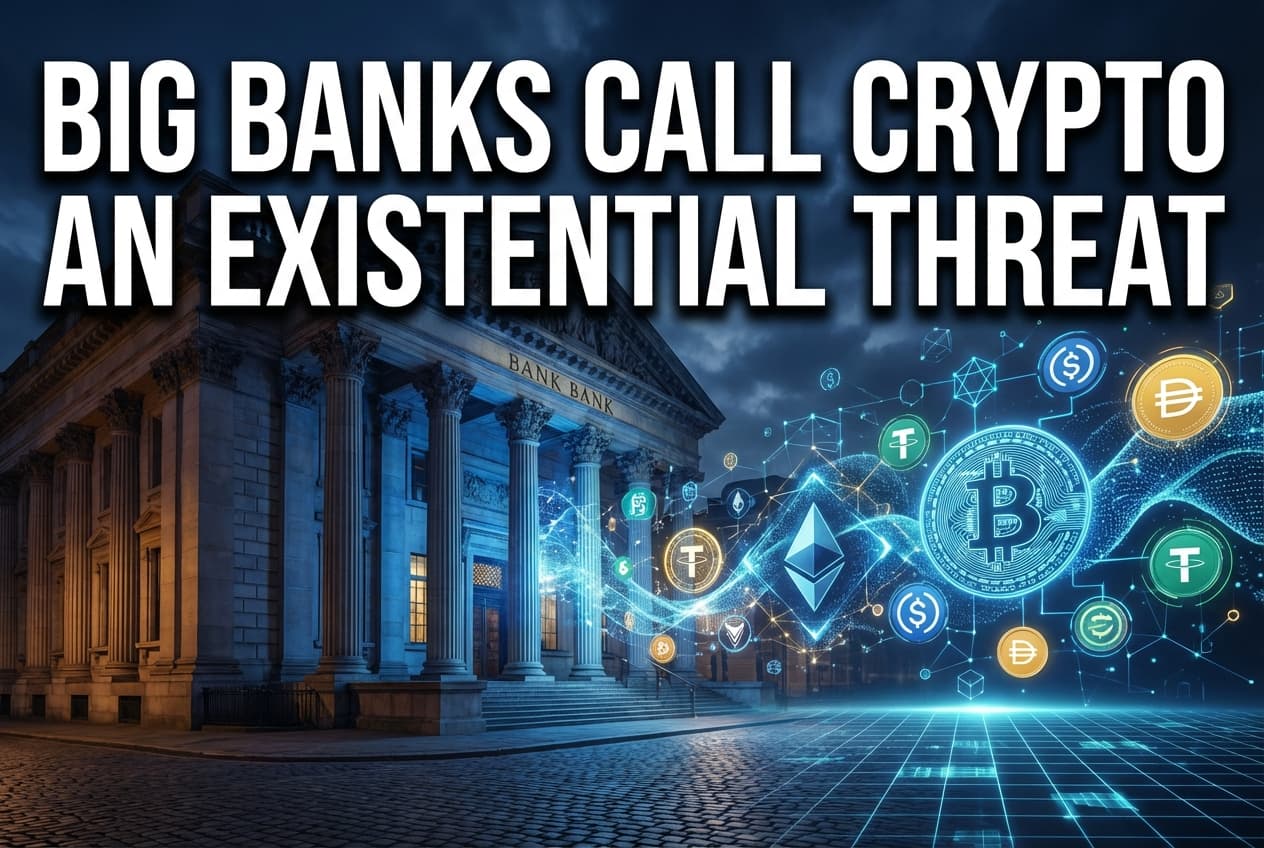
🏦 Traditional Finance Sees Crypto As Survival Question
Coinbase CEO Brian Armstrong returned from the World Economic Forum in Davos with a striking message: a top executive at one of the world's 10 largest banks told him that crypto is now their "number one priority" and represents an "existential" threat to their business. Armstrong shared the revelation on X, highlighting a fundamental shift in how legacy financial institutions view digital assets. The comment signals that traditional banks are no longer treating crypto as a speculative sideshow but as a direct challenge to their core business model. For investors, this acknowledgment from banking leadership suggests that institutional adoption has moved beyond exploratory phases into strategic necessity. Armstrong noted that most financial leaders he met during the weeklong Davos event weren't just open to crypto but were actively seeking ways to integrate it into their operations before competitors gain an edge.
💰 Tokenization Wave Threatens Banking Middlemen
The urgency among traditional banks stems from crypto's potential to eliminate their role as intermediaries. Stablecoins and tokenized assets enable direct transfers that bypass legacy payment rails entirely, moving value instantly without clearing delays or middlemen taking a cut. Armstrong identified tokenization as one of the most discussed trends at Davos, extending beyond stablecoins into equities, credit, and other financial products that banks have traditionally controlled. As stablecoin circulation surpassed $300 billion in 2025, processing over $18 trillion in transfer volume that exceeded Visa and Mastercard combined, the competitive threat became impossible to ignore. For retail and institutional investors alike, this shift means access to financial products with lower fees and faster settlement. Banks relying on correspondent banking networks and payment processing fees face a future where global asset managers or fintech firms could offer tokenized securities and stablecoin transfers directly, cutting banks out of transactions that once generated billions in revenue.
🌍 Four Billion Unbrokered Adults In Crypto's Crosshairs
Armstrong pointed to the estimated 4 billion "unbrokered" adults worldwide who lack access to high-quality investments as a massive opportunity for tokenization. These individuals, concentrated in emerging markets, face barriers including minimum investment thresholds, geographic restrictions, and complex account opening processes that traditional banks impose. Tokenization could eliminate these barriers by enabling fractional ownership and global access to assets previously available only to wealthy or institutional investors. Research from S&P Global suggests stablecoin adoption could reach 10 to 20 percent of bank deposits in countries where wealth preservation is paramount, with emerging markets contributing significantly to growth. For investors watching this space, the expansion of tokenized assets into underserved markets represents both a humanitarian opportunity and a massive addressable market that could dwarf current crypto adoption. Armstrong predicted "major progress" in 2026 as tokenization infrastructure matures and regulatory frameworks clarify.
🇺🇸 U.S. Regulatory Push Sets Global Standard
Political support for crypto in the United States appears to be strengthening under the Trump administration, which Armstrong described as "the most crypto-forward government in the world." The administration is backing crypto-focused legislation including the CLARITY Act, which aims to provide a regulatory framework for digital assets that has been missing for years. Armstrong emphasized that clear rules are essential to keeping the U.S. competitive as countries like China invest heavily in stablecoin and blockchain infrastructure. The 2025 legislative year saw significant progress, with the SEC approving generic listing standards for commodity-based trust shares and the CFTC launching a digital assets pilot program for tokenized collateral in derivatives markets. For traders and institutional investors, regulatory clarity removes the compliance uncertainty that has kept many traditional finance players on the sidelines. The shift from enforcement-heavy skepticism to flexibility for market participants represents a fundamental change in how U.S. regulators approach digital assets and distributed ledger technology.
🤖 AI Agents Choose Stablecoins Over Banks
Armstrong highlighted the convergence of artificial intelligence and crypto as one of the most significant themes at Davos, noting that AI agents will likely default to using stablecoins for payments rather than traditional banking rails. AI systems bypass conventional identity checks and banking restrictions by using programmable stablecoins that can execute complex payment logic autonomously. This trend poses yet another threat to banks, as an entire category of economic activity, machine-to-machine payments, could emerge outside traditional financial systems. Circle CEO Jeremy Allaire, speaking at Davos, noted that stablecoin adoption across the global banking system is accelerating with compound annual growth around 40 percent as institutions move from pilots to production use. For developers building AI applications and investors funding AI infrastructure, stablecoins offer settlement speed and programmability that traditional payment systems cannot match. The infrastructure already exists, and usage is growing rapidly as AI agents increasingly need to transact value without human intervention or traditional banking accounts.
🎯 Conclusion: Adapt Or Face Obsolescence
Armstrong's message from Davos is clear: crypto has moved from speculative asset to strategic priority for the world's largest financial institutions. Banks that fail to integrate tokenization, stablecoins, and blockchain infrastructure risk becoming obsolete as competitors, fintech firms, and global asset managers bypass them entirely. For investors, this institutional acknowledgment validates crypto's long-term viability and suggests that adoption will accelerate in 2026 as regulatory clarity improves and more traditional finance players enter the market. The banks that view crypto as existential are correct, but the threat cuts both ways. Institutions that adapt quickly could capture new revenue streams from tokenized assets, stablecoin services, and blockchain-based settlement, while those that resist will watch their core businesses erode. Traders should monitor which banks announce tokenization initiatives and stablecoin partnerships as indicators of which institutions are positioning for the transition. The question is no longer whether traditional finance will adopt crypto, but how quickly banks can transform before they lose market share to more nimble competitors.
Sources
https://www.coindesk.com/business/2026/01/24/coinbase-ceo-says-big-banks-now-view-crypto-as-an-existential-threat-to-their-business https://x.com/brian_armstrong/status/2015130657429598703 https://www.americanbanker.com/news/payment-fintechs-push-stablecoin-tech-for-2026 https://www.spglobal.com/ratings/en/regulatory/article/scenario-and-sensitivity-analysis-what-growing-adoption-of-foreign-currency-stablecoin-means-for-emerging-markets-s101666210 https://www.theblock.co/post/386768/institutional-crypto-adoption-passed-point-reversibility-pwc
Market Munchies and Mode Mobile communications are for informational purposes only, and are not a recommendation, solicitation, or research report relating to any investment strategy, security, or digital asset. All investments involve risk including the loss of principal and past performance does not guarantee future results.
Any information contained in this commentary does not purport to be a complete description of the securities, markets, or developments referred to in this material. The information has been obtained from sources considered to be reliable, but we do not guarantee that the foregoing material is accurate or complete. There is no guarantee that any statements or opinions provided herein will prove to be correct.
Get fresh insights, breaking news, and hidden gems in the world of crypto—delivered straight to your inbox with our Crypto Cookies newsletter. Don't miss out—sign up now and get your first bite of insider knowledge!