Big Tech’s Week of Truth Begins
Markets are starting the week in a tense but familiar position: close to record territory, heavily dependent on megacap tech, and suddenly paying attention to oil again. After the S&P 500 and Nasdaq finished last week at fresh highs, early Monday trading has looked mixed…
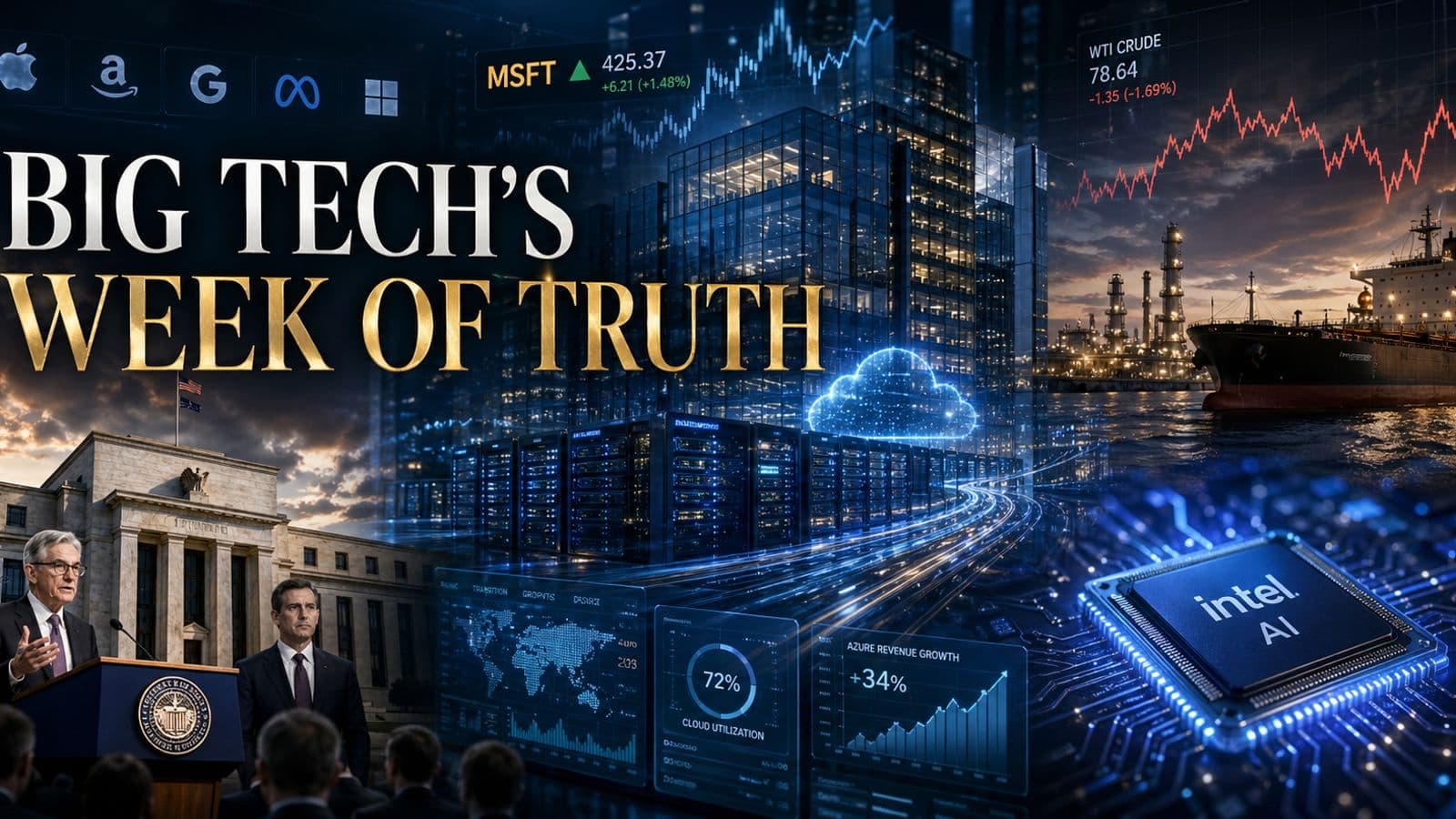
Markets are starting the week in a tense but familiar position: close to record territory, heavily dependent on megacap tech, and suddenly paying attention to oil again. After the S&P 500 and Nasdaq finished last week at fresh highs, early Monday trading has looked mixed rather than euphoric, with investors trying to balance strong earnings momentum against a Federal Reserve decision, elevated crude prices, and a wave of Big Tech results that could reset the tone for the rest of the quarter.
The setup is especially important because this rally has become more selective. AI optimism is still doing a lot of the lifting, but the market is no longer rewarding every AI headline equally. Investors want proof: cloud demand, margin durability, capital spending discipline, and evidence that enormous AI infrastructure outlays are turning into revenue rather than just bigger depreciation bills.
That makes this week less about whether investors still believe in AI and more about whether the largest companies in the market can justify the prices already being paid for that belief. Microsoft, Alphabet, Amazon, Meta, and Apple all report this week, more than one-third of the S&P 500 is due to release results, and the Fed is set to announce its latest rate decision on Wednesday.
Stock of Interest Today: Microsoft (MSFT)
Microsoft enters the week as one of the cleanest tests of the AI trade because it sits at the intersection of almost every major question facing the market right now: cloud demand, AI monetization, OpenAI exposure, capital spending, and margin pressure.
The bullish case is still easy to understand. Azure remains supply-constrained rather than demand-constrained, which is a good problem to have. In its most recent reported quarter, Microsoft said Azure and other cloud services grew strongly on a constant-currency basis, while management said demand continued to exceed available supply. That means customers still want more AI and cloud capacity than Microsoft can currently provide.
The harder question is whether the spending required to meet that demand will keep weighing on margins. Microsoft’s own performance notes said gross margin percentage slipped slightly because of continued AI infrastructure investment and growing AI product usage, even as efficiency gains helped soften the hit. That is the trade-off investors are watching closely: Microsoft can have excellent AI demand and still face pressure if the cost of serving that demand rises faster than revenue.
There is also a fresh wrinkle this morning: Microsoft and OpenAI announced an amended partnership agreement. Microsoft’s official blog framed it as a simpler, more flexible partnership, while Reuters reported that Microsoft will no longer have exclusive access to OpenAI’s models and products. Microsoft remains OpenAI’s primary cloud partner and retains a license to OpenAI intellectual property through 2032, but the loss of exclusivity changes the story from “Microsoft owns the OpenAI lane” to “Microsoft remains central, but the ecosystem is opening up.”
That does not break the Microsoft thesis, but it makes this earnings report more important. Investors will want management to show that Azure demand, Copilot adoption, enterprise AI workloads, and operating discipline can stand on their own, even as OpenAI gets more flexibility to work across other cloud platforms.
Current price: $424.62
Analyst expectation: $570.00
Five Market Signals To Watch
This week has several moving parts, but they all connect to one bigger question: whether this rally is broadening into a durable earnings-led advance or simply leaning harder on the same few AI-sensitive names.
The five signals below matter because they show how much confidence is still beneath the surface. Big Tech earnings will test the market’s growth story, dealmaking will test corporate confidence, the Fed will test institutional trust, oil will test inflation patience, and Intel will test whether the AI trade is spreading or overheating.
1) Big Tech Earnings Are No Longer Optional
The most important market event this week is not just that Microsoft, Alphabet, Amazon, Meta, and Apple are reporting. It is that they are reporting after a powerful rally that has already priced in a lot of good news. After Friday’s record highs, investors are not merely asking whether Big Tech is still strong. They are asking whether it is strong enough.
That distinction matters. AI has moved from story to scorecard. The market now wants evidence of cloud acceleration, stronger AI monetization, healthier digital advertising, resilient consumer demand, and spending discipline. If the numbers are strong, the rally has a stronger foundation. If the numbers are only decent, the market may start treating high valuations less generously.
2) Dealmaking Is Sending a Quieter Confidence Signal
While Big Tech earnings are getting most of the attention, corporate dealmaking is also sending an important message. Sun Pharma agreed to acquire Organon in an all-cash deal valued at about $11.75 billion, including debt, giving India’s largest drugmaker a much broader global platform across women’s health, biosimilars, and branded medicines.
That is not just a pharma story. Big cross-border deals tend to happen when companies believe financing markets, regulatory risk, and long-term demand are manageable enough to act. The same theme is showing up elsewhere: Ligand is buying XOMA Royalty to expand its biopharma royalty portfolio, while Nestlé is selling Blue Bottle Coffee as part of a broader push to simplify its portfolio. Together, these moves suggest companies are not frozen by macro uncertainty. They are becoming more selective about where they want scale and where they want to cut complexity.
3) The Fed Is Expected to Hold, but Powell’s Words Still Matter
The Fed is widely expected to hold rates steady this week, but the bigger drama may be institutional rather than numerical. Powell is nearing the end of his term as Fed chair, while Kevin Warsh’s confirmation process appears to be moving forward after Senator Thom Tillis said he was ready to support the nomination following the Justice Department’s decision to end its investigation into Powell.
That creates a strange market tension. Investors are listening to Powell for clues on inflation, oil, growth, and rate cuts, while also trying to understand how a Warsh-led Fed might communicate and set policy. Warsh has pledged independence, but his nomination is arriving after months of political pressure on Powell, which means markets may focus as much on Fed credibility as on the actual rate decision.
The risk is not that the Fed holds steady. That is already expected. The risk is that investors begin to wonder whether the Fed’s reaction function is changing at the same time inflation, oil prices, and earnings are all in motion. Powell’s press conference is therefore doing double duty: it is a policy update and a handoff moment.
4) Oil Is Back as a Market Risk
Oil has moved back into the center of the market conversation as renewed U.S.-Iran tension and stalled diplomacy put energy supply risk back on investors’ screens. That matters because higher crude is not just an energy-sector issue. It can feed into transportation costs, corporate margins, consumer gasoline prices, inflation expectations, and Fed policy.
For now, equities are not acting like panic has taken over. The early tone is more cautious than disorderly. But the longer oil stays elevated, the more complicated the soft-landing story becomes. A sustained energy shock could make inflation look stickier, squeeze consumers, and limit the Fed’s flexibility just as investors are hoping for policy stability.
5) Intel Shows the AI Trade Is Broadening, but Also Getting Hotter
Intel’s surge last week was one of the clearest signs that the AI trade is widening beyond the usual GPU leaders. Reuters reported that demand for Intel’s central processors from AI-service providers was strong enough to drive an upbeat forecast and a sharp rally in the stock. That suggests investors are now paying closer attention to CPUs, servers, inference, and the broader hardware stack needed to run AI at scale.
That is good news if it means the AI rally is becoming less dependent on a small group of winners. It is more complicated if prices are moving faster than earnings. Intel’s move shows that investors are hungry for the next AI beneficiary, but it also raises the bar. The market is rewarding any credible sign of AI demand, which means the next challenge will be separating real earnings acceleration from simple momentum chasing.
Bottom Line
This is a market that still wants to go higher, but it now needs better reasons.
Last week’s record highs showed that investors are willing to look through geopolitical stress when earnings and AI momentum are strong. This week will test whether that confidence is justified. Big Tech must prove that AI is becoming profitable, deal activity must show corporate confidence is more than stock-market enthusiasm, Intel must defend a suddenly revived chip story, and the Fed must manage a rare moment where policy uncertainty and leadership uncertainty are arriving together.
The big takeaway: the rally is not dead, but the easy part is over. From here, markets need execution, not just excitement, and Powell’s final stretch may matter almost as much as Warsh’s first impression.
Sources:
- https://www.reuters.com/business/wall-st-week-ahead-soaring-us-stocks-face-pivotal-week-tech-led-earnings-fed-2026-04-24/
- https://www.reuters.com/legal/litigation/microsoft-end-exclusive-license-openais-technology-2026-04-27/
- https://www.microsoft.com/en-us/investor/earnings/fy-2026-q2/performance
- https://www.tipranks.com/stocks/msft/forecast
- https://apnews.com/article/3867248f5664b14e6f545724e6ed085a
- https://www.marketwatch.com/story/sen-thom-tillis-drops-opposition-says-hell-back-kevin-warshs-fed-confirmation-b7252136
- https://www.reuters.com/business/healthcare-pharmaceuticals/sun-pharma-acquire-organon-1175-bln-all-cash-deal-2026-04-27/
- https://www.businesswire.com/news/home/20260426881370/en/Sun-Pharma-signs-Definitive-Agreement-to-Acquire-Organon
- https://www.wsj.com/health/pharma/ligand-pharmaceuticals-is-buying-xoma-for-nearly-740-million-5bb4a22f
- https://www.fooddive.com/news/nestle-sells-blue-bottle-coffee-to-Centurium-Capital/818334/
- https://www.reuters.com/business/intel-set-record-high-ai-driven-cpu-demand-powers-upbeat-forecast-2026-04-24/
- https://www.reuters.com/legal/transactional/intel-forecasts-second-quarter-revenue-above-estimates-2026-04-23/
Market Munchies and Mode Mobile communications are for informational purposes only, and are not a recommendation, solicitation, or research report relating to any investment strategy, security, or digital asset. All investments involve risk including the loss of principal and past performance does not guarantee future results.
Any information contained in this commentary does not purport to be a complete description of the securities, markets, or developments referred to in this material. The information has been obtained from sources considered to be reliable, but we do not guarantee that the foregoing material is accurate or complete. There is no guarantee that any statements or opinions provided herein will prove to be correct.