Bitcoin Holds Ground While Gold Tumbles and Oil Soars
📊 A Market Snapshot Built on Geopolitical Fire On March 19, 2026, traders woke up to a market that looked nothing like what the textbooks predicted. Bitcoin was changing hands near $69,400, down about 2.6% on the day, while gold shed 5% to hover around $4,500 per ounce, its…
📊 A Market Snapshot Built on Geopolitical Fire
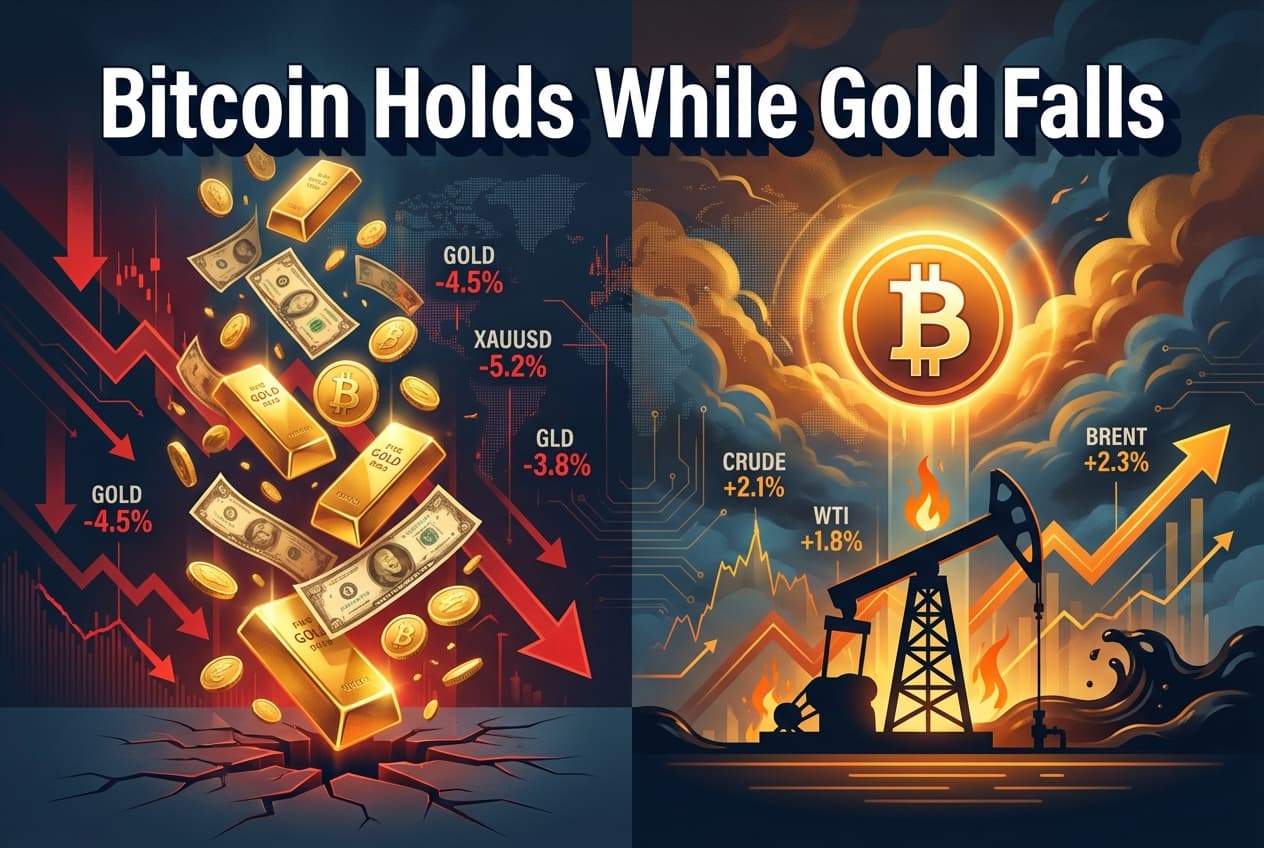
On March 19, 2026, traders woke up to a market that looked nothing like what the textbooks predicted. Bitcoin was changing hands near $69,400, down about 2.6% on the day, while gold shed 5% to hover around $4,500 per ounce, its lowest level since early February. Oil was swinging toward $100 per barrel. Silver dropped 6.6%. The CoinDesk 20 Index, a broad gauge of the crypto market, fell a comparatively modest 2.1%. Across traditional equities, the S&P 500 and Nasdaq slid nearly 1% to fresh 2026 lows. The catalyst for all of this was geopolitical: escalating Middle East tensions, including strikes on energy infrastructure, sent shockwaves through every major asset class. For investors watching multiple screens at once, the correlation between assets was breaking down in ways that were hard to ignore and even harder to position around.
⚡ Why Oil Is the Market's Real Villain Right Now
At the center of the turbulence sits crude oil, now threatening the psychologically significant $100 per barrel threshold. The proximate cause is Middle East conflict, with Iran's attacks on U.S. bases and ongoing threats to Strait of Hormuz shipping lanes rattling energy markets. For everyday consumers and investors alike, an oil spike of this magnitude has far-reaching consequences. It raises the cost of transportation, manufacturing, and food, all of which feed directly into inflation readings. When energy gets expensive, every other price tends to follow. That inflationary pressure forces central banks, particularly the Federal Reserve, into an uncomfortable position: keep interest rates elevated longer than markets had hoped. February's Producer Price Index came in at a hotter-than-expected +0.7%, further reinforcing that inflation is not done. The Fed trimmed its 2026 rate cut projections from two cuts to just one, sending the 10-year Treasury yield jumping to 4.2% and pushing the Dollar Index toward 99.9.
🪙 The Gold Paradox: Falling During a War
Gold's 5% single-day drop during an active Middle East conflict might seem like a logic puzzle. War is usually good for gold. But the March 2026 gold selloff reflects a counterintuitive dynamic playing out in real time. The oil shock fueling the conflict is simultaneously reigniting inflation, and higher inflation means higher-for-longer interest rates, which is genuinely bad for gold. Gold is a non-yielding asset, meaning it pays no interest or dividends. Its entire bull case in recent years rested on falling real yields and a weakening dollar. When the Fed signals it cannot cut rates because oil is keeping inflation sticky, both of those pillars collapse at once. Leveraged traders caught long gold were squeezed out as the dollar strengthened, amplifying the move lower. The yellow metal initially spiked on the Hormuz news, then reversed hard, illustrating just how fast the inflation narrative can overwhelm traditional safe-haven instincts. For long-term gold holders, the fundamental case remains intact, but the near-term picture is deeply uncomfortable.
₿ Bitcoin's Unusual Moment in the Spotlight
While gold was getting hammered, Bitcoin quietly held its ground in relative terms. Since the Iran conflict began, Bitcoin has outperformed gold by approximately 20%, an unusual dynamic for an asset that typically trades more like a high-beta tech stock than a safe haven. That divergence has reignited a long-running debate among institutional investors and researchers: is Bitcoin maturing into a genuine store of value? Some analysts argue that Bitcoin's decentralized, borderless, and censorship-resistant properties make it uniquely suited to periods of geopolitical stress, precisely because no government can devalue or seize it. Academic research published in recent years supports this view for certain market regimes, though results are mixed depending on the type and intensity of crisis. What's clear from the current data is that retail and institutional participants are increasingly treating Bitcoin as an alternative hedge, at least in the short run. Whether that behavior persists depends heavily on whether Bitcoin can clear and hold above $75,000.
🔍 What Smart Money Is Actually Doing
Despite Bitcoin's relative resilience, experienced traders are not piling in. Bryan Tan, a strategist at Wintermute Trading, offered a measured read on the current environment. He noted that while Bitcoin's outperformance versus gold is notable, the lack of sustained momentum above $75,000 is a warning sign. "Being flat is a strong position," Tan said, recommending that traders consider "reserving dry powder until we see a meaningful confirmation in either direction." This is the voice of institutional risk management speaking: in a headline-driven market with elevated oil-price volatility and uncertain Fed policy, chasing moves in either direction is how portfolios get damaged. For retail investors, this kind of advice is easy to dismiss during exciting price action, but it reflects a deeper truth. When the macro picture is as murky as it is today, with energy prices, inflation, and geopolitics all moving simultaneously, patience genuinely is a competitive edge.
🎯 Navigating Uncertainty Without Getting Burned
The current market environment is a stress test for every investment thesis. Bitcoin is holding up better than gold, but that does not automatically mean it is safe to buy aggressively at $69,000. Gold's unexpected decline is a reminder that even traditional safe havens can get caught wrong-footed when the macro backdrop shifts quickly. Oil near $100 per barrel threatens to keep inflation elevated and interest rates higher for longer, which historically weighs on risk assets including crypto. For traders and longer-term investors alike, the clearest takeaway from this week's action is that diversification and position sizing matter more than ever. The assets that looked bulletproof a few months ago are now showing cracks, and the assets that looked risky, like Bitcoin, are offering unexpected stability. Neither trend is guaranteed to continue. As Tan's advice underscores, waiting for genuine confirmation before committing capital is not a sign of weakness. In volatile, headline-driven markets, it is often the wisest trade you can make.
Sources
https://www.coindesk.com/markets/2026/03/19/bitcoin-holds-usd69-000-as-gold-tumbles-oil-spikes-but-analyst-says-stay-on-sidelines https://www.coindesk.com/markets/2026/02/28/bitcoin-could-see-further-downside-risks-as-iran-attacks-u-s-bases-across-middle-east https://goldsilver.com/industry-news/article/gold-price-drop-march-2026-why-gold-fell-during-an-oil-shock/ https://www.fool.com/investing/2026/03/13/is-bitcoin-now-a-safe-haven-asset-if-so-then-it-co/ https://markets.financialcontent.com/stocks/article/marketminute-2026-3-13-interest-rates-overpower-geopolitics-gold-prices-retreat-as-inflation-data-reshapes-fed-outlook
Market Munchies and Mode Mobile communications are for informational purposes only, and are not a recommendation, solicitation, or research report relating to any investment strategy, security, or digital asset. All investments involve risk including the loss of principal and past performance does not guarantee future results.
Any information contained in this commentary does not purport to be a complete description of the securities, markets, or developments referred to in this material. The information has been obtained from sources considered to be reliable, but we do not guarantee that the foregoing material is accurate or complete. There is no guarantee that any statements or opinions provided herein will prove to be correct.
Get fresh insights, breaking news, and hidden gems in the world of crypto—delivered straight to your inbox with our Crypto Cookies newsletter. Don't miss out—sign up now and get your first bite of insider knowledge! --- ALTERNATIVE HEADLINES: 1. Gold Crashes 5% While Bitcoin Shrugs Off Geopolitical Storm 2. Why Bitcoin Is Beating Gold in a War Market (And What Analysts Say to Do About It) CALL TO ACTIONS: 1. Bitcoin is outperforming gold for the first time in a major geopolitical crisis. Find out what it means for your portfolio. 2. Oil near $100, gold in freefall, Bitcoin holding steady. Is this the moment the safe-haven narrative finally shifts? TEASER PARAGRAPH: Geopolitical tensions sent markets into a spin on March 19, 2026, but the big story wasn't just the selling. Gold collapsed 5%, oil surged toward $100 per barrel, and even the S&P 500 hit fresh 2026 lows. Meanwhile, Bitcoin dropped just 2.6%, quietly outperforming every traditional safe-haven asset on the board. It sounds like good news for crypto bulls, but veteran traders are urging patience. Here's why one Wintermute strategist says doing nothing right now might be the smartest trade you can make. bitcoin, gold price drop, oil prices, geopolitical risk, Bitcoin safe haven, Middle East conflict, Federal Reserve, interest rates, inflation, market volatility, crypto markets, BTC price, Wintermute, macroeconomics