Bitcoin's 50% Drop Is Normal, Not a Crisis
📉 Historical Drawdowns Show This Is Business As Usual Bitcoin's nearly 50% plunge from its October 2025 all-time high has rattled markets, but hedge fund veteran Gary Bode argues the selloff reflects the asset's inherent volatility rather than structural weakness. In a post on…
📉 Historical Drawdowns Show This Is Business As Usual
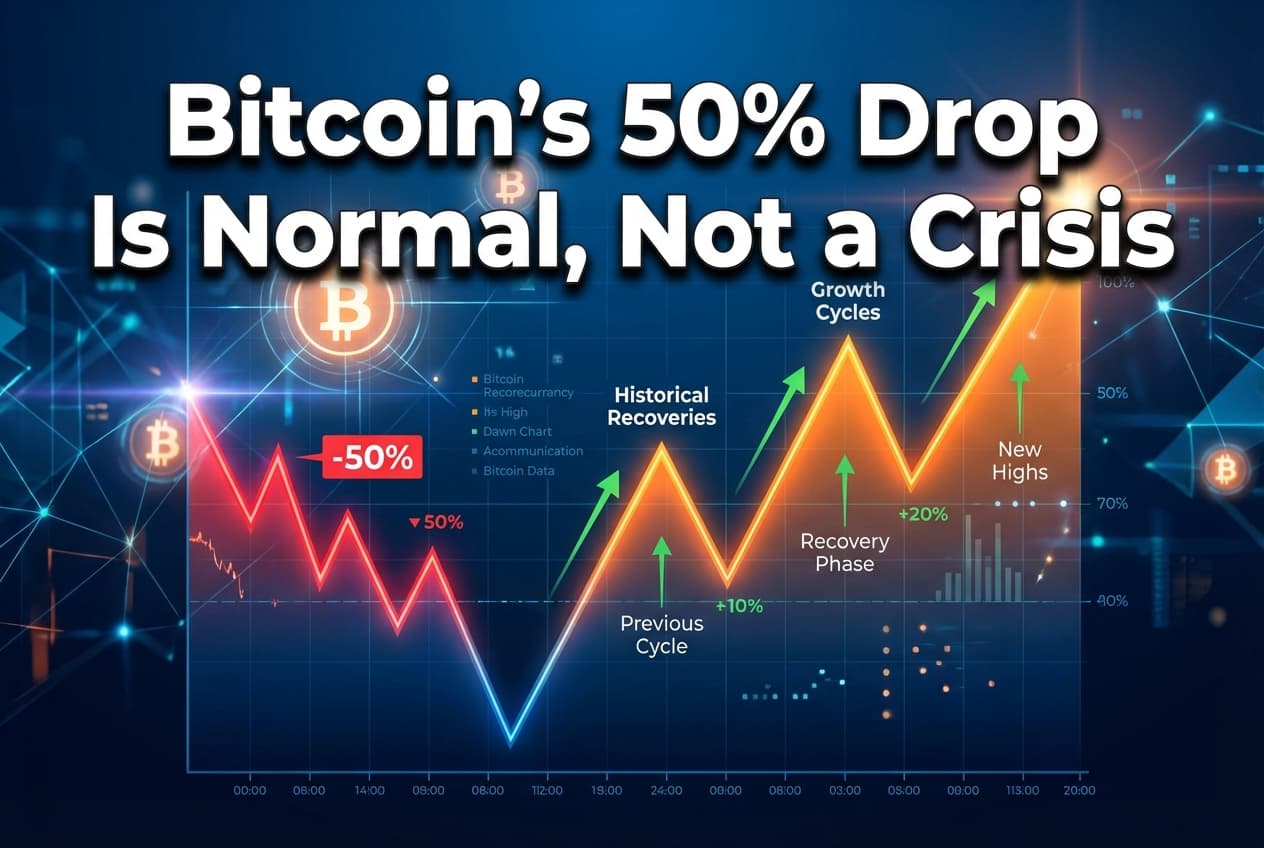
Bitcoin's nearly 50% plunge from its October 2025 all-time high has rattled markets, but hedge fund veteran Gary Bode argues the selloff reflects the asset's inherent volatility rather than structural weakness. In a post on X, Bode noted that 80% to 90% drawdowns are common in bitcoin's history. The cryptocurrency experienced a 93% decline in 2011 and an 86% to 87% drop in 2017, yet recovered to reach new peaks each time. Historical data shows bitcoin undergoes a 30% or more correction every three to six months on average. For investors who have weathered previous cycles, the current decline from $122,200 to around $68,000 represents a familiar pattern. Those willing to stomach temporary volatility have historically been rewarded with strong long-term returns. The question is not whether bitcoin will experience dramatic price swings, but whether investors can maintain conviction during them.
🏛️ Market Misread Warsh's Fed Nomination
Much of the recent turbulence can be traced to President Trump's nomination of Kevin Warsh to succeed Jerome Powell as Federal Reserve chair. Markets interpreted the move as a signal of tighter monetary policy, with investors fearing higher interest rates that would make zero-yield assets like bitcoin less attractive. Margin calls on leveraged positions amplified the decline, triggering forced selling across crypto markets. However, Bode disputes this interpretation. He pointed to Warsh's public statements supporting lower rates and notes from Trump suggesting Warsh promised a lower fed funds rate. Analysts note that while Warsh is viewed as hawkish on inflation, his stance on bitcoin is more nuanced than markets initially assumed. Combined with Congress's ongoing multi-trillion-dollar deficits, the Fed has limited ability to influence longer-term Treasury yields. Bode argued that perception, rather than fundamentals, drove much of the selling.
🐋 Whale Selling Is Profit-Taking, Not Panic
One theory circulating among traders is that early bitcoin holders who mined or purchased coins when prices were near zero are now offloading their holdings. While Bode acknowledges that large wallets have been active and some significant sellers have emerged, he frames these moves as profit-taking rather than an indication of long-term weakness. The technical skill of early adopters and miners deserves recognition, but their sales do not necessarily predict bitcoin's future trajectory. These whales accumulated bitcoin at drastically lower prices, and taking profits after holding through multiple cycles is a rational investment decision. For retail investors, whale activity can create short-term price pressure, but it also represents a transfer of ownership from early participants to a broader base of holders. The key is distinguishing between strategic profit-taking by sophisticated players and genuine capitulation that would signal deeper problems in the bitcoin ecosystem.
📊 Strategy Proxy Risk Looms Over Markets
Michael Saylor's Strategy has emerged as a potential source of short-term pressure after bitcoin slid below the prices at which the company purchased many of its holdings. The company's stock fell sharply during the recent decline, prompting fears that Saylor might be forced to sell bitcoin to meet obligations or investor pressure. Bode described this risk as real but limited, comparing it to when Warren Buffett buys a large stake in a company. Investors appreciate the support from a high-profile holder, but worry about eventual sales creating downward pressure. However, Bode stressed that bitcoin itself would survive such events, though prices could temporarily dip. Strategy's concentrated position makes it a barometer for institutional conviction, and any significant selling would likely be telegraphed well in advance. For now, the bigger risk is perception rather than actual forced liquidation.
📄 Paper Bitcoin Increases Supply Without Changing Hard Cap
The rise of paper bitcoin through exchange-traded funds and derivatives has increased the effective supply available for trading without altering bitcoin's hard cap of 21 million coins. While these instruments make bitcoin more accessible to traditional investors, they also create downward pressure on prices in the short term. Bode drew parallels to the silver market, where increased paper trading initially suppresses prices until physical demand pushes them higher. The distinction between owning actual bitcoin and holding an ETF or derivative becomes critical during periods of stress. Analysts note that paper bitcoin can influence short-term prices, but the fundamental scarcity of 21 million coins remains unchanged. For long-term holders, the proliferation of paper instruments represents a temporary headwind rather than a permanent threat to bitcoin's value proposition as a scarce digital asset.
🎯 Volatility Is a Feature, Not a Bug
Bode's assessment frames the recent decline as a natural consequence of bitcoin's design rather than evidence of a systemic crisis. While critics argue that volatility disqualifies bitcoin from being a store of value, Bode counters that nearly every asset carries risk, including fiat currencies backed by heavily indebted governments. Gold requires energy to secure unless you are comfortable leaving it on your front porch, and traditional stores of value face inflation and counterparty risks. Bitcoin is permissionless and requires no trust in a counterparty, making it fundamentally different from government-backed alternatives. The current selloff represents a test of investor conviction rather than a breakdown in bitcoin's core value proposition. For traders, the key takeaway is that price swings, no matter how dramatic, are not necessarily signals of systemic risk. Those who understand bitcoin's volatility as an intrinsic feature can position themselves to benefit from eventual recoveries, while those seeking stable returns may need to look elsewhere.
Sources
https://www.coindesk.com/markets/2026/02/07/bitcoin-s-50-drop-isn-t-a-crisis-says-hedge-fund-veteran-gary-bode https://www.radom.com/insights/implications-of-kevin-warsh-s-potential-federal-reserve-appointment-on-cryptocurrency-markets https://www.hedgeco.net/news/02/2026/bitcoin-loses-half-its-value-in-three-months-inside-the-2026-crypto-crunch.html
Market Munchies and Mode Mobile communications are for informational purposes only, and are not a recommendation, solicitation, or research report relating to any investment strategy, security, or digital asset. All investments involve risk including the loss of principal and past performance does not guarantee future results.
Any information contained in this commentary does not purport to be a complete description of the securities, markets, or developments referred to in this material. The information has been obtained from sources considered to be reliable, but we do not guarantee that the foregoing material is accurate or complete. There is no guarantee that any statements or opinions provided herein will prove to be correct.
Get fresh insights, breaking news, and hidden gems in the world of crypto—delivered straight to your inbox with our Crypto Cookies newsletter. Don't miss out—sign up now and get your first bite of insider knowledge!