Boom, Bust, or Both? Why the AI Economy Feels Like Déjà Vu for Investors
🤖 Same Circus, Smarter Clowns Every few decades, the market dusts off the same old script, swaps a few buzzwords, and calls it innovation. In 1999, it was “dot-com.” In 2025, it’s “ AI boom vs bust .” The props have changed—floppy disks replaced by neural chips—but the plot…
🤖 Same Circus, Smarter Clowns
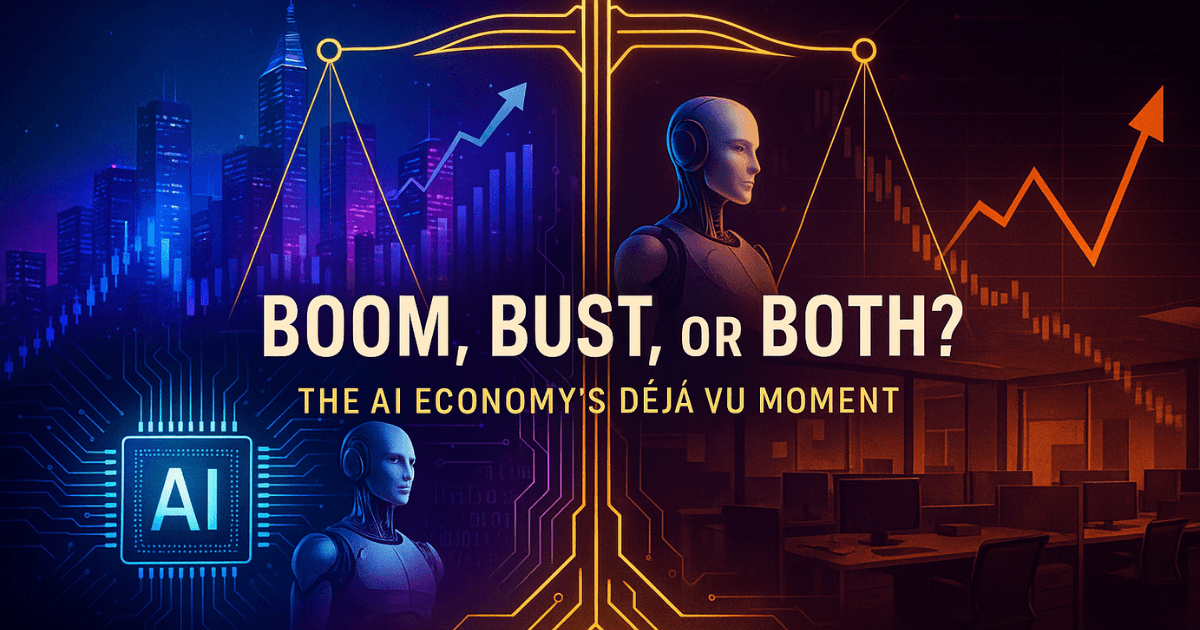
Every few decades, the market dusts off the same old script, swaps a few buzzwords, and calls it innovation. In 1999, it was “dot-com.” In 2025, it’s “AI boom vs bust.” The props have changed—floppy disks replaced by neural chips—but the plot feels uncannily familiar: sky-high AI valuations, visionary CEOs, and investors convinced this time it’s different. Meanwhile, behind the curtain, companies are quietly downsizing, consolidating, and “realigning” toward the future. Translation: the robots are getting promoted. From Silicon Valley to London, it’s a modern-day déjà vu—except this time, the bubble talks back.
💻 The Dual Reality of the AI Economy
It’s hard not to miss the irony of the AI economy risk. On the one hand, boardrooms are buzzing about AI-fueled productivity, record levels of investment in artificial intelligence, and the dawn of a smarter market. On the other hand, HR departments are quietly printing redundancy letters as tech sector job cuts rise again. Charter Communications has announced 1,200 job cuts—roughly 1% of its workforce—as part of a tech layoffs 2025 cost-cutting exercise aimed at streamlining operations. Broadcom, fresh off its AI startup investment surge and a high-profile partnership with OpenAI, is letting go of 247 employees in Palo Alto. The juxtaposition is striking: in an era obsessed with automation, tech restructuring is now driven by the very technology it once created. WProgress may, for thousands of workers, be a polite corporate rebrand of redundancy. Bloomberg Intelligence calls it a “second-wave recalibration,” a shift from headcount to hardware and from legacy software to AI-first platforms. Investing in tech restructuring has become less about growth and more about margin optimization—profit margins are the new holy grail; sentiment, the new currency. 💡 Smart Capital Signal: In a world where AI stock bubble headlines dominate, the best investors stay grounded in fundamentals. Efficiency doesn’t always mean expansion—sometimes it’s consolidation wearing a shinier suit.
📈 The Sky-High AI Trade and the Thin Air Beneath
The Financial Times recently highlighted a red flag beneath the euphoria: AI-linked firms now make up nearly 40% of the Nasdaq-100’s total market cap, a concentration unseen since the early 2000s. A handful of giants—Nvidia, Microsoft, Amazon, and Broadcom—are driving Nasdaq's AI concentration. Meanwhile, PitchBook data shows an AI startup investment surge of $22.6 billion in Q3 2025, up nearly 50% year over year. Yet insiders have quietly sold over $6 billion in AI-related stock since August. The public sees growth; insiders see an exit. Investors have seen this film before—it just used to star dot-coms, not data models. 💼 Tactical Insight: Artificial intelligence investing is thrilling until the oxygen thins. Diversification isn’t glamorous, but it’s the seatbelt when markets start to rattle.
🏦 The Bank of England Sounds the Alarm
In its latest Financial Stability Report, the Bank of England warned that markets are “dangerously exposed to sentiment-driven assets.” Translation: AI valuations warning. Investors are pricing AI like it’s magic, not mathematics. Deputy Governor Sarah Breeden cautioned that AI-heavy portfolios are “extended relative to productivity gains” and could unwind fast if central banks delay rate cuts. The message echoed across London and Wall Street: when central bankers start name-dropping AI stocks, you know the bubble chatter isn’t far off. 🏁 Investor Radar: AI economy risk isn’t doom and gloom—it’s data-driven prudence. When the Bank of England AI warning makes the front page, portfolios should be more balanced than buzzed.
⚠️ The Ghost of Bubbles Past
The Economic Times and CNBC analysts are now comparing the AI investment frenzy to the 1999 tech bubble. AI-themed ETFs have tripled inflows since 2023, and retail investors hold nearly 30% of AI fund assets. The enthusiasm is impressive; the herd behavior is familiar. Nomura Research went further:
“If AI productivity fails to match current valuations, the correction could be faster—and broader—than 2008.”
This isn’t speculation—it’s arithmetic. Every bubble begins with belief and ends with math. 📊 Strategic Cue: Investing in AI stocks can pay off handsomely, but don’t mistake momentum for immunity. The AI boom vs. bust debate isn’t about who’s right—it’s about who’s still solvent when the music stops.
👓 When AI Gets Real: The AR Retail Revolution
While headlines chase hype, applied AI retail is quietly proving its worth. Perfect Corp., the company behind the YouCam app, just launched its AI + AR virtual try-on technology, integrating 13,000 eyewear SKUs from brands like Ray-Ban, Oakley, and Warby Parker. Using real-time 3D facial mapping and generative rendering, it lets shoppers see how frames fit—without leaving the couch. CEO Alice Chang revealed that adoption has tripled year over year, demonstrating that virtual try-on technology can bridge commerce and computing. 🧭 Market Lens: This is where the AI economy gets tangible. Applied AI retail and AR AI retail try-on show that innovation linked to cash flow—not just code—drives durable value.
🥂 Boom, Bust… or Balance?
The AI investment frenzy is a paradox: tech layoffs in 2025 in the morning, record AI valuations by noon, and market correction AI warnings by dinner. Investors are trying to decode whether this is a revolution or a recession. The truth is—it’s both. The AI stock bubble narrative and the applied AI retail reality are unfolding simultaneously. Smart investors aren’t picking sides; they’re balancing hype with hedge. Because history rarely repeats exactly—but it does love a reboot. 📚 Sources
- Reuters – Charter lays off around 1,200 employees to streamline corporate roles
- San Francisco Chronicle – Tech giant cuts nearly 250 Palo Alto jobs days after OpenAI deal
- Financial Times – “Of course it’s a bubble”: AI startup valuations soar in unprecedented funding wave
- The Guardian – Bank of England warns of growing risk that AI bubble could burst
- Associated Press – Is there an AI bubble? Financial institutions sound a warning
- Business Wire – Perfect Corp. Releases Virtual Try-On for Glasses Update with New In-Platform Product Library Featuring Over 13,000 Pre-Loaded Glasses SKUs
- Reuters – AI venture funding continued surge in third quarter, data shows (Oct 6 2025
Market Munchies and Mode Mobile communications are for informational purposes only, and are not a recommendation, solicitation, or research report relating to any investment strategy, security, or digital asset. All investments involve risk including the loss of principal and past performance does not guarantee future results.
Any information contained in this commentary does not purport to be a complete description of the securities, markets, or developments referred to in this material. The information has been obtained from sources considered to be reliable, but we do not guarantee that the foregoing material is accurate or complete. There is no guarantee that any statements or opinions provided herein will prove to be correct.