CES 2026 Signals the Next Phase of AI Investing—And It’s Not About Software
If AI is everywhere already, why are investors suddenly paying attention to robots, hardware, and data centers instead? Every January, something familiar happens in markets. Trading volumes are thin. Conviction softens. Investors scan headlines with one eye while the calendar…
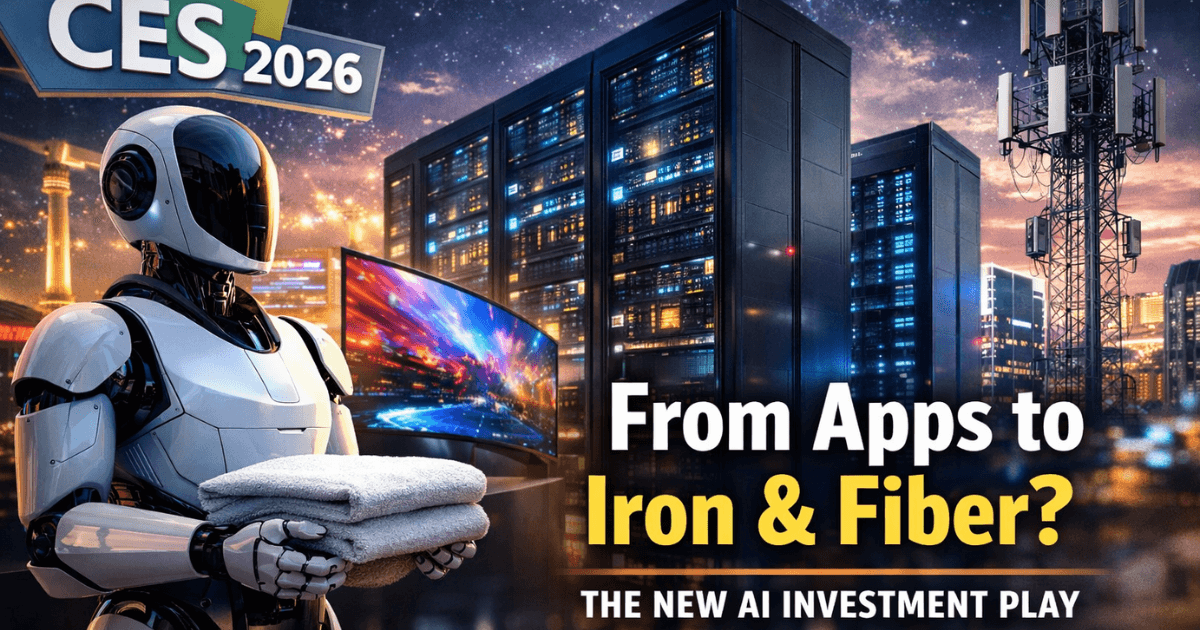
If AI is everywhere already, why are investors suddenly paying attention to robots, hardware, and data centers instead?
Every January, something familiar happens in markets. Trading volumes are thin. Conviction softens. Investors scan headlines with one eye while the calendar still feels half-closed. Then CES arrives. Not with answers—but with clues. As CES 2026 approaches, the conversation around AI investing has shifted in a way that feels easy to miss. Artificial intelligence is no longer competing for belief. That debate is over. The more interesting question now sounds quieter, almost boring by comparison: Where does AI actually live? Because the latest signals suggest the next phase of AI growth won’t be led by software upgrades or model releases. It will be driven by physical deployment, infrastructure ownership, and applied intelligence that shows up in the real world. That’s where the capital is starting to reposition.
CES 2026 Moves AI From Screens to Physical Space
CES has always been good at spectacle. What feels different now is restraint. Early previews point toward AI robotics, autonomous systems, and embedded intelligence designed to operate continuously—not impress briefly. The emphasis sits firmly on physical AI adoption, where machines assist, navigate, respond, and integrate into daily environments. Smart home AI devices. Robotics platforms. AI-driven hardware built for repetition rather than novelty. Artificial intelligence is no longer something users interact with. It’s something that quietly works around them. Investor Radar: Markets tend to underestimate the phases of applied technology. Robotics and hardware adoption often start slowly, then scale with surprising durability.
Big Tech Isn’t Chasing Attention—It’s Defending Position
Major players arriving at CES are no longer trying to prove relevance. They’re protecting it. Companies like Samsung, Sony, and NVIDIA are expected to emphasize AI hardware, edge computing, and platform-level ecosystems that stretch far beyond individual devices. The strategy feels deliberate. Fewer hero products. More connective tissue. AI-powered displays, robotics platforms, and wearables increasingly function as gateways into broader data and services stacks. Once embedded, switching costs rise quietly. Tactical Insight: Platform positioning often compresses short-term margins while strengthening long-term pricing power—an uncomfortable but familiar trade-off.
LG’s Home Robot Isn’t a Gimmick—It’s a Signal
One of the clearest directional tells comes from LG Electronics. Its upcoming AI-powered home robot isn’t marketed as futuristic theater. The pitch is practical: reducing household effort through automation and folding laundry. Retrieving items. Coordinating smart appliances. Learning routines. Nothing flashy. Everything is intentional. Mass adoption may take time. Direction, however, feels settled. Smart Capital Signal: Consumer robotics shifting from novelty to utility suggests broader acceptance of AI robotics investment strategies rooted in function rather than fascination.
SoftBank’s Infrastructure Bet Explains the Real AI Trade
While CES handles the visible layer, SoftBank Group quietly placed one of the more revealing AI bets by acquiring DigitalBridge. The logic wasn’t software. Or models. Or hype. It was infrastructure. Data centers. Fiber networks. Connectivity. The physical backbone is required to support increasingly compute-intensive AI workloads. As AI adoption scales, constraints shift from algorithms to energy, latency, and capacity. Owning the rails becomes strategically valuable—regardless of which model dominates. Infrastructure Lens: AI infrastructure investment tends to trade excitement for stability, offering exposure to growth with more predictable economics.
Seasonal Markets Often Reveal Long-Term Truths
Holiday periods do something useful to markets. They mute the noise. Lower liquidity strips momentum from the equation and forces investors to focus on structure. Right now, the structure suggests consolidation rather than acceleration. AI is settling into its operational phase. Next-generation consumer tech trends now prioritize durability, integration, and scale. Not louder. Just deeper. Investor Context: Transitions from hype to infrastructure often mark the point where long-term capital quietly steps in.
AI Is Growing Up—and Portfolios Should Notice
Artificial intelligence isn’t disappearing into the background. It’s embedding itself into systems that don’t need attention to remain valuable. Robotics that assist. Hardware that endures. Infrastructure that compounds quietly. Fewer headlines. More balance-sheet relevance. Markets often misprice that phase—until they don’t.
Why the Next Phase of AI Investing Looks Boring—and That’s the Point
The most investable AI stories rarely sit under the brightest lights
CES 2026 hints at where AI meets everyday life. LG shows how intelligence becomes useful. SoftBank reveals where scale actually lives. Together, they tell a consistent story: AI’s next phase isn’t about software dominance. It’s about physical presence, infrastructure ownership, and execution at scale. For investors, that shift doesn’t demand urgency. It rewards patience, selectivity, and perspective. And historically, those are the positions that age best.
Sources
- CES AI & robotics outlook – Yahoo Tech
- CES 2026 investor preview – Investors.com
- LG CLOiD home robot announcement
- SoftBank DigitalBridge acquisition
- AI infrastructure analysis – Computerworld
Market Munchies and Mode Mobile communications are for informational purposes only, and are not a recommendation, solicitation, or research report relating to any investment strategy, security, or digital asset. All investments involve risk including the loss of principal and past performance does not guarantee future results.
Any information contained in this commentary does not purport to be a complete description of the securities, markets, or developments referred to in this material. The information has been obtained from sources considered to be reliable, but we do not guarantee that the foregoing material is accurate or complete. There is no guarantee that any statements or opinions provided herein will prove to be correct.