Coinbase Withdraws Support for Senate Crypto Bill Hours Before Markup
📋 Last-Minute Reversal Shakes Senate Banking Committee Coinbase CEO Brian Armstrong announced Wednesday night that the exchange could not support sweeping cryptocurrency legislation under consideration by the Senate Banking Committee. The decision came just hours before a…
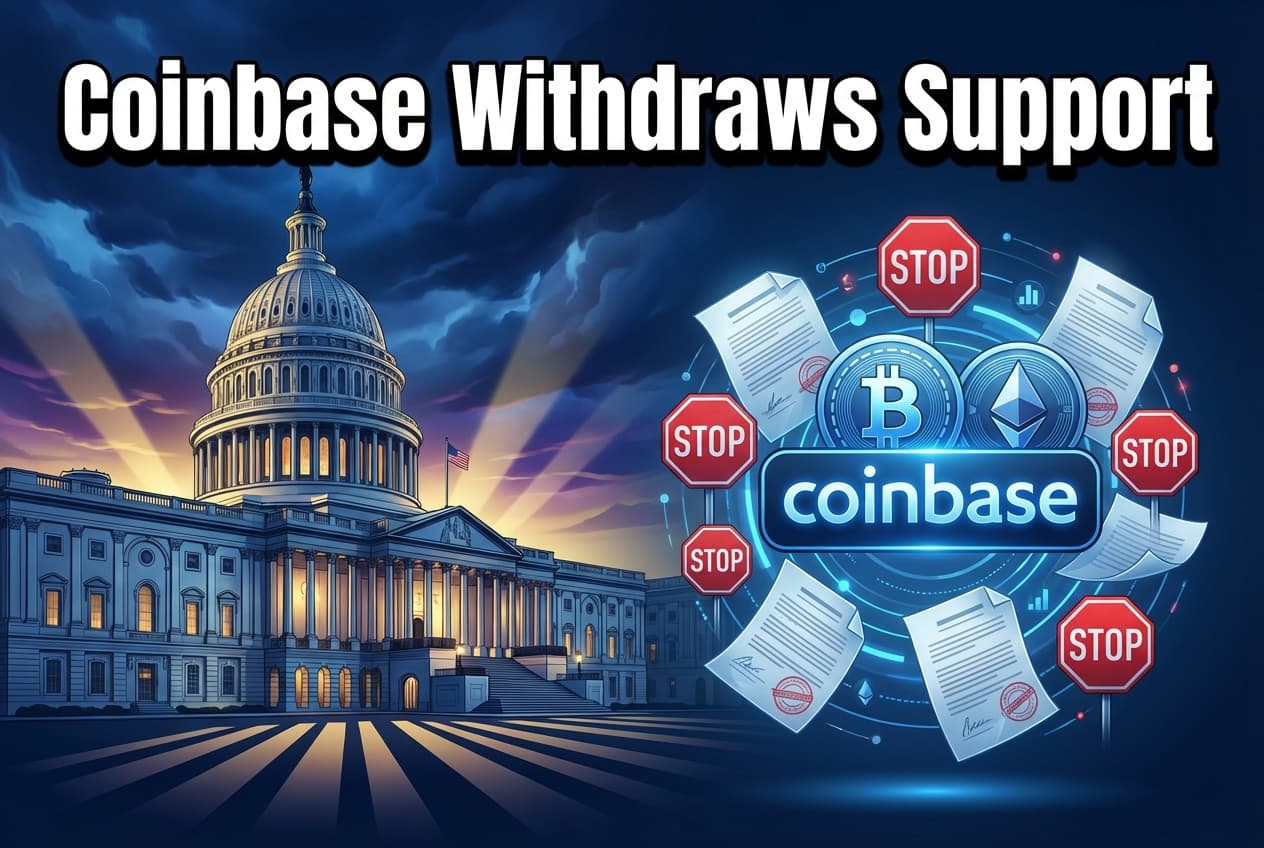
📋 Last-Minute Reversal Shakes Senate Banking Committee
Coinbase CEO Brian Armstrong announced Wednesday night that the exchange could not support sweeping cryptocurrency legislation under consideration by the Senate Banking Committee. The decision came just hours before a scheduled markup session on Thursday, sending shockwaves through an industry that had been counting on regulatory clarity. Armstrong cited four major concerns including treatment of tokenized equities, DeFi provisions, stablecoin reward restrictions, and the role of the Securities and Exchange Commission. For investors and industry participants who spent months advocating for this bill, the withdrawal represents a significant setback in efforts to establish clear rules for digital assets. The timing pressure became especially acute after the bill text was released Monday night, giving stakeholders less than 72 hours to review more than 270 pages of dense regulatory language before amendments were due Tuesday afternoon.
⚖️ Four Critical Issues Drove the Decision
The decision to pull support was not made lightly, according to a source familiar with the matter who spoke to The Block. Concerns crystallized when stakeholders saw the full bill text for the first time Monday evening. Whole sections appeared that raised immediate red flags, including a new chapter focused on illicit finance that industry observers found problematic. Armstrong specifically pointed to provisions he said would "kill rewards on stablecoins," a feature that has become central to many crypto platforms' business models and generates roughly $1.3 billion in annual revenue for Coinbase alone. The stablecoin yield debate has emerged as a flashpoint between traditional banks worried about deposit flight and crypto firms defending innovation. Additionally, concerns about DeFi oversight and tokenized securities provisions suggested the bill could be materially worse than the current regulatory status quo, a conclusion that ultimately prompted Coinbase's public opposition.
🏛️ Banking Committee Postpones Markup Amid Industry Pushback
Later Wednesday night, Senate Banking Committee Chairman Tim Scott announced the markup had been postponed. "I've spoken with leaders across the crypto industry, the financial sector, and my Democratic and Republican colleagues, and everyone remains at the table working in good faith," Scott said in a statement. The decision reflected the reality that necessary votes were simply not there. Democratic Senator Ruben Gallego, a key negotiator, told reporters he was scheduled to meet with Patrick Witt, executive director of the President's Council of Advisors for Digital Assets, but Witt did not attend the meeting. Gallego added that as of Wednesday evening, he could not support the bill in its current form. For traders watching legislative developments, the postponement buys time but also injects uncertainty into markets that have been anticipating regulatory clarity. The American Bankers Association had been lobbying hard to close perceived loopholes around stablecoin interest payments, with more than 10,000 bankers sending letters to Senate offices in recent days.
🏦 Stablecoin Rewards Become Central Battleground
The stablecoin yield restriction has emerged as perhaps the most contentious provision in the bill. Traditional banks argue that allowing crypto platforms to pay interest on stablecoin balances creates regulatory arbitrage that threatens community banking systems and local lending. The legislation builds on last year's Genius Act, which established a framework for payment stablecoins but left open questions about yield-bearing features. Banks fear these products could drain deposits from the traditional banking system, reducing capital available for mortgages and business loans in local communities. For crypto platforms, however, stablecoin rewards represent both a competitive advantage and a core value proposition for users who have come to expect yields on their digital dollar holdings. The restriction could force platforms to fundamentally redesign their product offerings or risk losing customers to offshore competitors operating under more permissive regulatory regimes. Investors watching the stablecoin sector should recognize that this debate will shape the competitive landscape for years, potentially determining which business models can survive in the U.S. market.
🔍 DeFi and Tokenized Securities Add Complexity
Beyond stablecoins, the bill's treatment of decentralized finance and tokenized securities raised alarm bells for Coinbase and other stakeholders. Armstrong warned that some provisions could grant the government "unlimited access to personal financial records," eroding user privacy protections that many in the crypto community consider foundational. The legislation attempts to clarify jurisdictional boundaries between the Commodity Futures Trading Commission and the Securities and Exchange Commission, a long-standing source of confusion in digital asset markets. However, critics argue the current draft tilts too heavily toward SEC authority, potentially stifling innovation in areas like DeFi protocols and tokenized real-world assets. For developers building on blockchain infrastructure, regulatory uncertainty around which assets qualify as securities versus commodities creates existential business risk. The bill's approach to DeFi oversight particularly concerns protocol builders who argue that decentralized systems cannot comply with traditional intermediary-focused regulations without sacrificing the very characteristics that make them decentralized. This tension between innovation and investor protection remains one of the central challenges facing crypto regulation.
🎯 What Comes Next for Crypto Regulation
Despite the setback, stakeholders across the industry emphasized their commitment to continuing negotiations. The source familiar with Coinbase's thinking said the issues are fixable but need to be resolved before the next committee markup. The expectation is not to achieve 100% consensus but to reach a version that is "good enough" to move forward without creating more problems than it solves. Ripple CEO Brad Garlinghouse posted on X that his company remains "at the table and will continue to move forward with fair debate," expressing optimism that issues can be resolved through the markup process. For investors, the postponement extends the period of regulatory uncertainty that has characterized U.S. crypto markets for years. However, it also prevents the passage of legislation that key industry players believe would have been counterproductive. The coming weeks will be critical as senators, industry representatives, and banking groups attempt to find common ground on stablecoin yields, DeFi oversight, and privacy protections. Traders should watch for signals about whether meaningful compromise is possible or whether the bill will remain stalled, leaving the industry to navigate the existing patchwork of enforcement actions and regulatory guidance.
Sources
https://www.theblock.co/post/385704/coinbase-pulled-support-what-happened https://bankingjournal.aba.com/2026/01/senate-banking-committee-postpones-vote-on-crypto-market-structure-bill/ https://www.forbes.com/sites/jasonbrett/2026/01/14/coinbase-pulls-support-night-before-senate-markup-of-market-structure/ https://www.ainvest.com/news/battle-crypto-regulation-defi-stablecoin-clauses-2026-senate-market-structure-bill-2601
Market Munchies and Mode Mobile communications are for informational purposes only, and are not a recommendation, solicitation, or research report relating to any investment strategy, security, or digital asset. All investments involve risk including the loss of principal and past performance does not guarantee future results.
Any information contained in this commentary does not purport to be a complete description of the securities, markets, or developments referred to in this material. The information has been obtained from sources considered to be reliable, but we do not guarantee that the foregoing material is accurate or complete. There is no guarantee that any statements or opinions provided herein will prove to be correct.
Get fresh insights, breaking news, and hidden gems in the world of crypto—delivered straight to your inbox with our Crypto Cookies newsletter. Don't miss out—sign up now and get your first bite of insider knowledge!