Could Binance Get Its $4.3 Billion Back After CZ's Trump Pardon?
🏛️ The Pardon That Sparked a Billion-Dollar Question President Donald Trump's pardon of Binance founder Changpeng "CZ" Zhao on October 23, 2025, eliminated the criminal consequences of his Bank Secrecy Act conviction. CZ served four months in a low-security California facility…
🏛️ The Pardon That Sparked a Billion-Dollar Question
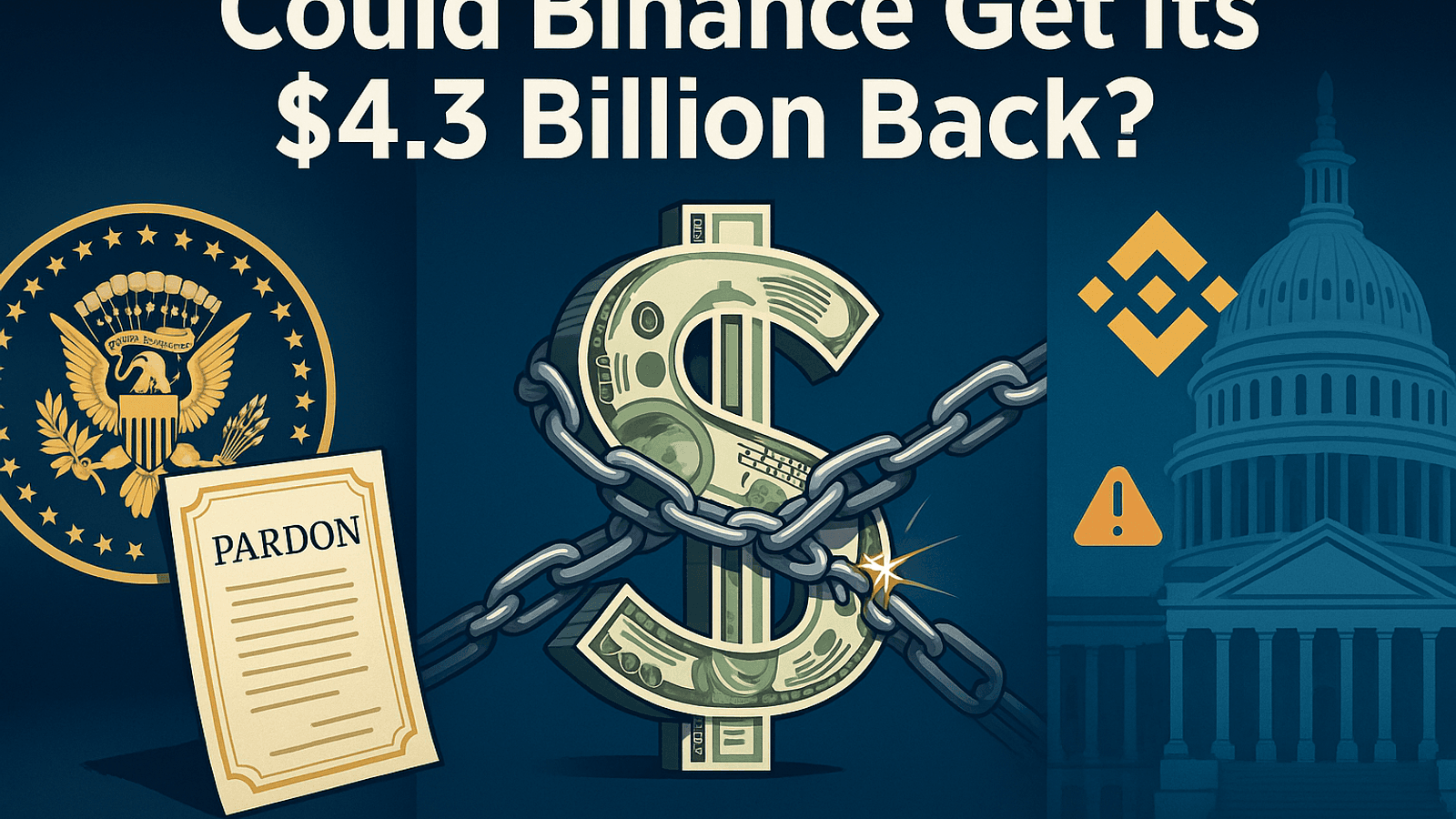
President Donald Trump's pardon of Binance founder Changpeng "CZ" Zhao on October 23, 2025, eliminated the criminal consequences of his Bank Secrecy Act conviction. CZ served four months in a low-security California facility after pleading guilty to running an ineffective anti-money laundering program. The pardon erased his remaining legal exposure, but it left intact the massive $4.3 billion settlement that Binance paid to U.S. agencies in 2023. On X, CZ addressed the possibility of a refund with a casual quip, saying any recovered funds would be reinvested in America. For crypto investors watching this case, the real question isn't whether CZ is grateful, but whether a pro-crypto White House could actually unwind the largest enforcement action ever brought against a cryptocurrency exchange.
💰 Where the Money Actually Went
The $4.3 billion figure isn't sitting in one government account waiting to be refunded. Binance's settlement was split across multiple federal agencies, each with separate legal instruments. The Department of Justice collected roughly $4.316 billion in criminal forfeiture and fines from Binance corporate. Treasury's Financial Crimes Enforcement Network imposed a $3.4 billion civil penalty and mandated that the main Binance exchange exit U.S. markets entirely. The Office of Foreign Assets Control added a $968.6 million sanctions settlement with five years of compliance monitoring. The Commodity Futures Trading Commission secured $2.7 billion split between penalties and disgorgement, plus a $150 million personal fine against CZ. These numbers overlap because DOJ credited some amounts toward parallel Treasury and CFTC resolutions. For investors and traders, this complexity matters because unwinding these payments would require coordinated action across multiple institutions, not just a presidential signature.
⚖️ Legal Limits of Presidential Pardons
Presidential pardons are powerful, but they don't function as refund buttons. Constitutional law distinguishes between eliminating future penalties and recovering past payments. A 1877 Supreme Court case, Knote v. United States, established that money already paid into the U.S. Treasury can only be withdrawn through congressional appropriation. That doctrine remains active today. Federal judges rejected similar refund claims from January 6 defendants who received clemency but wanted their fines back. The courts ruled that pardons don't make original convictions or payments "erroneous." Legal scholars note that standard full pardons differ from explicit remissions of fines, and even remissions historically apply only to unpaid amounts. For Binance, this means CZ's pardon covers his personal criminal case but doesn't automatically reach the corporate penalties or civil settlements imposed by Treasury and the CFTC. Investors should understand that recovering already-collected funds would require either new legislation from Congress or creative reinterpretation of century-old precedent.
🔄 How a Refund Could Actually Happen
Despite the legal obstacles, a Trump administration could pursue several pathways to effectively return money to Binance. The White House could issue additional clemency documents that explicitly remit any unpaid criminal fines for CZ personally. More controversially, the president could test whether corporations can receive clemency, drawing on sparse historical precedent compiled in congressional research. Trump's team could also instruct the DOJ and Treasury to renegotiate existing consent orders. Court-approved settlements can be modified if both parties agree and a judge approves the changes. For Binance, this could mean shortening or terminating the three-year DOJ monitorship, which sources say is already under discussion for early termination. FinCEN and OFAC could adjust their five-year monitoring requirements or soften the complete U.S. market exit mandate. While these moves wouldn't generate a literal cash refund, they would reduce compliance overhead and free up capital, delivering financial benefits that function like a partial repayment. Traders should watch for any official announcements about monitorship modifications as an early signal of regulatory softening.
🤝 The Trump Family Connection Complicates Everything
Any refund effort faces immediate scrutiny because of financial ties between Binance and Trump-linked crypto ventures. In May 2025, Abu Dhabi's state-backed MGX fund invested $2 billion in Binance using USD1, a stablecoin issued by World Liberty Financial, the Trump family's DeFi project. That transaction now represents three-quarters of all USD1 coins in circulation and generates approximately $80 million annually in interest payments to Trump-affiliated entities. The Wall Street Journal reported that Binance not only facilitated the settlement but may have helped build the underlying technology for USD1. Democratic lawmakers, including Senators Elizabeth Warren and Adam Schiff, introduced a resolution rebuking CZ's pardon and calling it "blatant corruption." For institutional investors evaluating regulatory risk, this political dynamic matters. A refund or quasi-refund of public enforcement proceeds to Binance would flow into an ecosystem where Trump-linked businesses are active counterparties. Ethics experts and congressional oversight committees will scrutinize any moves that could be characterized as rewarding a Trump family business partner.
🎯 What This Means for Crypto Enforcement Going Forward
The Binance case served as the flagship AML and sanctions enforcement action under the previous administration. Treasury called it FinCEN's largest virtual asset settlement in history, framing it as a model for cleaning up offshore exchanges. Under Trump's second term, analysis from Galaxy Digital and law firm Pillsbury suggests a shift toward "clarity over crackdowns," with greater emphasis on rulemaking rather than headline prosecutions. If Binance successfully pursues relief, either through refunds, modified monitorships, or softened consent orders, other exchanges will take note. For investors, this signals a fundamental change in how U.S. regulators approach crypto enforcement. The question isn't just whether Binance gets money back, but whether past enforcement deals can be renegotiated when political winds shift. Globally, financial regulators in Europe and Asia that treat U.S. sanctions and AML regimes as anchors may tighten their own oversight if they conclude American enforcement outcomes are re-tradable through politics. For now, the $4.3 billion remains with the U.S. government. Whether any of it returns to Binance depends less on legal precedent and more on how aggressively the Trump administration is willing to test constitutional boundaries and weather political backlash.
Sources
https://cryptoslate.com/binance-would-invest-4-3-billion-in-america-if-it-gets-a-refund-after-cz-pardon/ https://decrypt.co/348905/binance-founder-cz-addresses-delicate-question-of-4-3b-fine-following-trump-pardon https://www.factcheck.org/2025/11/addressing-trumps-claims-about-the-pardon-of-binance-founder/ https://www.cnbc.com/2025/10/23/trump-pardons-binance-founder-cz-zhao.html https://www.cnbc.com/2025/11/04/binance-ceo-richard-teng-denies-changpeng-zhao-trump-crypto-project-cz-pardon-world-liberty-financial-mgx-.html
Market Munchies and Mode Mobile communications are for informational purposes only, and are not a recommendation, solicitation, or research report relating to any investment strategy, security, or digital asset. All investments involve risk including the loss of principal and past performance does not guarantee future results.Any information contained in this commentary does not purport to be a complete description of the securities, markets, or developments referred to in this material. The information has been obtained from sources considered to be reliable, but we do not guarantee that the foregoing material is accurate or complete. There is no guarantee that any statements or opinions provided herein will prove to be correct.Hungry for the latest in crypto? Get fresh insights, breaking news, and hidden gems in the world of crypto—delivered straight to your inbox with our Crypto Cookies newsletter.Don’t miss out—sign up now and get your first bite of insider knowledge!