CPI Cools as AI Anxiety Still Drives the Market Mood
Thursday’s session had the feel of a market that wanted to breathe, but could not stop checking its pulse. Big tech slid again, volatility crept back, and investors kept rotating from “growth at any price” to “show me the cash flow,” with AI disruption fears expanding from…
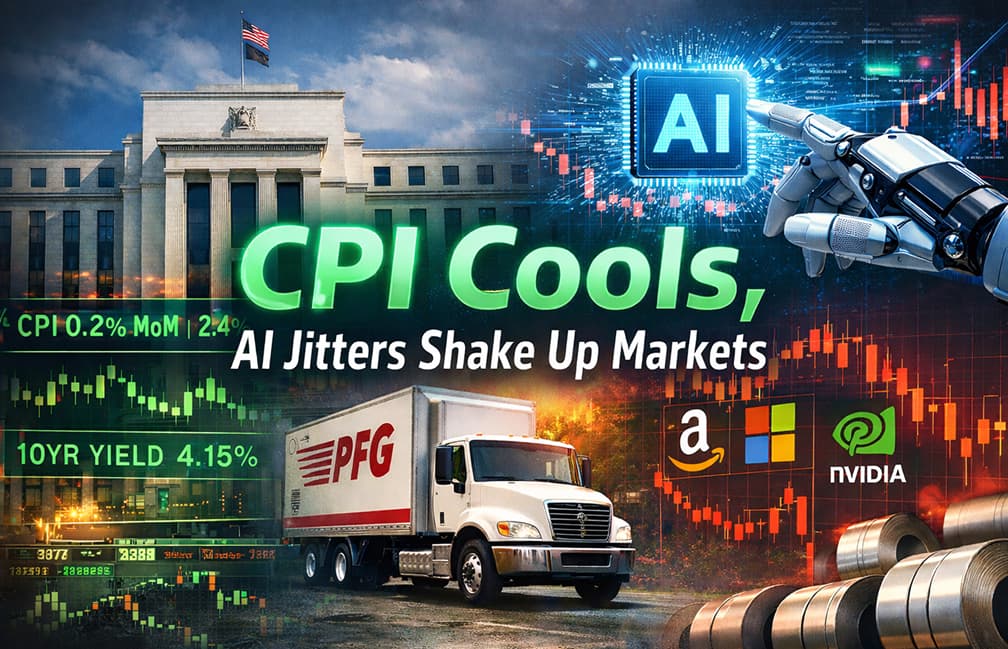
Thursday’s session had the feel of a market that wanted to breathe, but could not stop checking its pulse. Big tech slid again, volatility crept back, and investors kept rotating from “growth at any price” to “show me the cash flow,” with AI disruption fears expanding from software into adjacent corners of the market.
Then came the catalyst everyone was waiting for: January’s CPI print. The headline came in cooler than the prior month’s pace, and core inflation stayed restrained enough to keep the “Fed can cut later this year” narrative alive. That did not instantly undo the risk-off tone, but it did reduce the odds of a renewed bond-yield surge forcing another equity repricing.
In other words, inflation did its job by not making things worse. The bigger question is whether the market’s current drawdown is mostly about macro uncertainty, or whether it is about investors reassessing who really gets paid in the AI boom, and who gets disrupted by it.
Stock of Interest Today: Performance Food Group Company (PFGC)
Performance Food Group is not a flashy story, and that is part of the appeal in a market that is punishing crowded narratives. The company is one of North America’s largest food distributors, operating 150+ locations and serving 300,000+ customer locations across its Foodservice, Convenience, and Specialty businesses. Management pegs its total addressable market at roughly $787 billion, which matters because scale and route density tend to compound quietly over time in distribution.
The latest quarter shows steady demand but uneven near-term optics. In fiscal Q2 2026, PFG posts net sales of about $16.4 billion, up 5.2% year over year, with gains across segments (Foodservice and Convenience lead on case growth). Adjusted EBITDA rises to $451.2 million. The company also notes a “challenging consumer environment” and deflation in key categories, which can complicate pricing and mix even when volumes are growing.
The market’s negative reaction to the print is largely about execution timing, not the long runway. Commentary around the quarter points to higher-than-expected integration costs tied to the Cheney Brothers acquisition and continued deflation pressure in categories like cheese and poultry. That combination can squeeze margins and spook investors who wanted cleaner operating leverage.
The longer-term framing is where the bull case lives. Management reiterates FY2028 targets of $73 billion to $75 billion in revenue and $2.3 billion to $2.5 billion in EBITDA, suggesting confidence that scale benefits and integration synergies can reassert themselves once near-term noise fades.
Current price: $97.22
Analyst target: $116.44
Five Market Themes Worth Watching
Yesterday’s close is a reminder that this market is being driven by two competing forces. First, macro data can still move rate expectations quickly. Second, AI is no longer a one-direction catalyst. It is now a source of both growth optimism and disruption fear, and the market is repricing winners and losers in real time.
CPI and the Fed path: Relief, not a victory lap
January CPI showed inflation rising 0.2% month over month, with the CPI up 2.4% year over year. Core CPI (less food and energy) rose 0.3% on the month and 2.5% year over year.
Markets took it as a “no new inflation scare” outcome. That matters because a hot CPI can quickly harden expectations that the Fed stays restrictive for longer, pushing yields higher and forcing equities to reprice. This print reduced that risk, even if it did not magically restore bullish confidence overnight.
AI Disruption Fear Hits Transportation and Logistics
One of the strangest market moments was how quickly a small name triggered a large move. Reuters reported that trucking stocks slid after SemiCab (formerly Algorhythm Holdings) promoted an AI-powered logistics product, stoking fears of disruption across freight and brokerage models. C.H. Robinson and Landstar were among the hardest hit in the selloff.
The takeaway is not that AI will “delete trucking” tomorrow. It is that investors are now quick to sell first and ask questions later when a sector looks exposed to software-driven efficiency gains.
Magnificent Seven Momentum Stays Broken
The market’s leadership trade is no longer on autopilot. Financial Times reported another wave of selling tied to AI disruption worries and pressure in large technology names.
Meanwhile, the Roundhill Magnificent Seven ETF (MAGS) has been flagged as slipping into correction territory versus its recent high, reinforcing the idea that breadth and leadership are both under stress.
Memory Tightness Becomes the Quiet AI Bottleneck
While “AI spending” has recently read as a bearish headline, the supply chain reality can still create powerful pockets of demand. Applied Materials forecasts second-quarter sales above estimates, explicitly pointing to AI-driven demand and a worldwide memory shortage as catalysts. Shares jump over 12% after hours, lifting peers as investors lean into the idea that memory and equipment are nearer-term beneficiaries of the buildout.
Tariff Rollback Talk Shifts the Metals and Industrial Lens
Reuters reported the Trump administration is planning to roll back some steel and aluminum tariffs, including reviewing items subject to tariffs and considering exemptions, with officials concerned about consumer price impacts for goods like canned food and beverages.
If enacted, tariff relief is not just a trade policy story. It is also a marginal inflation story. Any reduction in input-cost pressure can ripple through packaging, industrial supply chains, and consumer goods pricing at the edges, which the market tends to notice when the Fed is data-dependent.
Bottom Line
CPI delivered the kind of inflation print markets can live with: cooler, steady, and not scary. But the session’s real message was that the AI trade is evolving from a simple “buy megacap” story into a more complex game of winners, margin pressure, and disruption risk. In that environment, the market is rewarding execution and cash flow clarity, which is exactly why steady compounders like PFGC start to look more interesting when sentiment gets jumpy.
Sources:
- https://apnews.com/article/220441c8c229d1b7e1beeacd502988fe
- https://www.businesswire.com/news/home/20260204875555/en/Performance-Food-Group-Company-Reports-Second-Quarter-and-First-Six-Months-Fiscal-2026-Results
- https://investors.pfgc.com/press-releases/press-release-details/2025/Performance-Food-Group-Company-Hosts-Investor-Day-Webcast-Reaffirms-Fiscal-2025-Guidance-Sets-3-Year-Targets-Announces-New-500-Million-Share-Repurchase-Program/default.aspx
- https://s22.q4cdn.com/140600076/files/doc_presentations/2025/May/28/PFGC_Investor-Day-Presentation_FINAL.pdf
- https://investors.pfgc.com/stock-info/stock-quote-and-chart/default.aspx
- https://www.marketwatch.com/investing/stock/pfgc/analystestimates
- https://www.reuters.com/world/china/global-markets-wrapup-1-2026-02-12/
- https://www.bls.gov/news.release/pdf/cpi.pdf
- https://www.reuters.com/business/trucking-stocks-skid-ai-worries-weigh-2026-02-12/
- https://www.barrons.com/articles/amazon-stock-microsoft-google-nvidia-ea60f9bc
- https://www.reuters.com/business/applied-materials-forecasts-second-quarter-sales-above-estimates-2026-02-12/
- https://www.reuters.com/world/us/trump-plans-roll-back-tariffs-metal-aluminium-goods-ft-reports-2026-02-13/
- https://www.cmegroup.com/markets/interest-rates/cme-fedwatch-tool.html
Market Munchies and Mode Mobile communications are for informational purposes only, and are not a recommendation, solicitation, or research report relating to any investment strategy, security, or digital asset. All investments involve risk including the loss of principal and past performance does not guarantee future results.
Any information contained in this commentary does not purport to be a complete description of the securities, markets, or developments referred to in this material. The information has been obtained from sources considered to be reliable, but we do not guarantee that the foregoing material is accurate or complete. There is no guarantee that any statements or opinions provided herein will prove to be correct.