Crypto Slides While Metals Soar: The Safe-Haven Divergence Reshaping Markets
💥 Post-Christmas Sell-Off Hits Crypto Hard Bitcoin tumbled below $87,000 on Friday as crypto markets gave up overnight gains in a now-familiar pattern of early U.S. trading weakness. The largest cryptocurrency briefly touched $89,000 during Asian hours before sliding 1.6% as…
💥 Post-Christmas Sell-Off Hits Crypto Hard
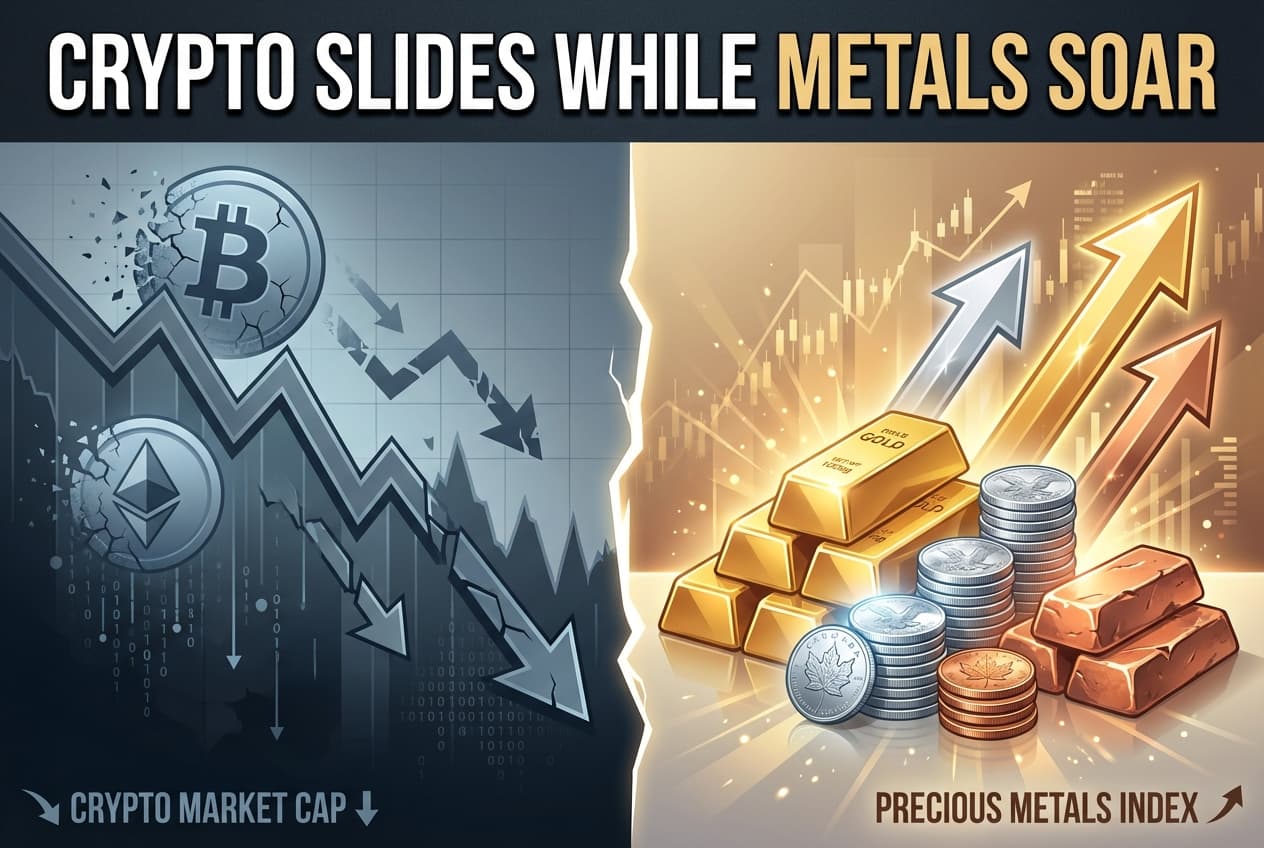
Bitcoin tumbled below $87,000 on Friday as crypto markets gave up overnight gains in a now-familiar pattern of early U.S. trading weakness. The largest cryptocurrency briefly touched $89,000 during Asian hours before sliding 1.6% as American markets opened following the Christmas holiday. Ethereum followed suit with similar losses, while Dogecoin dropped more than 4% and XRP sank 3%. The crypto sector's weakness extended to equity markets, with bitcoin miners particularly hard hit. IREN, Cipher Mining, Terawulf, and Marathon Digital all fell 5% or more, while Hut 8, despite strong AI partnerships, led losses with a 7.5% decline. For traders who expected a year-end rally, Friday's action delivered another dose of disappointment. The selling pressure suggests institutional players remain hesitant to deploy capital into crypto assets, even as traditional markets traded nearly flat.
🥇 Precious Metals Hit Record Highs Across the Board
While crypto stumbled, precious and industrial metals surged to new all-time highs on Friday. Gold rose 1.5% to $4,573 per ounce, extending its remarkable 2025 rally. Silver and copper each gained 5%, while palladium and platinum led the charge with gains exceeding 10%. The metals rally reflects a dramatic shift in investor preference toward tangible assets with real-world utility. According to Solomon Global data, retail investor interest in precious metals jumped 122% year-over-year in October 2025. This divergence between crypto and metals reveals a fundamental change in how investors view risk and value preservation. Where bitcoin was once touted as "digital gold," the actual yellow metal has proven far more attractive during periods of uncertainty. For investors seeking safety, the message is clear: when geopolitical tensions rise, capital flows to assets with centuries of proven value rather than decade-old digital experiments.
🌍 Geopolitical Tensions Drive Safe-Haven Demand
Rising global tensions provided the catalyst for Friday's metals surge. U.S. military strikes against Islamic State targets in Nigeria on Christmas Day, combined with increased pressure on Venezuela through sanctioned oil tanker blockades, heightened investor anxiety about geopolitical stability. These developments come amid ongoing Trump administration tariffs and broader concerns about global economic coordination. Goldman Sachs recently lifted its gold price forecast for December 2026 to $4,900 per ounce, citing strong structural demand from central banks and Federal Reserve easing. The debasement trade, where investors flee fiat currencies for hard assets, has traditionally benefited both gold and bitcoin. However, 2025 data shows capital overwhelmingly choosing traditional safe havens over crypto alternatives. CryptoQuant analyst Maartunn noted that Bitcoin no longer trades like a tech stock or safe haven, instead "carving out its own market regime." For protocol developers and crypto advocates, this presents an identity crisis that won't resolve itself through narrative alone.
🔄 Bitcoin's Failed Safe-Haven Test
The stark divergence between bitcoin and gold exposes a critical flaw in crypto's value proposition. When fear grips markets, investors demonstrate overwhelming preference for tangible assets with established track records. Bitcoin's correlation to the Nasdaq has approached zero, while turning negative against gold, suggesting the asset exists in a peculiar middle ground. It's no longer riding tech stock momentum, but it hasn't earned safe-haven status either. U.S. spot bitcoin ETFs recorded eight consecutive days of institutional selling through late December, with approximately $825 million in outflows driven by tax-loss harvesting strategies. This selling pressure reveals how institutional investors actually view bitcoin: as a high-beta risk asset suitable for tactical trades, not a core safe-haven holding. The fact that polar opposites like gold (fear hedge) and copper (AI-linked industrial metal) both outperformed BTC in 2025 suggests the market no longer trusts promises of digital scarcity when real-world uncertainty emerges. Retail and institutional investors alike are voting with their wallets, and the verdict isn't favorable for crypto's safe-haven narrative.
⚙️ Industrial Demand Versus Speculative Appeal
Beyond safe-haven dynamics, the metals rally benefits from concrete industrial applications that crypto simply cannot match. Silver, for instance, plays an essential role in solar panels, electronics, and emerging green technologies. The Silver Institute declared silver the "next generation metal" in a December report, highlighting its critical importance across high-growth sectors pursuing digital innovation and clean energy mandates. Copper's record-breaking performance similarly reflects strong demand from AI infrastructure buildout, electric vehicle production, and broader electrification trends. These metals possess dual appeal: safe-haven characteristics during uncertainty, plus genuine industrial utility driving structural demand. Bitcoin and other cryptocurrencies lack this dual foundation. While blockchain technology has use cases, the tokens themselves don't get consumed in manufacturing processes or provide essential inputs for physical infrastructure. For investors evaluating long-term holdings, assets with both safe-haven appeal and industrial necessity present a compelling case that pure-play cryptocurrencies struggle to match.
🎯 What This Divergence Means for Crypto's Future
The crypto-metals divergence tells us something important about market maturity and investor sophistication. When presented with genuine uncertainty, capital flows to proven stores of value rather than speculative alternatives. This doesn't necessarily doom cryptocurrencies, but it does force a realistic assessment of their role in portfolios. Some analysts maintain optimism that bitcoin will have its moment in 2026, predicting mean reversion against gold and silver's outperformance. However, such predictions rest on assumptions about changing market conditions rather than bitcoin's intrinsic properties. For crypto to reclaim momentum, the sector needs either a dramatic shift in macroeconomic conditions favoring risk assets, or fundamental developments that establish genuine utility beyond speculation. Meanwhile, investors should recognize that portfolio diversification isn't about choosing crypto or metals, it's about understanding each asset's actual behavior during different market regimes. The 2025 divergence provides valuable data: when fear dominates, tangible assets win. When optimism returns and risk appetite increases, crypto may find its footing again. But expecting bitcoin to perform like gold during a flight to safety runs counter to observed investor behavior.
Sources
https://www.coindesk.com/markets/2025/12/26/crypto-assets-slide-as-geopolitical-tensions-rise-whole-gold-silver-rally https://finance.yahoo.com/news/gold-silver-2025-multiple-record-133600639.html https://finance.yahoo.com/news/gold-silver-prices-hit-highs-163340928.html https://finance.yahoo.com/news/tax-loss-harvesting-drives-825m-094935038.html https://finance.yahoo.com/news/bitcoin-trails-polar-opposites-gold-075521709.html
Market Munchies and Mode Mobile communications are for informational purposes only, and are not a recommendation, solicitation, or research report relating to any investment strategy, security, or digital asset. All investments involve risk including the loss of principal and past performance does not guarantee future results.
Any information contained in this commentary does not purport to be a complete description of the securities, markets, or developments referred to in this material. The information has been obtained from sources considered to be reliable, but we do not guarantee that the foregoing material is accurate or complete. There is no guarantee that any statements or opinions provided herein will prove to be correct.
Get fresh insights, breaking news, and hidden gems in the world of crypto—delivered straight to your inbox with our Crypto Cookies newsletter. Don’t miss out—sign up now and get your first bite of insider knowledge!