Dow Tests New High Ground as a Delayed Jobs Report Rewrites the Rate-Cut Narrative
Tuesday’s session closed with a familiar pattern for 2026: the Dow pushing to another record while the broader market hesitated. By the bell, the Dow added a modest gain, while the S&P 500 and Nasdaq slipped as investors digested softer consumer data and waited for a key…
Tuesday’s session closed with a familiar pattern for 2026: the Dow pushing to another record while the broader market hesitated. By the bell, the Dow added a modest gain, while the S&P 500 and Nasdaq slipped as investors digested softer consumer data and waited for a key labor-market update.
Then came the delayed January employment report, and it landed with a twist. Payroll growth came in stronger than economists expected, and the unemployment rate edged lower, both of which complicate the near-term case for faster rate cuts. But the same release also carried a major historical adjustment that quietly undercut last year’s “too hot to cut” storyline.
That mix, strong current momentum paired with a softer revised past, is why this week’s market signal is not a simple “risk-on” cheer. It is a repricing of what matters most: the Fed’s confidence that inflation can keep moving toward its 2% goal without the labor market breaking.
Stock of Interest Today: Coinbase Global (COIN)
Coinbase sits at the center of a basic 2026 tension: crypto prices can crater, but the underlying “picks-and-shovels” businesses are trying to grow up. Even as digital assets have been volatile, Coinbase has been leaning harder into revenue streams that are not purely spot trading, including stablecoins, staking and rewards, and subscription-style offerings. In Q3 2025, the company reported $747 million in subscription and services revenue, including $355 million in stablecoin revenue and $185 million from blockchain rewards.
The other quiet shift is who is doing the trading. Coinbase reported institutional trading volume of $236 billion versus total trading volume of $295 billion in Q3 2025, meaning institutions represented roughly four-fifths of activity by dollars in that quarter.
Balance sheet strength remains a key part of the bull case in a cyclical business. Coinbase reported $11.9 billion in “USD resources” at the end of Q3 2025, and it also provided Q4 outlook ranges that explicitly tied results to stablecoin growth and interest-rate expectations.
Near term, the next catalyst is earnings. Consensus expectations heading into the report call for EPS of about $1.15 on revenue around $1.85 billion. And longer term, the thesis increasingly leans on stablecoin adoption. Coinbase has pointed to USDC market cap hitting a new all-time high in October (per its outlook commentary), while third-party trackers show USDC remains one of the largest dollar-pegged tokens in circulation.
Current price: $156.08Analyst expectation: $240
Five Market Themes Driving the Tape
Markets are not reacting to a single headline right now. They are triangulating between growth, policy, geopolitics, and where earnings momentum is still real. The five signals below explain why “record highs” can coexist with defensive positioning and why the next macro print matters more than usual.
January Payrolls Surprise vs. the Fed’s Timing
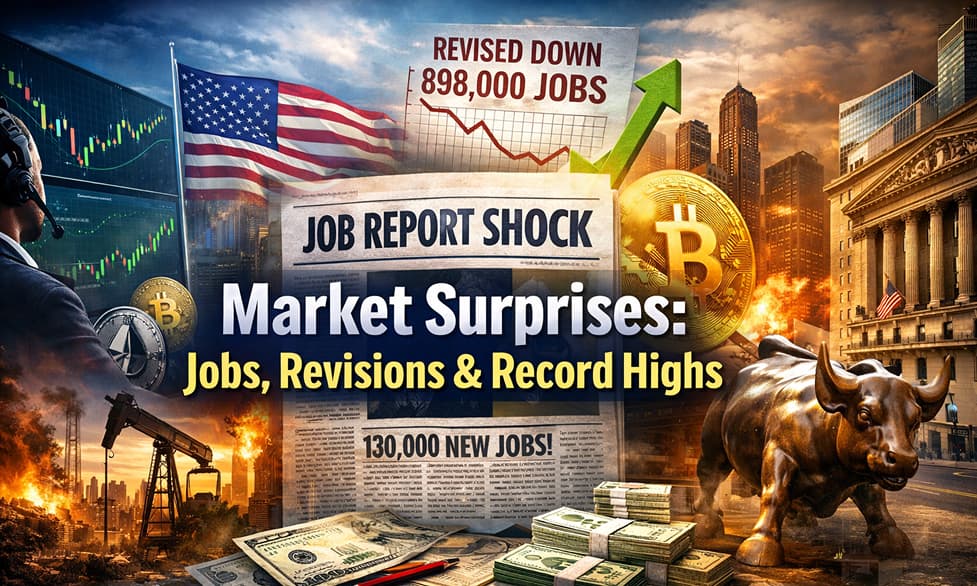
The delayed January jobs report showed payrolls up 130,000 and unemployment down to 4.3%, beating expectations and reinforcing the idea that the labor market is not cooling on command.
That matters because the Fed’s bar is not “good enough growth.” It is inflation returning to 2% over time without a labor-market shock. Stronger hiring makes it easier for the Fed to wait, and it makes markets less comfortable pricing aggressive cuts before inflation is clearly tamed.
The 898,000-Job Revision That Changes the Backstory
The most market-moving detail may have been backward-looking: benchmark revisions showed the economy added 898,000 fewer jobs from April 2024 through March 2025 than previously estimated.
In practice, this creates a “strong present, weaker past” dynamic. It gives the Fed evidence that prior labor-market strength was overstated, even as current conditions look firm. That tension helps explain why policy expectations can whipsaw, and why investors are increasingly sensitive to any single data point.
Oil’s Geopolitical Premium Is Back in Play
Oil has been reacting to Middle East risk again, with prices rising as traders weigh disruption scenarios.
The macro implication is bigger than the daily move: a persistent geopolitical premium can keep headline inflation sticky, which is exactly the kind of complication that makes the Fed slower to declare victory. Reports of U.S.-Iran diplomacy alongside continued regional military signaling are part of what keeps that premium alive.
Retail Sales Weakness vs. Hiring Strength
Here is the uncomfortable split: consumer spending data has been soft even while the labor market prints look resilient. Tuesday’s trade was shaped in part by disappointing retail sales figures, one reason the S&P 500 and Nasdaq faded while the Dow held up better.
If people are employed but spending cautiously, it can signal that wage gains are being absorbed by high fixed costs, debt service, or simply a preference to rebuild savings. That is not an “imminent recession” call, but it is a warning sign for parts of consumer discretionary that rely on easy volume growth.
Cloud Infrastructure Strength Still Has Pockets of Real Momentum
Not all tech is trading on hype. Cloudflare jumped after reporting Q4 results and issuing guidance that topped expectations, highlighting ongoing demand for network and edge infrastructure even in a market that has been skeptical about big tech spending payback.
The takeaway is selective, not broad: investors are rewarding companies that can show durable growth, clear demand signals, and credible forward guidance. In 2026, “AI-adjacent” is not enough. Proof is the product.
Bottom Line
The market is trying to price two realities at once: a labor market that still refuses to crack, and a revised history that suggests last year’s strength was overstated. That is why rate-cut expectations feel unstable, why oil risk matters again, and why weak consumer data can suddenly dominate a record-high headline. In this environment, leadership narrows to what can demonstrate real demand and resilient fundamentals, whether that is cloud infrastructure printing beat-and-raise quarters, or platforms like Coinbase leaning on diversified revenue while waiting for the next crypto cycle to turn.
Sources:
- https://www.barrons.com/livecoverage/stock-market-news-today-021126/card/dow-heads-for-another-record-as-jobs-take-center-stage-stock-futures-rise--lLFQBA63QK9DLnExJlcs
- https://www.sec.gov/Archives/edgar/data/1679788/000167978825000207/q325shareholderletter.htm
- https://www.barrons.com/livecoverage/stock-market-news-today-021126/card/u-s-treasury-yields-edge-lower-as-market-awaits-employment-data-lvlYnNkzEIVLxyTcAOER
- https://www.reuters.com/business/us-job-growth-accelerates-january-unemployment-rate-falls-43-2026-02-11/
- https://www.bls.gov/news.release/empsit.nr0.htm
- https://www.reuters.com/business/energy/oil-prices-rise-report-us-plans-seize-iranian-oil-tankers-2026-02-11/
- https://www.census.gov/retail/sales.html
- https://www.cloudflare.com/en-ca/press/press-releases/2026/cloudflare-announces-fourth-quarter-and-fiscal-year-2025-financial-results/
Market Munchies and Mode Mobile communications are for informational purposes only, and are not a recommendation, solicitation, or research report relating to any investment strategy, security, or digital asset. All investments involve risk including the loss of principal and past performance does not guarantee future results.
Any information contained in this commentary does not purport to be a complete description of the securities, markets, or developments referred to in this material. The information has been obtained from sources considered to be reliable, but we do not guarantee that the foregoing material is accurate or complete. There is no guarantee that any statements or opinions provided herein will prove to be correct.