Europe's Largest Asset Manager Brings $2.3 Trillion Powerhouse to Ethereum
💶 The Tokenization Milestone That Signals Traditional Finance's Blockchain Shift Amundi, Europe's largest asset manager with approximately $2.3 trillion in assets under management, has launched the first tokenized share class of one of its money market funds on the Ethereum…
💶 The Tokenization Milestone That Signals Traditional Finance's Blockchain Shift
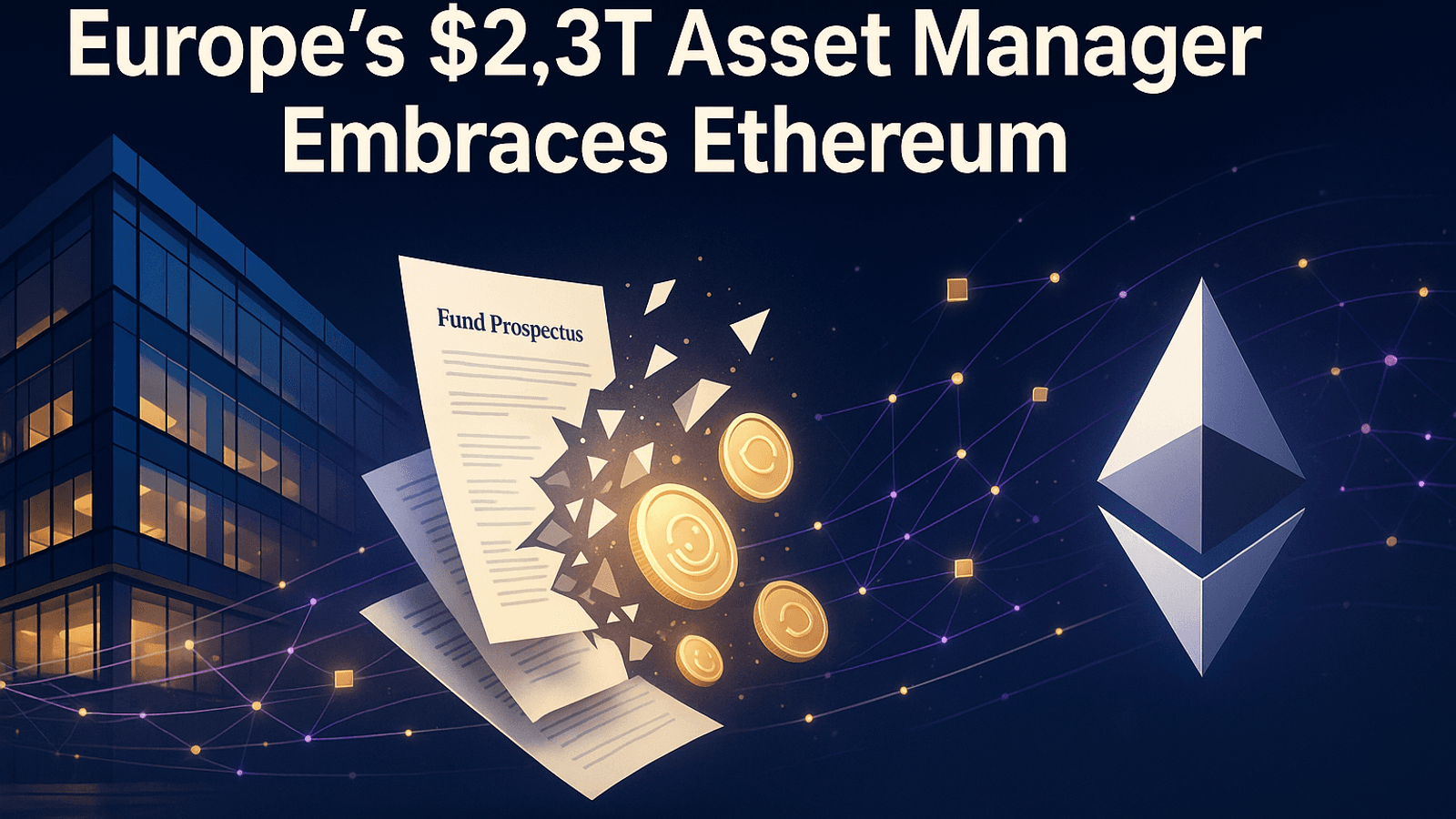
Amundi, Europe's largest asset manager with approximately $2.3 trillion in assets under management, has launched the first tokenized share class of one of its money market funds on the Ethereum blockchain. The new share class, labeled Amundi Funds Cash EUR - J28 EUR DLT, represents a significant step in bringing traditional finance infrastructure onto public blockchain networks. For institutional investors, this marks a watershed moment where one of the world's largest asset managers commits to distributed ledger technology not as an experiment, but as a production-ready distribution channel. The Paris-headquartered firm positioned the launch as part of its broader digital assets roadmap, signaling that tokenization will become a core component of how large asset managers distribute fund shares. Retail and institutional investors alike now have access to a money market fund that operates simultaneously on traditional rails and blockchain infrastructure, creating optionality that didn't exist before.
⚙️ How Blockchain Infrastructure Enables 24/7 Fund Operations
The tokenized fund operates through a partnership with CACEIS, one of Europe's leading asset-servicing providers and transfer agents. CACEIS supplies the entire technology stack including blockchain-based transfer agent infrastructure, digital wallets for investors, and a 24/7 digital order platform supporting subscriptions and redemptions. The fund units are recorded on the public Ethereum blockchain, enabling transparent record-keeping and full transaction traceability that traditional systems cannot match. Jean-Pierre Michalowski, CACEIS CEO, stated this is a decisive step toward achieving 24/7 subscription and redemption services for investment fund units payable in stablecoins or central bank digital currency when it becomes available. For traders and active portfolio managers, this infrastructure promises instant order execution and operational continuity outside traditional market hours. The blockchain integration doesn't replace existing distribution channels but adds an additional layer, allowing investors to choose between traditional broker-dealers or direct blockchain-based access depending on their preferences and operational capabilities.
📊 What Tokenization Means for Investor Access and Efficiency
The shift to blockchain-based fund shares delivers several concrete benefits that traditional infrastructure struggles to provide. First, instant settlement reduces counterparty risk and frees up capital that would otherwise sit in transit during T+2 or T+3 settlement windows. Second, 24/7 availability means investors can respond to market events regardless of whether traditional markets are open, particularly valuable during weekend news cycles or global events occurring outside Western business hours. Third, the transparent on-chain record of fund units eliminates reconciliation issues that plague traditional transfer agents, reducing operational overhead and potential errors. For institutional allocators, the hybrid model Amundi deployed matters significantly because it doesn't force a choice between blockchain and traditional systems. Existing relationships with prime brokers and custodians remain intact while new blockchain-native distribution opens simultaneously. This flexibility removes adoption friction and allows institutions to migrate at their own pace rather than facing a binary infrastructure decision.
🇪🇺 Europe's Regulatory Framework Gives It the Lead in Tokenized Funds
Europe has established an early lead in regulated tokenized fund issuance, with firms in Luxembourg, France, and Germany issuing blockchain-native fund units for years thanks to regulatory clarity. The region's rules provide asset managers with explicit guidance on how to hold and record digital shares, removing legal ambiguity that has slowed adoption in other jurisdictions. This regulatory environment explains why Amundi, Franklin Templeton, and other major European asset managers have moved quickly to launch tokenized products while some U.S. counterparts remain in pilot phases. For investors evaluating tokenized fund opportunities, the regulatory framework matters as much as the technology itself. European funds benefit from investor protection rules, fund governance requirements, and operational standards that apply equally to tokenized and traditional share classes. Jean-Jacques Barberis, Head of Institutional and Corporate Clients and ESG at Amundi, noted that asset tokenization is a transformation set to accelerate in the coming years around the world, with the firm planning to expand tokenization initiatives for clients in France and internationally. The regulatory head start Europe has built could translate into sustained competitive advantage as other regions work through their own frameworks.
📈 Real-World Asset Tokenization Explodes from $15 Billion to $37 Billion in 2025
The tokenization of real-world assets on blockchains has witnessed rapid expansion in 2025, rising from a market cap of $15.2 billion at the start of the year to $37.1 billion as of November 27, according to The Block's data dashboard. The Provenance blockchain currently leads the segment with a tokenized RWA market cap of $13.9 billion, boosted by significant issuance from Figure Technologies, the leading independent non-bank home equity line of credit originator in the U.S., which went public on the Nasdaq in September. Ethereum holds second place with a tokenized RWA market cap of $12.4 billion, followed by smaller issuance on ZKsync, BNB Chain, Polygon, and others. For investors tracking the sector, the 144% growth in tokenized RWA market cap over 11 months suggests institutional adoption is accelerating beyond early pilot programs. Money market funds represent a particularly attractive asset class for tokenization because their short-duration, low-volatility characteristics align well with investor demand for blockchain-based yield while minimizing the complexity of tokenizing longer-dated or illiquid assets. The trajectory suggests that by year-end 2026, tokenized RWAs could represent a market measured in hundreds of billions rather than tens of billions.
🎯 What Amundi's Move Means for the Future of Asset Management
Amundi's tokenization launch sends a clear signal that major traditional finance institutions are moving beyond blockchain experimentation toward production deployment. When a $2.3 trillion asset manager commits to Ethereum-based infrastructure for a live product, it validates the technology's maturity and reduces adoption risk for other institutions evaluating similar moves. For crypto-native investors, this represents the institutional bridge they've anticipated, where traditional finance assets become composable with DeFi protocols and blockchain-native applications. The implications extend beyond money market funds to the entire spectrum of investment products that could benefit from blockchain rails including bond funds, equity funds, and eventually more complex structured products. Investors should watch for whether other large asset managers follow Amundi's lead in the coming quarters, as network effects in tokenized finance infrastructure will favor early movers who establish dominant standards. The hybrid distribution model Amundi deployed likely represents the template for how traditional finance will adopt blockchain technology, maintaining legacy systems while building parallel blockchain infrastructure that gradually captures more flow. For traders and investors, the key question is not whether tokenization will reshape asset management, but rather which platforms and protocols will capture the infrastructure layer as this transition accelerates.
Sources
https://www.theblock.co/post/380765/amundi-tokenizes-money-market-fund-on-ethereum https://www.theblock.co/data/decentralized-finance/real-world-assets https://www.amundi.com/globaldistributor/amundi-european-leader-asset-management
Market Munchies and Mode Mobile communications are for informational purposes only, and are not a recommendation, solicitation, or research report relating to any investment strategy, security, or digital asset. All investments involve risk including the loss of principal and past performance does not guarantee future results.
Any information contained in this commentary does not purport to be a complete description of the securities, markets, or developments referred to in this material. The information has been obtained from sources considered to be reliable, but we do not guarantee that the foregoing material is accurate or complete. There is no guarantee that any statements or opinions provided herein will prove to be correct.
Hungry for the latest in crypto? Get fresh insights, breaking news, and hidden gems in the world of crypto—delivered straight to your inbox with our Crypto Cookies newsletter.Don’t miss out—sign up now and get your first bite of insider knowledge!