Factories Lose Steam, Economies Cool—Is Global Growth Running Out of Gas?
When the World’s Economic Engine Starts Coughing, Investors Lean In You can tell a lot about the world by how its factories sound. For months, the hum of global manufacturing —from the car lines in Stuttgart to the chip foundries in Taipei—has started to falter. The rhythm is…
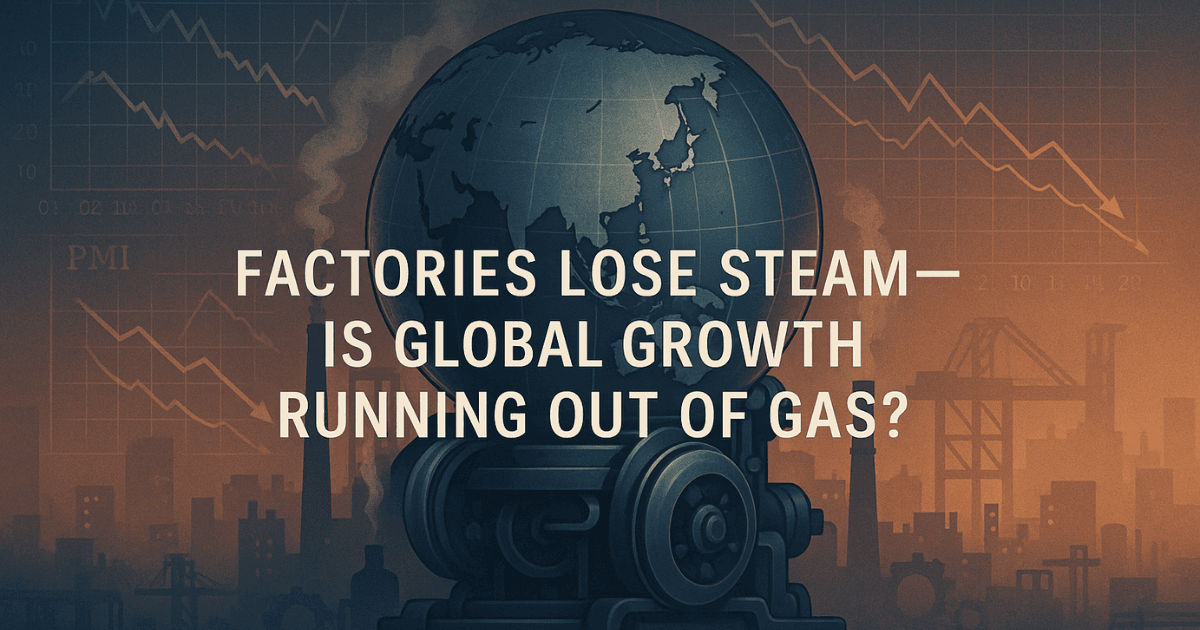
When the World’s Economic Engine Starts Coughing, Investors Lean In
You can tell a lot about the world by how its factories sound. For months, the hum of global manufacturing—from the car lines in Stuttgart to the chip foundries in Taipei—has started to falter. The rhythm is still there, but it’s slower, patchier, like a machine running on half a tank. That faint sputter has investors listening closely. Because when factories across Asia and Europe hit the brakes at the same time, it’s rarely just a manufacturing story—it’s a signal of a global economic slowdown. The question now is simple: Are we just cooling down… or breaking down? Recent data tell a nuanced story: factory PMI readings are weakening, global growth forecasts are softening, and trade policy uncertainty is on the rise. Yet amid all the noise, there’s balance—emerging Asia innovation continues to thrive, and investors are finding defensive equity sectors surprisingly resilient. The world isn’t collapsing—it’s just catching its breath.
🏭 Factories Fall Silent Across Continents
Across Europe, the contraction in manufacturing has become more pronounced. The Eurozone factory PMI slipped to 49.8, confirming a broader industrial downturn.
- Germany printed 48.9, with export orders drying up.
- France dropped to 49.4, showing weaker domestic demand.
- Italy trailed at 49.2, reflecting fading confidence in manufacturing output.
Across Asia, the picture mirrors that of Europe.
- China’s Caixin PMI landed at 49.6, the sixth month of factory contraction—tariffs, a property slump, and muted demand forming a perfect storm.
- Japan’s Jibun Bank PMI slipped to 48.7, the lowest since 2023.
- Taiwan’s fell to 47.9, signaling a slowdown in semiconductor exports, while South Korea just held above water at 50.2, boosted by AI chip exports.
“The resilience of labour markets is fading; trade growth has halved compared to the 2010s,” said Clare Lombardelli, OECD Chief Economist.
Tactical Insight: A broad global manufacturing slump often signals macroeconomic risk for investors. Keep an eye out for stimulus measures in Asia or policy easing in the Eurozone—historically, these moves mark the turning point in a global economic cycle.
🌍 Forecasts Cool—but the World Isn’t Freezing
Leading institutions are tempering expectations.
- The OECD projects global growth to ease from 3.3% (2024) → 3.2% (2025) → 2.9% (2026), citing economic policy headwinds and rising trade barriers.
- The World Bank forecasts just 2.3% growth in 2025, warning of a synchronized slowdown.
- The Conference Board maintains a steady outlook of 3.0% for 2025 and 2.9% for 2026, supported by capital expenditure growth in emerging Asia.
- The IMF’s World Economic Outlook is expected to echo similar caution.
It’s a measured decline, not a free fall—a classic mid-cycle softening of global growth forecasts. Investor Radar: When global GDP growth dips below 3%, investment opportunities during slowdowns tend to shift. Focus on defensive equity sectors, high-quality bonds, and markets with strong capital reallocation trends, such as India and Indonesia.
🇺🇸 America: Slow, Steady, and Still Stubborn
The U.S. economy remains the steadiest player in this global rebalancing act.
- S&P Global forecasts U.S. GDP to expand by 1.9% in 2025 and 1.8% in 2026, representing modest but stable growth.
- Deloitte reports that only 107,000 jobs were added over four months, a sign that the U.S. labor market is cooling.
- Wage growth near 3.8% y/y keeps inflation from disappearing entirely.
The U.S. isn’t sprinting—but it’s still running ahead of the pack. Smart Capital Signal: Expect gradual Fed easing, not aggressive cuts. Short-term yields remain attractive, while long-term bonds may soon regain prominence as macroeconomic risk subsides.
⚖️ Trade Wars 2.0—The Silent Tax on Growth
The OECD warns that rising protectionism could reduce global GDP by 0.5% next year. McKinsey’s global survey found 64% of executives citing trade policy uncertainty as their top concern, followed by geopolitical instability. This evolving supply chain disruption is forcing global companies to rethink their production strategies. Near-shoring is no longer a buzzword—it’s becoming a necessity. Portfolio Pointer: Look toward near-shoring investment, automation, and logistics innovation—industries redefining efficiency amid trade volatility. The next growth story may lie in companies optimizing their supply routes, rather than expanding them.
💡 The Silver Lining: Innovation Still Outruns Uncertainty
Amid all this noise, emerging Asia innovation continues to shine. AI, green tech, and digital infrastructure projects are attracting global capital. Investors are reallocating funds from slowing industrial hubs to the energy transition and semiconductor ecosystems—sectors that thrive even during global growth slowdowns. Strategic Spoonful: Investment opportunities in slowdowns often hide where capital is already migrating. Follow the money—not the fear.
🥂 Final Word: The World’s on Simmer, Not Stuck
The global economy isn’t breaking—it’s rebalancing. Factories are quieter, trade policy is tense, and growth forecasts are more subdued, but innovation remains alive and compounding. The slowdown may feel uncomfortable, but it’s also setting the stage for the next phase of smarter, more resilient growth. As any seasoned investor knows, when the global economy turns down, long-term portfolios tend to turn up. Sometimes, the best opportunities are served slowly.
Sources
- OECD Interim Economic Outlook (Sept 2025)
- OECD Press Release on Global Outlook (Sept 2025)
- Reuters – Euro Zone Manufacturing Returned to Contraction (Oct 2025)
- Reuters – Japan’s Factory Activity Falls (Oct 2025)
- Reuters – South Korea Factory Activity Expands (Oct 2025)
- AP News – China’s Factory Activity Contracts for a Sixth Straight Month (Sept 2025)
- Financial Times – China’s Factory Activity Suffers Longest Decline in Six Years (Sept 2025)
- McKinsey Global Economic Conditions Snapshot (Q3 2025)
- World Bank Global Economic Prospects (Sept 2025)
- Conference Board Global Economic Outlook (Sept 2025)
- Investopedia – OECD Says U.S. GDP Growth to Slow Next Year (Sept 2025)
Market Munchies and Mode Mobile communications are for informational purposes only, and are not a recommendation, solicitation, or research report relating to any investment strategy, security, or digital asset. All investments involve risk including the loss of principal and past performance does not guarantee future results.
Any information contained in this commentary does not purport to be a complete description of the securities, markets, or developments referred to in this material. The information has been obtained from sources considered to be reliable, but we do not guarantee that the foregoing material is accurate or complete. There is no guarantee that any statements or opinions provided herein will prove to be correct.