From Beijing’s Ban to Trump’s Visa Bomb—Why Markets Are Balancing on a Razor’s Edge
A Rally, a Reversal, and a Razor’s Edge 🎭 Markets have rarely looked this glossy and this fragile at the same time. Record highs fueled by AI market trends collided with policy risk investing shocks sharp enough to slice through sentiment. Beijing blocked Nvidia’s chips, Trump…
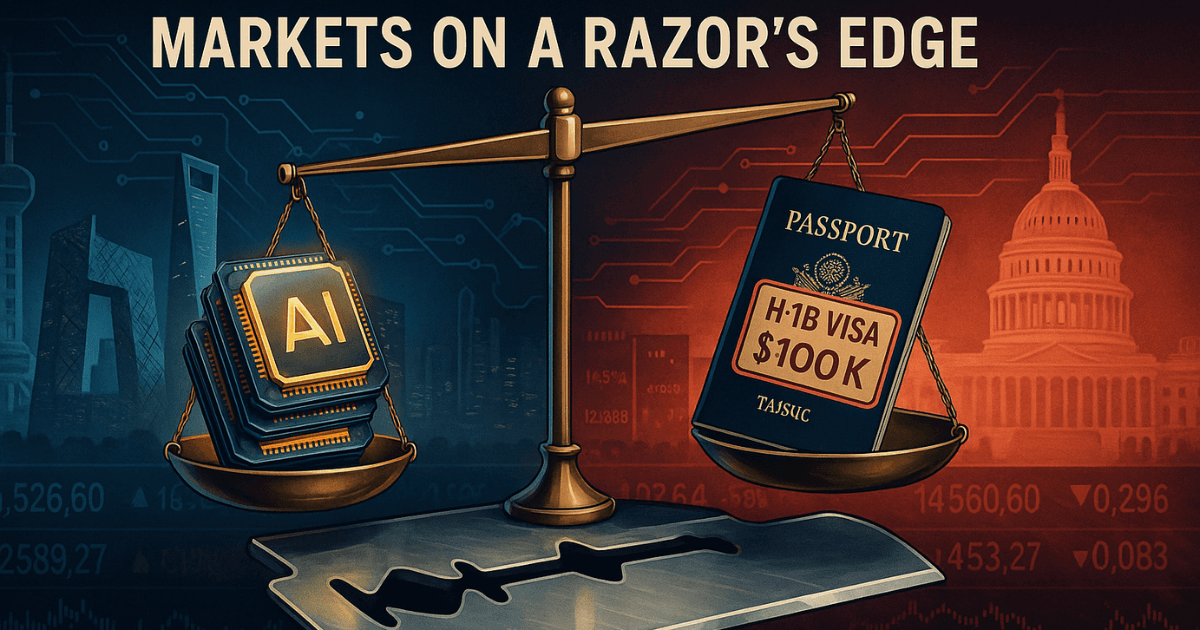
A Rally, a Reversal, and a Razor’s Edge 🎭
Markets have rarely looked this glossy and this fragile at the same time. Record highs fueled by AI market trends collided with policy risk investing shocks sharp enough to slice through sentiment. Beijing blocked Nvidia’s chips, Trump floated a visa fee that sounded more like a ransom note, and Wall Street’s mega-cap volatility dictated the rhythm. The result? A rally that looked unstoppable—until it suddenly wasn’t. This isn’t just market noise. It’s the sound of geopolitical investing and concentrated risk stocks reshaping the rhythm of global portfolios.
Beijing Bars Nvidia Chips 🚫💻
China turned up the heat on the US–China tech war by banning major firms like ByteDance and Alibaba from acquiring Nvidia’s RTX Pro 6000D GPUs. The move wasn’t about cost or availability. It was about control—a push for technological sovereignty that sidelines U.S. suppliers. Nvidia’s response? Disappointment. Investors’ response? A quick markdown of future semiconductor supply chain growth. Meanwhile, Huawei and other domestic players quietly celebrated.
- Why it matters: This isn’t incremental—it’s escalation. Tech decoupling is no longer speculative. It’s policy reality.
- Market pulse: Nvidia shares softened, Chinese competitors received a sentiment boost, and supply chain uncertainty intensified.
Smart Capital Signal: When geopolitical investing collides with AI hype stocks, portfolios need insulation. Expect volatility to spread through AI infrastructure investing and cloud-heavy sectors.
Trump Floats a $100K Visa Fee 💼🚧
As if supply chains weren’t enough, Washington lobbed its own grenade. Donald Trump proposed a $100,000 fee for H-1B visas, a system central to U.S. innovation. Markets didn’t wait to panic. Indian IT stocks—Infosys, Wipro, TCS—slid immediately. Nasdaq futures softened, and universities warned of a chilling effect on global research.
Julie Sweet, CEO of Accenture, tried to reassure: “Every time there’s a big policy change, it’s an opportunity to reassess. Only about 5% of our U.S. workforce is on H-1B visas.”
- Why it matters: Visa fee shock policies pose a threat to global tech ecosystems. Immigration rules are no longer just politics—they’re core to innovation economics.
- Market pulse: Tech firms in Silicon Valley, already navigating tech policy risk, must now factor in immigration headwinds.
Tactical Insight: The impact of the H-1B visa policy is a direct investment variable. For investors, policy risk investing isn’t optional—it’s essential for evaluating the growth of AI, biotech, and the cloud.
Tech Titans Lead Volatility ⚡📈📉
This wasn’t a broad rally; it was a concentrated cap action. Apple, Tesla, Oracle, and Nvidia swung markets like oversized pendulums.
- Apple rode strong iPhone 17 demand.
- Tesla rebounded, reflecting EV staying power.
- Oracle declined after a brief surge in AI activity.
- Nvidia—split between its OpenAI deal and the Nvidia China ban—was the market’s loudest drumbeat.
The effect? Mega cap volatility that pulled indexes higher one day and lower the next. Investor Radar: Concentration risk stocks magnify fragility. A portfolio tied too tightly to four CEOs isn’t diversification—it’s dependency.
Records, Then Retreat 🏔️➡️⛷️
On September 22, the S&P 500, Nasdaq, and Dow Jones Industrial Average all hit record highs. The fuel? AI hype stocks paired with Fed easing. However, by September 24, the gains had evaporated. Tech underperformed, energy and materials picked up the slack, and valuations looked overstretched. The market rotation 2025 narrative gained traction, with cautious flows shifting into industrials and materials. Goldman Sachs summed it up: “Enjoy the calm now—volatility is likely to return in October.”
- Why it matters: Narrow rallies collapse faster.
- Market pulse: Elevated P/E ratios and tech policy risk made investors wary of piling into crowded trades.
Capital Compass: Global tech regulation and valuation stretch don’t mix. Investors chasing AI infrastructure investing stories must weigh hype against harder fundamentals.
Final Word: Investing on a Knife’s Edge 🔪📊
Put simply, markets are balancing on a razor’s edge. From Beijing’s Nvidia ban to Trump’s visa fee shock, geopolitics now dictates investor confidence. Yes, AI market trends remain irresistible. However, optimism alone can’t shield portfolios from global tech regulation, visa fee shocks, or the risks associated with mega-cap concentration. The wisest move is resilience. Hedge with market rotation 2025 strategies, diversify across sectors, and remember—policy risk investing is as real as earnings per share.
Sources
- Financial Times – China bans tech firms from Nvidia chip purchases
- Reuters – China willing to maintain dialogue after Nvidia ban
- The Guardian – Trump H-1B visa fees spark backlash
- Business Insider – Indian IT stocks sink on visa fee shock
- Investopedia – Dow Jones Sept 24 Market Recap
- Wall Street Journal – Nvidia, Tesla, Apple market drivers
- Barron’s – September rally hits a snag
- Reuters Breakingviews – Global markets commentary
- Economic Times – Goldman Sachs warns volatility ahead
Market Munchies and Mode Mobile communications are for informational purposes only, and are not a recommendation, solicitation, or research report relating to any investment strategy, security, or digital asset. All investments involve risk including the loss of principal and past performance does not guarantee future results.
Any information contained in this commentary does not purport to be a complete description of the securities, markets, or developments referred to in this material. The information has been obtained from sources considered to be reliable, but we do not guarantee that the foregoing material is accurate or complete. There is no guarantee that any statements or opinions provided herein will prove to be correct.