Gaza Just Held Its First Election in 20 Years. The Results Tell You Everything About What Comes Next.
On Saturday, in a city of tents and wooden ballot boxes — because the schools that would normally serve as polling stations were destroyed by Israeli airstrikes — residents of Deir al-Balah in central Gaza voted in a municipal election for the first time in two decades.…
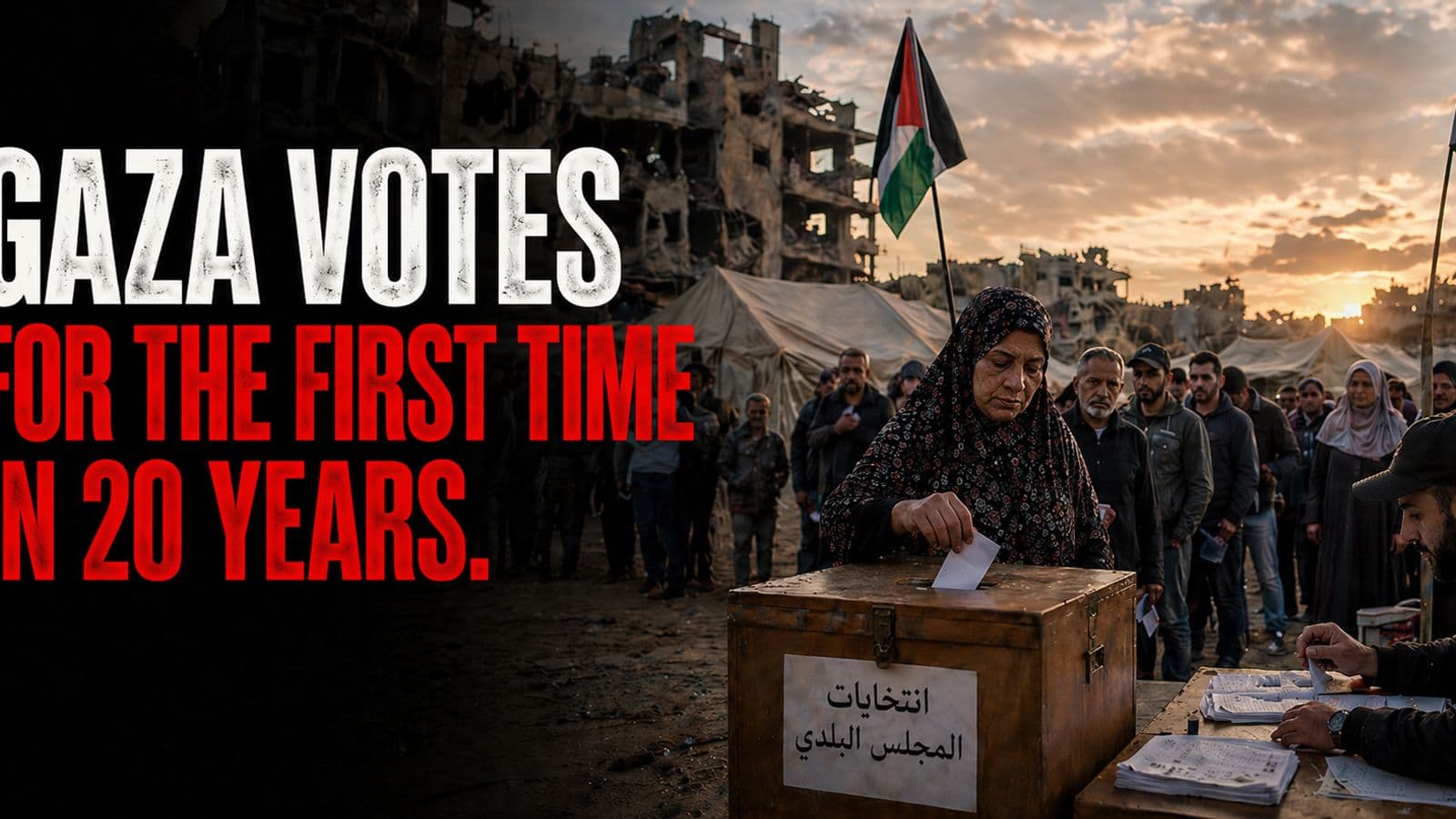
On Saturday, in a city of tents and wooden ballot boxes — because the schools that would normally serve as polling stations were destroyed by Israeli airstrikes — residents of Deir al-Balah in central Gaza voted in a municipal election for the first time in two decades.
Approximately 16,000 of 70,000 eligible voters cast ballots. That is a 23% turnout rate. The Fatah-linked list won six of 15 council seats. The list widely seen by residents and analysts as aligned with Hamas won two. The remaining seats went to independents.
Palestinian Authority officials declared the vote a historic success. The headline number tells a more complicated story.
What Actually Happened and Why It Matters
To understand Saturday's vote, you need to understand what it was not.
It was not a general election. It was not a presidential election. It was not even a territory-wide municipal election. It was a single city, in one of the areas of Gaza that was least destroyed during the war, covering approximately 5% of Gaza's total eligible voters, for the purpose of choosing a local council responsible for water, roads, and electricity.
The Palestinian Authority framed it as a pilot program — a proof of concept that Gaza and the West Bank can be treated as a single democratic unit, and that elections are possible even amid the devastation of two years of war. Palestinian Prime Minister Mohammad Mustafa called it "an important first step in a broader national process aimed at strengthening democratic life." President Mahmoud Abbas had promised that 2026 would be "the year of Palestinian democracy."
That framing matters for a specific strategic reason. A reformed Palestinian Authority with demonstrated democratic legitimacy is a precondition of the Trump administration's 20-point peace plan for Gaza. The plan, endorsed by UN Security Council Resolution 2803 last November, envisions an international Board of Peace eventually ceding control of Gaza to a reformed PA — but only once "conditions may finally be in place for a credible pathway to Palestinian self-determination and statehood." Elections, in that framework, are not just politics. They are a certification required to unlock reconstruction funding and international recognition.
What the Numbers Actually Say
The Palestinian Authority's narrative and the election's actual numbers sit uncomfortably together.
In the West Bank, turnout was 56% — roughly comparable to recent elections there and not a dramatic signal of either renewed enthusiasm or deep disillusionment. In Gaza, the 23% figure is where the story gets complicated.
Before attributing the 23% figure primarily to political disillusionment, it is worth being precise about the logistical ceiling that wartime conditions imposed. The Palestinian Central Elections Commission reported that Israel blocked the entry of ballot papers, boxes, and ink into Gaza. COGAT, the Israeli military body that oversees humanitarian affairs in the territory, did not respond to press questions about the restrictions and offered no public rationale — leaving it unclear whether the blockage reflected a security designation, bureaucratic inaction, or deliberate obstruction. Officials were forced to improvise with wooden ballot boxes and ink repurposed from a vaccination drive. Civil registry records still listed thousands of eligible voters who had been killed, displaced, or forced to flee, inflating the denominator of the turnout calculation with people who were physically unable to vote. Most schools that would have served as polling stations had been destroyed, requiring tents instead. Under those conditions, 23% may be closer to a logistical ceiling than a political floor.
That said, Palestinian analysts pointed to genuine disillusionment running beneath the structural obstacles. "The result laid bare the depth of the Palestinian political crisis," Mustafa Ibrahim, a Gaza-based political analyst, told The New Arab. For many residents, he argued, voting felt disconnected from the survival priorities that dominate daily life — food, shelter, safety, and the absence of Israeli strikes. Both things are simultaneously true: the conditions made high turnout nearly impossible, and the political appetite for PA-administered elections in Gaza has been eroded by two decades of stalled governance, cancelled elections, and visible institutional failure.
The Hamas Question
The most analytically significant dimension of Saturday's vote is what it revealed — and did not reveal — about Hamas's popularity.
Hamas was formally excluded from the ballot. Participation required candidates to recognize Israel, support a two-state solution, and accept the PLO's political program — conditions Hamas cannot accept without abandoning its founding ideology. Hamas did not campaign. Hamas did not try to block the vote. And Hamas's own armed police forces stood guard outside the polling stations — an image that captures the strange ambiguity of the organization's position: not a participant, not an opponent, but a physical presence that could not be ignored.
Some candidates on the list known as "Deir al-Balah Brings Us Together" were widely identified by residents and analysts as Hamas-aligned. That list won two seats. Fatah won six. Independents took the rest.
Read one way, this is good news for the Palestinian Authority: in the only Gaza election in 20 years, with Hamas excluded from the ballot and its police watching from outside, Fatah still won. Read another way, it raises an uncomfortable question: if Hamas cannot be on the ballot and can only win two seats through proxies, does the election result actually tell you anything useful about what Gaza's population wants — or does it tell you only what happens when the options are constrained in advance?
Hamas spokesperson Hazem Qassem called the Deir al-Balah election an "important step" and said Hamas had issued instructions to ensure the success of the process — a notably cooperative posture from an organization that was excluded from the ballot. Qassem simultaneously called for presidential and legislative elections. The implicit message: we accept this as a stepping stone toward the broader elections where Hamas can compete, but the question of who governs Gaza has not been answered by a local council vote.
The Legitimacy Problem That Saturday Did Not Solve
The deeper issue hovering over Saturday's vote is the Palestinian Authority's own fragility as an institution.
President Abbas is 90 years old, in the final years of a presidential term that was supposed to last four years and has now lasted 21. Public opinion polling has consistently shown 80% of Palestinians believe the PA is corrupt, and a majority regard it as a liability rather than an asset. The PA has not held presidential or legislative elections since 2006 — the same year Hamas won and then violently seized Gaza. Abbas cancelled planned parliamentary elections in 2021, deepening mistrust among Palestinians who have had no meaningful vote for national leadership in two decades.
"He's associated with failure," said Ghaith al-Omari, senior fellow at the Washington Institute for Near East Policy and a former adviser to the Palestinian negotiating team. "Whether it's failure in achieving Palestinian statehood through diplomacy or failure in governance. It's very hard to see how he can be politically rehabilitated."
That assessment is relevant to the Trump reconstruction plan in a very direct way. The plan's pathway to Palestinian statehood is contingent on PA reform. The Board of Peace, which is supposed to eventually hand Gaza's governance back to the PA, has been seeking to marginalize the PA throughout its early operations. The 15-person National Committee for the Administration of Gaza — the PA-aligned technocratic body meant to govern Gaza during the transition — has not yet been allowed into Gaza. There is no clear timeline for when that changes.
Saturday's vote was designed, at least in part, to demonstrate that the PA is capable of administering elections and building democratic legitimacy. The 23% turnout in Gaza, the logistical improvisations, the Hamas police at the gates, and the widespread analyst commentary about deepening public disillusionment are not what a clean legitimacy certification looks like.
What This Means for the Path Forward
For investors and observers tracking the Gaza reconstruction story, Saturday's election clarifies several things.
The Trump plan's pathway to reconstruction remains dependent on PA reform, and PA reform remains dependent on credible elections, and credible elections in Gaza remain deeply complicated for structural, logistical, and political reasons that a single pilot vote in one city has not resolved. The World Bank-backed reconstruction trust fund called for in UN Security Council Resolution 2803 has not been established. The Board of Peace remains a structure more than an operational entity. None of the 15 members of the NCAG governance committee has set foot in Gaza.
The reconstruction opportunity in Gaza — estimated by some analysts at well over $100 billion — is real and potentially significant for the construction, materials, logistics, and financial sectors that would support it. But it remains contingent on a political and security framework that Saturday's election moved forward incrementally, not transformationally.
The most honest assessment of what happened Saturday may have come from a voter outside a polling station in Deir al-Balah. "Municipal elections are an important step, but they are not enough," he told reporters. "We want general elections."
He is right. And general elections in Gaza — ones that include Hamas, or exclude it on terms that actual Gazans accept, and that produce a result the international community recognizes as legitimate — remain a problem that Saturday's wooden ballot boxes and ink borrowed from a vaccination drive have not yet solved.
Sources
- CNN — "Gaza holds first elections in 20 years amid stalled ceasefire process": https://www.cnn.com/2026/04/25/middleeast/gaza-palestinian-elections-deir-al-balah-intl
- NPR — "Palestinian officials hail local elections in a Gaza community and the West Bank": https://www.npr.org/2026/04/27/g-s1-118847/local-elections-in-gaza-and-the-west-bank
- Al Jazeera — "Abbas loyalists sweep Palestinian elections, including some seats in Gaza": https://www.aljazeera.com/news/2026/4/26/abbas-loyalists-sweep-palestine-elections-in-occupied-west-bank-gaza-city
- The Jerusalem Post — "Fatah claims 'sweeping victory' in 2026 Palestinian local elections": https://www.jpost.com/middle-east/article-894145
- The New Arab — "Only 23% voted in Gaza's Deir al-Balah for local elections": https://www.newarab.com/news/only-23-voted-gazas-deir-al-balah-local-elections
- WAFA — "Central Elections Commission announces final results of local elections": https://english.wafa.ps/Pages/Details/169835
- PBS News — "Palestinians vote in the first Gaza elections held in more than 20 years": https://www.pbs.org/newshour/world/palestinians-vote-in-the-first-gaza-elections-held-in-more-than-20-years
- J Street — "Six Months In: Assessing the Status of the Gaza Ceasefire": https://jstreet.org/six-months-in-assessing-the-status-of-the-gaza-ceasefire/
- CBC News — "Parties backed by Palestinian President Abbas win seats in Gaza, sweep occupied West Bank": https://www.cbc.ca/news/world/palestinian-municipal-elections-gaza-west-bank-9.7177915
- NPR — "With the ceasefire in place, what's next for Gaza?": https://www.npr.org/2025/10/14/nx-s1-5573168/with-the-ceasefire-in-place-whats-next-for-gaza
- Security Council Report — "The Middle East, including the Palestinian Question, April 2026 Monthly Forecast": https://www.securitycouncilreport.org/monthly-forecast/2026-04/the-middle-east-including-the-palestinian-question-24.php
- Council on Foreign Relations — "Security Council Backs U.S. Gaza Plan": https://www.cfr.org/article/security-council-backs-us-gaza-plan
Market Munchies and Mode Mobile communications are for informational purposes only, and are not a recommendation, solicitation, or research report relating to any investment strategy, security, or digital asset. All investments involve risk including the loss of principal and past performance does not guarantee future results.
Any information contained in this commentary does not purport to be a complete description of the securities, markets, or developments referred to in this material. The information has been obtained from sources considered to be reliable, but we do not guarantee that the foregoing material is accurate or complete. There is no guarantee that any statements or opinions provided herein will prove to be correct.