Global Economic Tensions Are Rising—So Why Are Markets Still Climbing?
You’re watching the stock market climb… so why does the risk backdrop feel heavier? You check the stock market before your second coffee. Indexes are holding near highs. Headlines sound confident. Commentators talk about momentum. Yet somewhere between the charts and the…
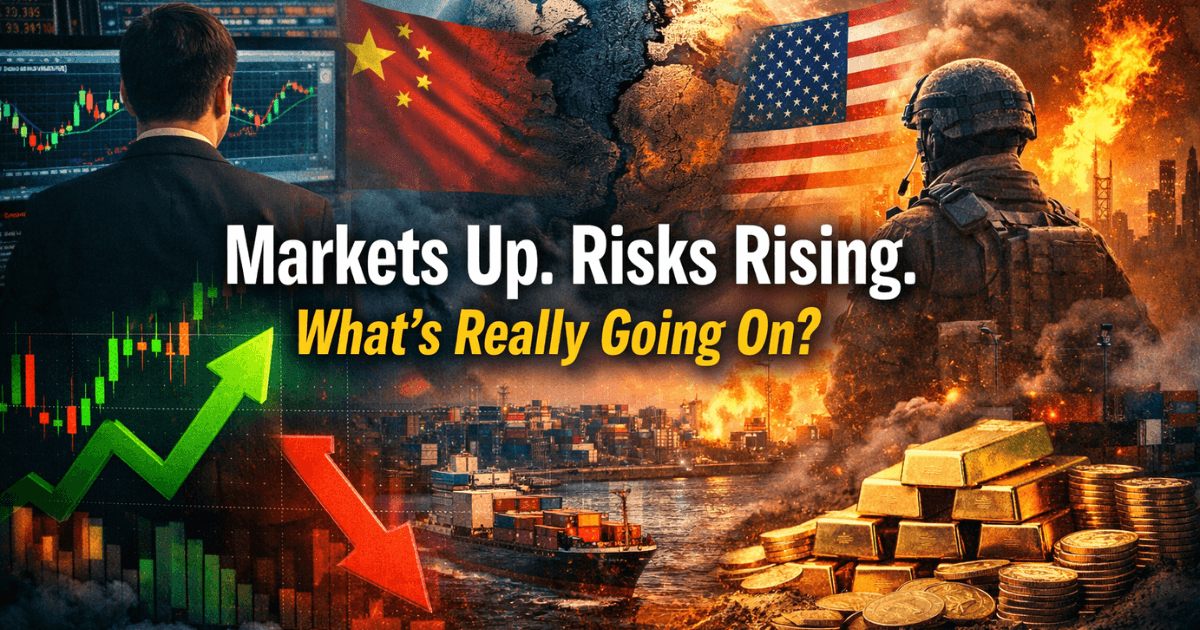
You’re watching the stock market climb… so why does the risk backdrop feel heavier?
You check the stock market before your second coffee. Indexes are holding near highs. Headlines sound confident. Commentators talk about momentum. Yet somewhere between the charts and the chatter, a quieter question pops up: why are markets still rising despite global economic tensions stacking up? That tension—between price action and reality—is exactly where careful investors live right now. And if you’re investing during economic uncertainty, understanding that gap matters more than chasing the latest green candle. Let’s break it down calmly, clearly, and without the usual financial theater.
When Global Economic Tensions Turn Into Market Risk
Global economic tensions aren’t background noise anymore. According to the World Economic Forum, geoeconomic risk now ranks among the most immediate threats to financial markets. Trade restrictions, sanctions, supply-chain reshoring, and resource competition are shaping how capital moves. These pressures affect everything from earnings forecasts to currency flows. For investors, geopolitical risk has become a practical input rather than a theoretical one. At Davos, policymakers and CEOs kept circling the same idea: economic pressure is now a frontline tool. Markets feel that shift, even when prices don’t immediately react. Investor Radar: Geopolitical tensions affect markets slowly—until they don’t. Portfolio risk management now includes global policy decisions.
Why the Market Rally Keeps Going Anyway
Here’s the part that confuses most people: a market rally doesn’t require global calm. It requires enough confidence, enough liquidity, and a story investors are willing to buy. Corporate balance sheets remain strong. Earnings visibility hasn’t collapsed. AI investment themes still attract capital. That confidence helped push Alphabet briefly past a $4 trillion market cap, reinforcing the idea that select growth narratives still work. Holiday-season trading dynamics also matter. Lower volumes often exaggerate price moves, allowing markets to drift higher without heavy resistance. Markets aren’t denying economic risk. They’re prioritizing what still produces returns. Tactical Insight: Stock market trends follow cash flow first, fear second. Risk often gets priced late.
Market Rotation Beyond Big Tech Is Gaining Momentum
While mega-cap technology stocks dominate headlines, a quieter market rotation has been unfolding beneath the surface. Small-cap stocks, healthcare, financials, and even gold have drawn renewed interest. Investors are responding to stretched valuations in big tech and looking for balance elsewhere. Equal-weight indexes have quietly outperformed, signaling healthier market breadth. This shift doesn’t look dramatic on social media. It seems deliberate in institutional portfolios. For investors considering diversification amid market volatility, that rotation matters far more than any single headline. Smart Capital Signal: Breadth strengthens markets. Broader participation often signals durability, not weakness.
Holiday Markets Reveal Investor Behaviour
Seasonality plays an underrated role in financial markets. During holiday periods, liquidity thins, noise drops, and real conviction becomes easier to spot. Experienced investors don’t chase momentum during these windows. They watch how capital behaves. Which sectors hold steady without hype? Which assets attract quiet accumulation? Which investments fail to break despite negative headlines? Those answers often guide long-term investment strategies during market volatility better than short-term price moves. Portfolio Compass: Thin markets expose intent. Investor behavior becomes clearer when participation drops.
So Why Are Markets Still Climbing Despite Rising Risk?
Markets continue climbing because economic risk hasn’t forced a reset yet. Earnings remain intact. Liquidity still flows. Confidence, while cautious, hasn’t cracked. Markets also excel at normalizing tension. Global macro risks become part of the landscape, not a trigger—until something disrupts that balance. The real mistake isn’t trusting the rally. The real error is assuming rising prices equal safety. For investors focused on risk management strategies, flexibility matters more than prediction.
Final Words: Calm Markets, Conditional Confidence
Markets aren’t lying to you. They’re functioning within current constraints. Prices reflect what investors can see clearly, not what might emerge later. For you, the goal isn’t panic or paralysis. The goal is awareness. Diversification. Discipline. A willingness to enjoy the upside without forgetting exits exist. Global economic tensions will continue to shape financial markets. Market volatility will return when expectations shift. Prepared investors won’t be surprised—they’ll already be positioned. Because the strongest portfolios aren’t built on certainty. They’re built on adaptability.
Sources
- World Economic Forum – Global Risks Outlook
- Fortune – CEO Risk Perception and Global Economic Outlook
- Barron’s – Alphabet Reaches $4 Trillion Market Capitalization
- AP News – Stock Market Performance and Market Breadth
- MarketWatch – Market Rotation Beyond Big Tech
Market Munchies and Mode Mobile communications are for informational purposes only, and are not a recommendation, solicitation, or research report relating to any investment strategy, security, or digital asset. All investments involve risk including the loss of principal and past performance does not guarantee future results.
Any information contained in this commentary does not purport to be a complete description of the securities, markets, or developments referred to in this material. The information has been obtained from sources considered to be reliable, but we do not guarantee that the foregoing material is accurate or complete. There is no guarantee that any statements or opinions provided herein will prove to be correct.