Global Growth Gets a Reality Check—But Markets Still Want Dessert
🥄 Stirring the Pot: Is the Global Economy Cooking or Just Simmering? Let’s talk macro—not the dull spreadsheet kind, but the kind that affects your portfolio and your next move. Recent data releases just dropped like a clatter of lids in a busy kitchen. The U.S. economy…
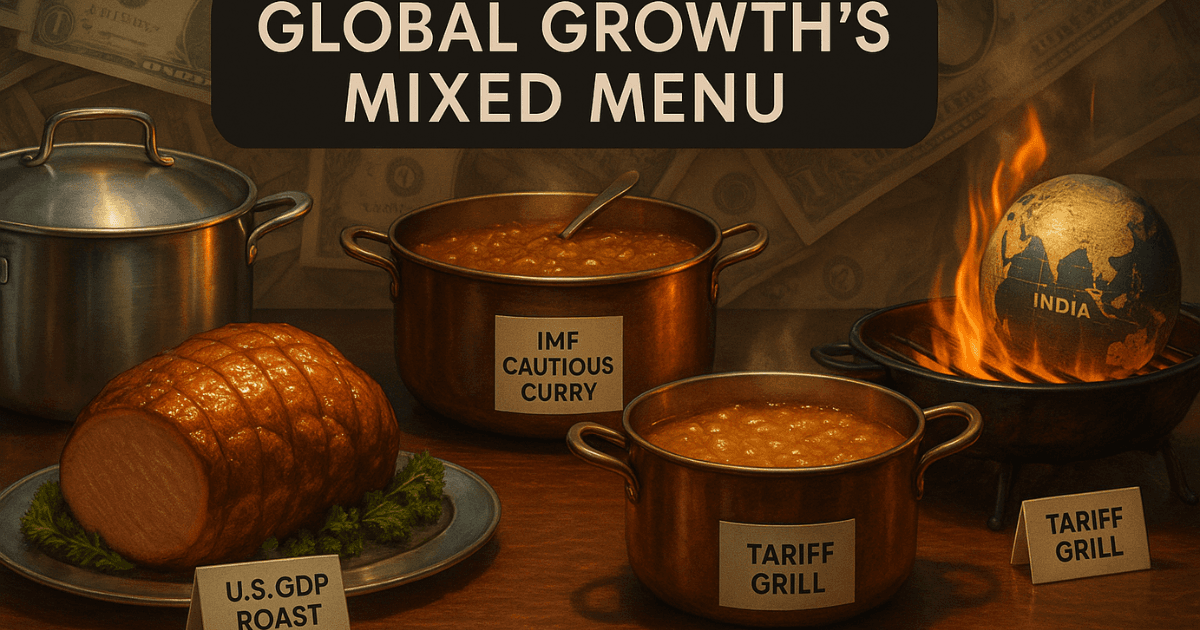
🥄 Stirring the Pot: Is the Global Economy Cooking or Just Simmering?
Let’s talk macro—not the dull spreadsheet kind, but the kind that affects your portfolio and your next move. Recent data releases just dropped like a clatter of lids in a busy kitchen. The U.S. economy clocked a 3.0% growth rate in Q2, sounding like a strong rebound from the prior quarter’s −0.5%. Meanwhile, inflation appears to be cooling, global institutions are serving up conflicting growth forecasts, and Trump has reignited the tariff grill with India. If you’re wondering whether to reach for the salt or sugar—let’s plate up the details.
🇺🇸 U.S. GDP: Tastes Like Growth, But Is It Fully Cooked?
The Bureau of Economic Analysis served up a surprisingly strong 3.0% GDP growth in Q2. That’s a big turnaround from Q1’s contraction. The main ingredients? Consumer spending remained solid, imports declined, and private investment in inventories finally contributed. On the inflation side, the Personal Consumption Expenditures (PCE) index—the Fed’s favorite thermometer—cooled to 2.1% YoY, with core PCE (ex-food and energy) at 2.5%. That’s still sticky, but trending in the right direction. However, it's important to note that the real underlying momentum, which excludes inventories and trade noise, is closer to 1.2%. So, maybe don’t serve this one medium-rare just yet.
"The U.S. economy is proving more resilient than expected, but the internals still show fragility," noted Deloitte’s senior economist.
Smart Capital Signal: While headline growth is appealing, it should always be balanced. Inventory boosts and import drops are short-term flavorings—core demand still needs more heat.
🌍 IMF’s Global Forecast: Slight Upgrade, Plenty of Caveats
In its latest update, the International Monetary Fund (IMF) nudged up its 2025 global growth forecast to 3.0% and 3.1% for 2026. Why the optimism?
- Major economies, such as the U.S., India, and Japan, are outperforming expectations.
- The European services sector is finally showing signs of life.
- Labor markets, despite the noise, remain tight and supportive.
But don’t get too comfortable. The IMF also flagged rising geopolitical risk, fiscal slippage, and a growing cloud of tariff tension—particularly between major economies such as the U.S., China, and India.
“Growth is intact, but uncertainty is the new baseline,” said IMF chief economist Pierre-Olivier Gourinchas.
📌 Tactical Insight: Even as numbers rise, so do risks. Be selective. Quality over quantity in global exposure will matter more as macro clouds gather.
📉 World Bank: Less Butter, More Burn
Not everyone’s seeing the same upside. The World Bank cut its 2025 global growth forecast to 2.3%, citing worsening trade dynamics and fragile investment sentiment. Their reasons are hard to ignore:
- Trade is becoming more fragmented with new tariff regimes emerging.
- Private investment remains muted in emerging markets due to currency risks and capital constraints.
- Debt servicing is surging, especially in low-income countries.
This divergence between the IMF and World Bank outlooks underscores a fundamental reality: global growth is uneven, and no single indicator tells the whole story. 🔍 Investor Radar: Watch the weak links. Global equity baskets may rise on average, but smart capital follows durability—not just momentum.
🇺🇸🇮🇳 Trump’s India Tariffs: New Spice in the Trade Stew
In a fresh twist, President Trump announced 25% tariffs on Indian imports, effective August 1. The rationale? India’s ongoing purchase of Russian oil. The tariffs affected pharmaceuticals, textiles, and food products, worth nearly $9 billion in U.S. imports. India is reportedly considering retaliation, and a WTO challenge may be forthcoming.
“Energy sovereignty must come with accountability,” Trump stated at a recent rally.
Global markets didn’t take this lightly. Indian equities declined by over 1.4%, and currency volatility increased. While the action was narrowly targeted, it’s yet another sign of a return to aggressive trade policies, just as supply chains were beginning to exhale. ⚠️ Global Positioning Cue: Tariffs are back on the menu. Diversify supply chain bets and maintain agile exposure—especially in emerging markets that are prone to U.S. scrutiny.
⛽ Commodities Still Reacting to Trade Whiplash
Even with a pause in new China tariffs, markets remain jittery. Energy prices saw movement, with oil up 3% and lithium trading mixed due to uncertainty over EV demand. Volatility indices, such as the VIX, nudged higher, reflecting deeper investor caution. U.S. equity indexes held steady, but momentum is thinning. In Europe and Asia, minor gains reflect tentative optimism—but no one’s all-in. 📈 Capital Flow Filter: Markets are sensitive to macro mood swings. Don’t chase commodity rallies unthinkingly—pair them with geopolitical foresight and supply-side clarity.
🍰 Closing Course: Don’t Let the Sugar High Fool You
Yes, the global economy looks alive again on the surface—growth numbers are improving, inflation is cooling, and the IMF is cautiously upbeat. But the deeper flavors tell a more nuanced story: fragmentation, trade instability, and shallow recoveries in key regions. For investors, the present isn’t a moment to fear—but it is a moment to focus. Macro noise is high, but so is the opportunity for those who can read between the headlines. Resilient returns will come from a resilience-aware strategy: less sizzle, more substance.
🧾 Sources
Market Munchies and Mode Mobile communications are for informational purposes only, and are not a recommendation, solicitation, or research report relating to any investment strategy, security, or digital asset. All investments involve risk including the loss of principal and past performance does not guarantee future results.
Any information contained in this commentary does not purport to be a complete description of the securities, markets, or developments referred to in this material. The information has been obtained from sources considered to be reliable, but we do not guarantee that the foregoing material is accurate or complete. There is no guarantee that any statements or opinions provided herein will prove to be correct.