🌍 Global Growth Slows Again—But the Real Risk Isn’t What You Think
🤔 Feeling Like the Economy Is "Fine"… But Slightly Off? Ever had that moment where everything looks normal on the surface—but something quietly feels… off? Markets aren't crashing. Headlines aren't screaming panic. Yet growth forecasts are slipping, inflation refuses to…
🤔 Feeling Like the Economy Is "Fine"… But Slightly Off?
Ever had that moment where everything looks normal on the surface—but something quietly feels… off?
Markets aren't crashing. Headlines aren't screaming panic. Yet growth forecasts are slipping, inflation refuses to behave, and global confidence feels thinner than it should be.
The latest update from the International Monetary Fund (IMF) didn't trigger chaos—but it did something more subtle—and, arguably, more important.
It confirmed a shift.
Not a collapse. Not a boom.
A slow, uncomfortable squeeze on global growth—with a new and very specific trigger at its center.
Let's break down what's really happening—and what it means for your capital.
📉 IMF Cuts Growth Outlook: A Quiet Warning, Not a Crisis
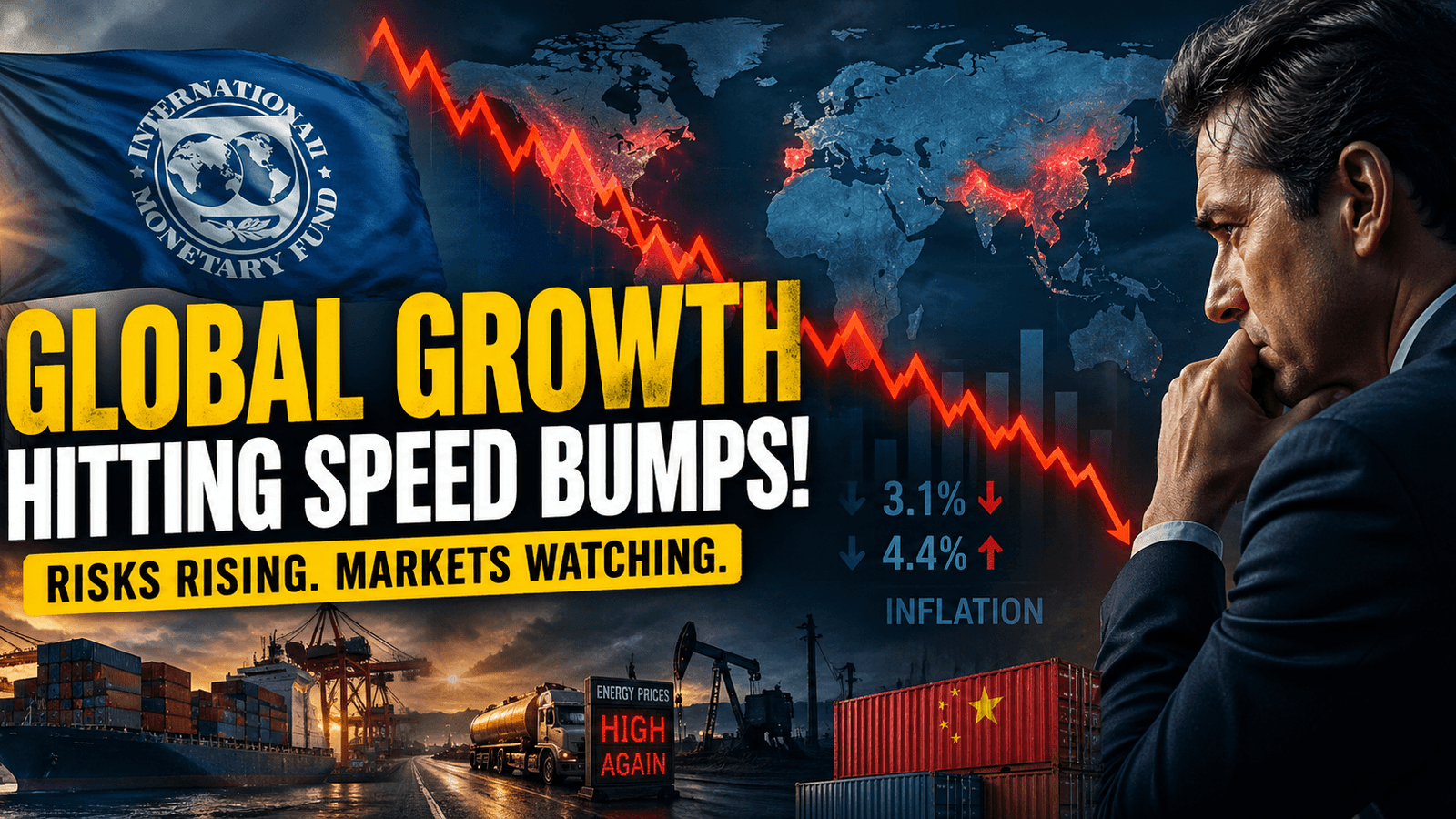
Global growth expectations have been trimmed to ~3.1%, while inflation projections creep higher toward ~4.4%.
On paper, that doesn't sound dramatic.
In reality? It's a signal.
Growth is cooling without inflation fully cooling alongside it—a tricky combo investors don't love.
The IMF's April 2026 World Economic Outlook—titled "Global Economy in the Shadow of War"—centers its entire analysis on a single, acute catalyst: the outbreak of war in the Middle East. This isn't a slow-burn structural story. It's a live shock, and markets are still absorbing it.
Behind the downgrade:
- Energy prices spiking on Middle East supply fears
- Trade flows disrupted by geopolitical instability
- Tight financial conditions limiting expansion
Even more telling, the IMF models out two darker scenarios. If the conflict broadens or drags on, growth could fall to 2.5%—or as low as 2% in a severe case. That's recession-adjacent territory.
💡 Smart Capital Signal:
A war-driven energy shock paired with stubborn inflation creates a "no easy win" macro environment—central banks can't ease aggressively, and growth can't accelerate freely.
⚡ Europe’s Energy Problem: The Pressure Cooker Nobody Escapes
Europe isn't just slowing—it's absorbing a full-blown cost shock, and the source is now unmistakable.
The surge in oil and gas prices since the start of the conflict in the Middle East has hit European manufacturers especially hard, pushing up overall inflation and raising costs across energy-intensive industries.
Germany, the region's industrial backbone, cut its 2026 growth forecast in half—from 1% down to just 0.5%. That's not a dip. It's a near-stall, and it happened fast.
Meanwhile:
- Manufacturing activity is weakening
- Supply chain snarls are delaying vital base products
- Consumers are facing higher costs, especially at the pump
Germany's challenge is both structural and immediate. As a net energy importer reliant on heavy industry, rising oil and gas costs hit harder and faster—and this time, industry was barely getting back on its feet from the Ukraine-era energy shock when the new one arrived.
🔎 Investor Radar:
War-driven energy inflation tends to linger longer than expected—and often drags entire regions into prolonged slowdowns. The speed of Germany's forecast revision is a warning sign worth watching.
🌐 Trade Tensions: The Slow Burn Dragging Everything Down
Global trade used to be the engine of growth. Now? It's becoming friction.
The IMF flags geopolitical fragmentation and trade reorientation as persistent drags on global activity—though there's a nuance worth noting. The reduction of some tariff rates earlier this year partially offset the IMF's downward revision, suggesting the trade picture isn't uniformly getting worse. But supply chains are still being rebuilt for security and resilience rather than efficiency.
That sounds smart. It also comes at a cost.
- Higher production expenses
- Slower cross-border flows
- Reduced global efficiency
Businesses are adapting—but not cheaply.
📊 Tactical Insight:
De-globalization doesn't crash markets overnight—it gradually lowers growth potential, quarter after quarter. And when layered on top of an acute geopolitical shock, it amplifies the damage.
🇨🇳 China's Outlook: More Nuanced Than It Looks
China's growth forecast has settled at ~4.4%—a modest step down from 5% in 2025—and the story here is more complicated than simple export weakness.
On one hand, the Middle East conflict creates headwinds through weaker global demand and energy cost pressures. On the other, China got a modest tailwind earlier this year when U.S. tariff rates were reduced following a Supreme Court ruling, which softened the effective trade burden. Additional fiscal support has also provided a buffer.
The net result: a gradual slowdown, not a collapse.
Still, when China's momentum fades—even slightly—the ripple effects matter:
- Commodity demand softens
- Emerging markets feel the drag
- Global trade loses a key engine
🧠 Macro Lens:
China doesn't need to crash to impact global markets—a gradual slowdown is enough to shift the entire demand curve. And the geopolitical uncertainty surrounding the broader Middle East conflict adds a layer of unpredictability to the trade picture.
🔗 The Bigger Picture: A New Macro Recipe Is Forming
Put all the pieces together, and a pattern emerges:
- A Middle East war sparks an energy shock
- Energy prices push inflation higher
- Inflation keeps monetary policy tight
- Tight conditions slow growth
- Trade fragmentation reduces efficiency
- China's slowdown weakens global demand
That's not a single problem. That's several, all feeding into each other—and all radiating from the same geopolitical epicenter.
⚠️ Strategic Perspective:
Expect more volatility without clear direction—not panic-driven swings, but persistent uncertainty shaped by a conflict whose duration and scope remain genuinely unknown.
🍷 Final Pour: Growth Isn’t Gone—It’s Just Getting Harder
Growth hasn't disappeared. It's just… harder to find.
The IMF's base case assumes the Middle East conflict stays limited and that disruptions fade by mid-year. If that holds, the global economy muddles through at 3.1%—slow, but stable.
If it doesn't? The math gets considerably worse.
What's clear either way is that the world that replaces easy global expansion—powered by cheap energy, smooth trade, and synchronized demand—is one where:
- Growth is slower
- Inflation is stickier
- Shocks travel faster
Not dramatic enough for headlines. But meaningful enough to reshape portfolios.
🎯 Closing Thought:
Smart investing in this environment isn't about chasing the next boom.
It's about recognizing the shift early— and positioning before the crowd realizes the rules have changed.
🔗 Sources
Market Munchies and Mode Mobile communications are for informational purposes only, and are not a recommendation, solicitation, or research report relating to any investment strategy, security, or digital asset. All investments involve risk including the loss of principal and past performance does not guarantee future results.
Any information contained in this commentary does not purport to be a complete description of the securities, markets, or developments referred to in this material. The information has been obtained from sources considered to be reliable, but we do not guarantee that the foregoing material is accurate or complete. There is no guarantee that any statements or opinions provided herein will prove to be correct.