Global Tariff Chess: Is the Trade War Cooling or Just Reheating?
♟️ High-Stakes Trade Tension Is Back—But With a Twist The global economic stovetop is heating up again, and this time it’s not just China in the frying pan. With new U.S. tariffs targeting the EU, Mexico, Japan, and South Korea —all set to take effect on August 1—investors are…
♟️ High-Stakes Trade Tension Is Back—But With a Twist
The global economic stovetop is heating up again, and this time it’s not just China in the frying pan. With new U.S. tariffs targeting the EU, Mexico, Japan, and South Korea—all set to take effect on August 1—investors are watching the markets with cautious curiosity. But it’s not just the size of the tariffs (a sizzling 30%) that’s making headlines. It’s the unexpected strategic diplomatic footwork unfolding behind closed doors. From the U.S.–Japan tariff compromise to eleventh-hour deals with the EU, a subtler pattern is emerging: a tactical retreat disguised as pressure, accompanied by a dose of political theater. Meanwhile, the Federal Reserve is being scrutinized over its independence as political pressure threatens to influence monetary policy. Let’s unpack this multi-course trade affair—and what smart investors should be digesting right now.
🇺🇸 Trump's 30% Tariff Blitz: Real Threat or Tactical Bluff?
President Trump didn’t mince words when he declared 30% tariffs on a suite of global partners—including the EU, Mexico, Japan, and South Korea—effective August 1. Canada faces an even spicier 35%, and tech sectors in Japan and Korea are bracing for collateral damage. Trump’s message, posted via Truth Social, was clear: “Our trade partners must stop freeloading off American innovation.” Yet markets have shown signs of skepticism, interpreting the escalation as a negotiation tactic rather than an inevitable blow. In fact, most trade observers view this move as an attempt to extract last-minute concessions before the tariffs take effect. Smart Capital Signal: While the numbers may appear aggressive, investors should watch not just the tariff rate but also the pace of negotiations. Rapid backchannels and diplomatic meetings suggest the 30% ceiling may be more bark than bite.
🇯🇵 Japan–U.S. Deal: A 15% Tariff That’s Easier to Swallow 🍣
The first sign that the tariff storm might be easing came from Tokyo. On July 23, Japan signed a trade deal with the U.S., reducing the expected tariff from 25% to a flat 15%—applicable to autos, electronics, and key tech components. In return, Japan pledged over $550 billion in U.S. investments and granted American farmers better access to Japan’s tightly protected agricultural market. Steel and aluminum, however, were left at a searing 50%—a nod to domestic politics in both capitals. Still, the compromise brought relief across Asian markets and helped stabilize investor sentiment in auto and tech sectors. Critics in Detroit, though, were less enthusiastic: U.S. automakers argue that the deal punishes North American production by favoring foreign-built cars. Tactical Insight: For investors, Japan’s agreement is a template. Expect similar 15% tariff ceilings and reciprocal investment commitments across future deals. Eyes should remain on capital flow announcements—not just headlines.
🇪🇺 EU’s Close Call: From Trade War to Trade Win?
The EU’s response was anything but passive. Officials prepped countermeasures targeting up to €93 billion in U.S. goods, ready to launch within days of any escalation. But just before markets could spiral, President Trump met with EU Commission President Ursula von der Leyen in Scotland. What emerged? A broad trade framework mimicking the Japan deal—anchored by a 15% blanket tariff, paired with $600 billion in European investment promises across U.S. energy, defense, and infrastructure sectors. Von der Leyen admitted it wasn’t a zero-for-zero ideal but said the EU “chose stability over escalation.” Steel and aluminum? Still at 50%, consistent with the new tariff template. Investor Radar: This isn’t a retreat—it’s a recalibration. The EU deal suggests a new global norm: tolerate mid-range tariffs in exchange for policy stability. Investors betting on transatlantic supply chains may find calmer waters ahead.
🏛️ Fed vs. Trump: The Rate-Cut Tug-of-War
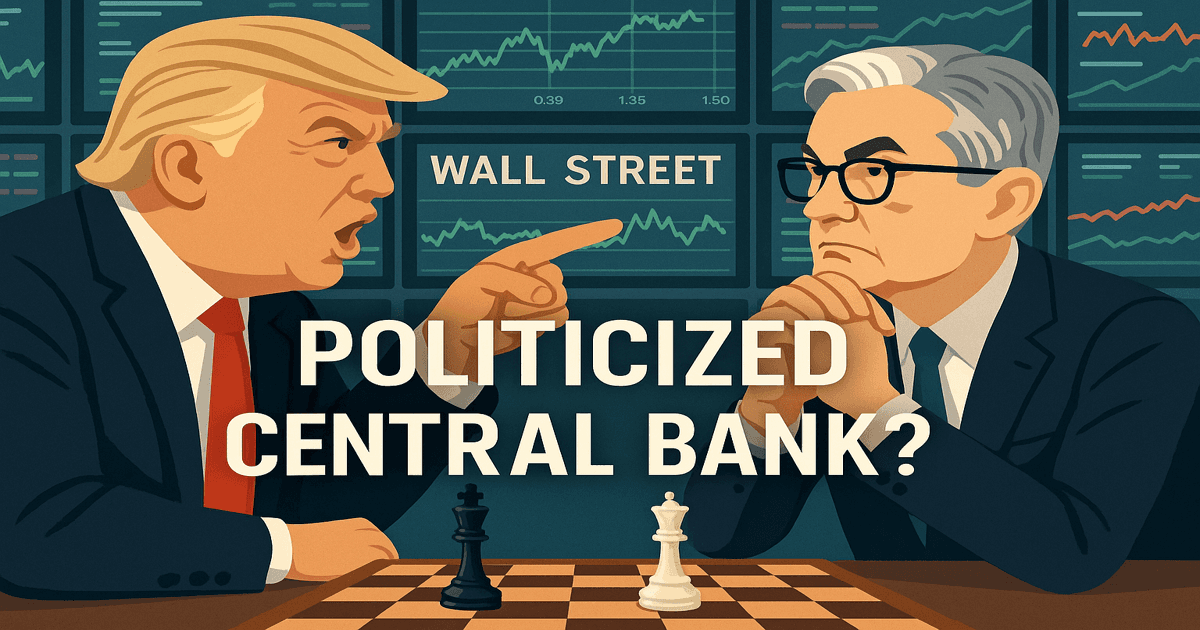
As if the global trade chessboard wasn’t dramatic enough, Trump turned his attention back home—targeting Federal Reserve Chair Jerome Powell with open criticism. In recent comments, he referred to Powell as a “numbskull” and advocated for interest rate cuts to 1%, suggesting that Powell might be removed after the 2026 election. Meanwhile, Powell has remained stoic, adhering to data-driven decision-making and avoiding any political entanglements. The Fed is expected to hold rates between 4.25% and 4.50%, but markets are beginning to price in political risk—and the implications could be big. U.S. bond credibility relies on federal independence. Undermining that could inject volatility into Treasury yields, credit markets, and global rate expectations. Policy Watch Note: Any signals of Fed interference are red flags for macro investors. A politicized central bank could raise the cost of capital and destabilize inflation expectations.
🧠 Final Bite: Is Global Trade Entering a New Normal?
What initially appeared to be the makings of a full-scale trade war has pivoted—at least for now—into something more complex: a “managed pressure” strategy. Instead of blanket protectionism, we’re seeing 15% tariffs become the new handshake rate, paired with strategic investments and policy pledges. It’s not a zero-sum game, but it’s not free trade either. For investors, this means the new global order is one of reluctant compromise—not all-out war.
In this environment, watch for winners in logistics, alternative sourcing, and domestic manufacturing. Avoid sectors still vulnerable to sudden tariff spikes—especially those lacking political insulation.
🔗 Sources
Market Munchies and Mode Mobile communications are for informational purposes only, and are not a recommendation, solicitation, or research report relating to any investment strategy, security, or digital asset. All investments involve risk including the loss of principal and past performance does not guarantee future results.
Any information contained in this commentary does not purport to be a complete description of the securities, markets, or developments referred to in this material. The information has been obtained from sources considered to be reliable, but we do not guarantee that the foregoing material is accurate or complete. There is no guarantee that any statements or opinions provided herein will prove to be correct.