Greg Abel Just Passed His First Test. Here's What the New Berkshire CEO Showed Investors.
Six minutes into Saturday's Berkshire Hathaway annual meeting in Omaha, a jersey bearing the number 60 — representing Warren Buffett's sixty years as CEO — was raised to the rafters of CHI Health Center. A three-minute video followed. Then Buffett spoke from his seat on the…
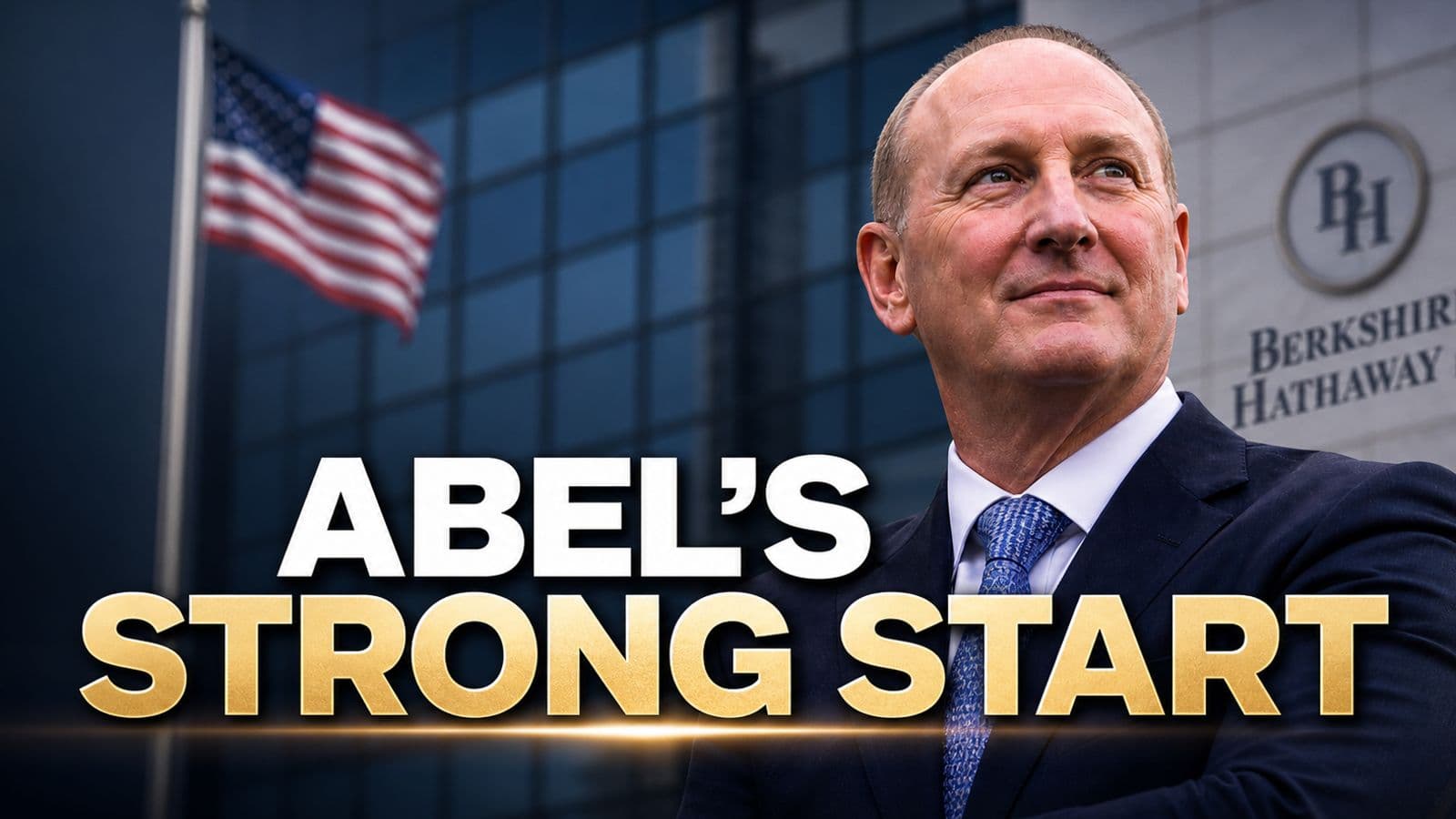
Six minutes into Saturday's Berkshire Hathaway annual meeting in Omaha, a jersey bearing the number 60 — representing Warren Buffett's sixty years as CEO — was raised to the rafters of CHI Health Center. A three-minute video followed. Then Buffett spoke from his seat on the floor, not from the stage. "This is not my show today," he said.
It was Greg Abel's show. And by most accounts, he handled it.
Roughly 40,000 shareholders made the trip to Omaha for the first meeting in six decades without Buffett at the podium. The crowd was smaller than prior years — several thousand seats were visibly empty in an arena that once required lotteries for access — but those who came were satisfied with what they saw. "He gave us a lot of detail on the business, touched on a lot of different businesses, demonstrated that he understood them, understood the risks, understood the opportunities," said Adam Mead, CEO of Mead Capital Management. "He's done his homework and he is absolutely the leader that Warren told us he would be."
Buffett himself was more direct. "Greg is doing everything I did and then some," he told shareholders from his seat, "and he's doing it better in all cases."
The Numbers He Walked In With
Abel's first meeting as CEO came alongside Berkshire's Q1 2026 earnings — the company's first report under his leadership — and the results gave him solid ground to stand on.
Operating profit from wholly owned units rose 18% year over year. Insurance underwriting led the gains, climbing 28.5% to approximately $1.7 billion — the division that had historically been Buffett's greatest pride and that Abel had spent the past two years deepening his relationship with after years of running the non-insurance side. GEICO and the reinsurance group both contributed.
The cash pile grew to a record $397.4 billion, up from approximately $389 billion at year-end 2025. That buildup came as Berkshire was a net seller of equities — roughly $24.1 billion in stock sales against $16 billion in purchases during the quarter. Berkshire resumed share repurchases on March 4, after pausing earlier in the year, signaling that Abel views the stock as attractively priced at current levels.
The one soft note: Berkshire shares have fallen approximately 6% year to date, lagging the S&P 500's 5.6% gain. That relative underperformance was the unspoken context hovering over the weekend.
What Abel Said — and How He Said It
Abel's presentation style is notably different from Buffett's, and Saturday made that difference visible.
Where Buffett operated through folksy anecdote and layered wit, Abel presented systematically — walking through business units, discussing operational improvements, addressing risks directly. He covered BNSF Railway's efforts to improve on-time performance and reduce costs. He discussed GEICO's profitability recovery. He talked about Berkshire Hathaway Energy's position in the AI data center power buildout, taking a position that will define future capital allocation: "The hyperscalers, the data centers, and the users of energy — they have to bear the full cost," he said, pushing back on the idea that data center electricity demand should be subsidized by grid consumers.
On artificial intelligence broadly, he was measured. Berkshire would deploy AI "in a form that is narrow in scope and focused on creating value propositions," he said. The company was not "going to do AI for the sake of AI." He acknowledged risks to "humanity" tied to the technology that Berkshire was keeping in mind. It was not the kind of AI commentary that generates a stock pop. It was the kind that suggests an operator who has thought carefully about what the technology can actually do inside a railroad, an insurance business, and a utility — and is not interested in sounding more excited than the evidence warrants.
The moment that most closely recalled the Buffett-Munger dynamic came during a question about Hormuz insurance. When asked whether Berkshire would consider underwriting ships crossing the closed strait, insurance chief Ajit Jain replied: "The short answer is, it depends on the price." The audience laughed. Abel looked at Jain and said: "I like your Charlie answer." The exchange was the meeting's most quoted moment by close of day — a small signal that the culture Buffett built around wit, patience, and price discipline has not left the building with him.
The $397 Billion Question Nobody Got a Clean Answer To
The question every investor brought to Omaha was the same one they left with: what is Abel going to do with $397 billion in cash?
He did not answer it directly. What he said was that Berkshire remained selective, that valuations on many businesses he found interesting were too high, and that patience remained the governing principle. "We've identified several firms with interesting management and operations," he said, "but we're not interested in buying or investing in them because of their high valuations."
That is faithful to Buffett's doctrine. It also means that $397 billion continues to compound in T-bills while Berkshire waits for the fat pitch. The question of whether Abel will be patient on the Buffett timescale — years, not quarters — or whether the pressure of managing a $1 trillion conglomerate with a record cash balance will push him toward more active deployment is the one that Saturday's meeting left genuinely open.
There are hints of where the capital might eventually land. Abel's background is in energy and utilities — he ran Berkshire Hathaway Energy for years before becoming CEO — and the recently completed $9.7 billion OxyChem acquisition serves as the most obvious blueprint for how he will deploy capital going forward: a high-quality industrial business with durable cash flows, acquired at a price that reflects Berkshire's patience rather than its urgency. Analysts expect bolt-on acquisitions in energy and industrials to remain Abel's primary deployment vehicle, with his deeper sector knowledge giving him conviction that Buffett — a generalist investor by inclination — did not always bring to those categories.
The other deployment question Abel did not answer directly was the one institutional investors have been loudest about: a dividend. With Buffett off the stage, Wall Street speculation about whether Abel will institute Berkshire's first-ever dividend to bleed off the record cash pile has been running at its highest level in the conglomerate's history. Abel signaled continued preference for buybacks over dividends — consistent with Buffett's longstanding doctrine that returning cash via repurchases is more tax-efficient for shareholders. But the institutional pressure to monetize $397 billion in a way that produces recurring income is higher than it has ever been, and it will not diminish until the capital is demonstrably deployed at returns that justify the wait.
What This Means for Investors
The short answer from Saturday is that the Berkshire transition has not broken anything. The operating businesses are performing. The insurance engine is running well. The decentralized culture is intact. Abel clearly understands every corner of the empire he inherited.
The harder question is whether Berkshire's investment thesis remains as compelling under Abel as it was under Buffett. The stock has underperformed the S&P 500 year to date — not dramatically, but enough to signal that the market is withholding its judgment on whether Abel can deploy capital with the same returns that Buffett generated across six decades.
For long-term Berkshire holders, Saturday's meeting was reassuring without being revelatory. Abel passed the first test. The $397 billion test — when it comes, on whatever terms the market eventually offers — is the one that will define his era.
Buffett's parting shot from the audience was characteristic: "You couldn't have made a better decision." He was talking about the board's choice of Abel as his successor. He was also, as usual, talking about a longer time horizon than any single annual meeting.
Sources
- CNBC — "Berkshire Hathaway annual meeting 2026: Live updates": https://www.cnbc.com/2026/05/02/warren-buffett-berkshire-hathaway-annual-meeting-2026-live-updates.html
- CNBC — "Greg Abel rules out Berkshire break-up, stresses continuity with Buffett's legacy": https://www.cnbc.com/2026/05/03/berkshire-annual-meeting-greg-abel-rules-out-break-up-stressing-continuity-with-buffett.html
- Yahoo Finance / Bloomberg — "Berkshire Investors Praise Greg Abel at Post-Buffett Meeting": https://finance.yahoo.com/news/berkshire-meeting-highlights-tough-balancing-181631012.html
- Business Standard — "Berkshire after Buffett: CEO Greg Abel signals patience on record cash pile": https://www.business-standard.com/world-news/berkshire-hathaway-greg-abel-first-ceo-meeting-warren-buffett-cash-126050300130_1.html
- Alpha Spread — "Berkshire Hathaway Annual Meeting Puts Greg Abel in the Spotlight as Buffett Steps Aside": https://www.alphaspread.com/market-news/corporate-moves/berkshire-hathaway-annual-meeting-puts-greg-abel-in-the-spotlight-as-buffett-steps-aside
- HeyGoTrade — "Berkshire Hathaway 2026 Annual Meeting: First Without Buffett": https://www.heygotrade.com/en/blog/berkshire-hathaway-2026-annual-meeting-first-without-buffett/
- Simply Wall St — "How Greg Abel's First Shareholder Meeting at Berkshire Hathaway Has Changed Its Investment Story": https://simplywall.st/stocks/us/diversified-financials/nyse-brk.a/berkshire-hathaway/news/how-greg-abels-first-shareholder-meeting-at-berkshire-hathaw
- IBTimes AU — "Greg Abel Faces First Berkshire Hathaway Annual Meeting as CEO on May 2, 2026": https://www.ibtimes.com.au/greg-abel-faces-first-berkshire-hathaway-annual-meeting-ceo-may-2-2026-1867715
- CNBC Video — "Greg Abel on cash flow safety, investment alignment with Warren Buffett": https://www.cnbc.com/video/2026/05/02/greg-abel-on-cash-flow-safety-investment-alignment-with-warren-buffett.html
- Berkshire Hathaway — Q1 2026 Earnings Release (SEC Form 10-Q): https://www.berkshirehathaway.com/qtrly/1stqtr26.pdf
Market Munchies and Mode Mobile communications are for informational purposes only, and are not a recommendation, solicitation, or research report relating to any investment strategy, security, or digital asset. All investments involve risk including the loss of principal and past performance does not guarantee future results.
Any information contained in this commentary does not purport to be a complete description of the securities, markets, or developments referred to in this material. The information has been obtained from sources considered to be reliable, but we do not guarantee that the foregoing material is accurate or complete. There is no guarantee that any statements or opinions provided herein will prove to be correct.