Hedge Funds Dumped Over $2 Billion in Bitcoin ETF Shares Last Quarter
📉 The Big Exit: Hedge Funds Retreat from Bitcoin ETFs A dramatic shift is reshaping the institutional Bitcoin landscape. According to new data from CF Benchmarks , a subsidiary of the Kraken crypto exchange, aggregate Bitcoin ETF allocations among the largest hedge fund…
📉 The Big Exit: Hedge Funds Retreat from Bitcoin ETFs
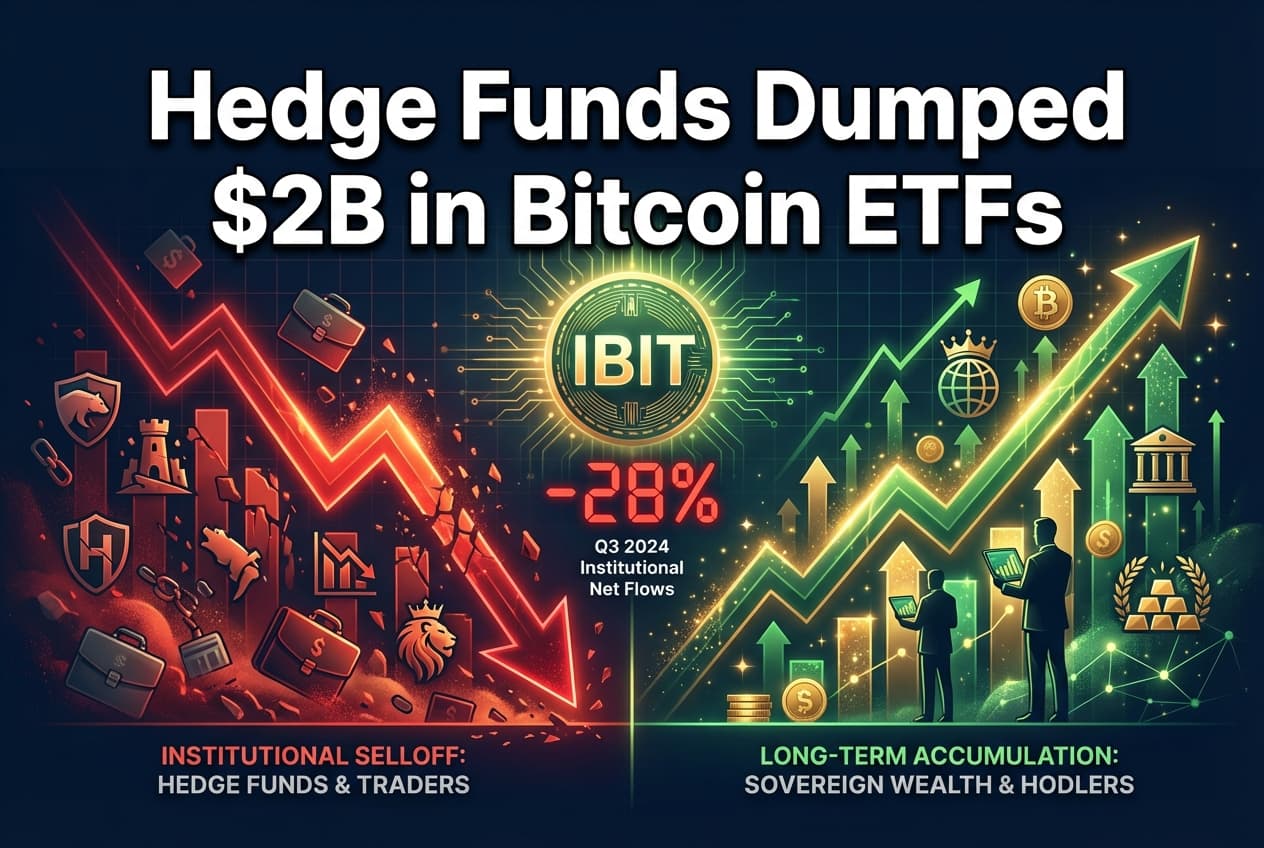
A dramatic shift is reshaping the institutional Bitcoin landscape. According to new data from CF Benchmarks, a subsidiary of the Kraken crypto exchange, aggregate Bitcoin ETF allocations among the largest hedge fund holders fell 28% between Q3 and Q4 2025. That translated to holders selling over 25,000 BTC worth of Bitcoin ETF shares in a single quarter. In dollar terms, the selling was even more striking: Brevan Howard alone slashed its position in BlackRock's iShares Bitcoin Trust (IBIT) by 86%, reducing holdings from roughly $2.4 billion to just $275 million. The moves were documented in SEC 13F filings, the quarterly disclosures required of institutional managers with at least $100 million under management, making them among the clearest windows into how professional money is actually deployed.
🔍 What Triggered the Selloff
The catalyst for the hedge fund retreat is largely mechanical. For much of 2024 and into 2025, funds exploited what is known as the Bitcoin basis trade, a strategy that captures the spread between spot Bitcoin ETFs and CME futures contracts. This arbitrage generated annualized returns of 15% to 25% at its peak. When Bitcoin surged to a new all-time high above $126,000 in October 2025, speculative positioning built rapidly beneath the surface. Then the blow-off top arrived. As Gabe Selby, head of research at CF Benchmarks, wrote in a February 19 research note, "The dominant theme of the last two quarters is hedge fund de-risking. The October blow-off top appears to have triggered systematic position reductions." By early February 2026, the annualized basis trade return had compressed to around 4%, barely above short-dated U.S. Treasuries, eliminating the primary reason many hedge funds held Bitcoin ETFs in the first place.
🏦 Who Sold and Who Stayed
The selloff was not uniform. Among the largest hedge fund holders in IBIT, aggregate positions fell from 114 million shares in Q3 2025 to 82 million by Q4, a 32-million-share reduction. Beyond Brevan Howard's 86% cut, DE Shaw trimmed from 9.7 million to 4.7 million shares, Farallon Capital reduced its position by 70%, and Symmetry Investments disappeared from the top holder list entirely. In contrast, long-term capital stayed put or even added. The Emirate of Abu Dhabi increased its IBIT stake by 46% in Q4 2025. JPMorgan Chase, Mubadala, and BlackRock were among the 17 out of the top 25 institutional BTC ETF holders that actually increased positions. The pattern tells a clear story: fast-money hedge funds were the first in and the first out.
📊 Five Weeks of Bleeding into 2026
The selling did not stop at year-end. U.S. spot Bitcoin ETFs have now experienced their longest outflow streak since February 2025, with nearly $3.8 billion leaving the funds over five consecutive weeks heading into late February 2026. BlackRock's IBIT accounted for about $2.13 billion of those redemptions alone. Fidelity's FBTC contributed another $954 million during the same stretch. Total year-to-date outflows reached approximately $4.5 billion by mid-February, compared to strong net inflows during the same period in 2025. The sustained withdrawals have contributed to Bitcoin trading in a compressed range between $60,000 and $70,000, unable to break through resistance. For traders watching price action, ETF outflows have acted as a consistent headwind, amplifying selling pressure during an already uncertain macro environment.
💼 Investment Advisers Are Buying What Hedge Funds Sold
While hedge funds fled, a quieter group of institutional buyers stepped in. Investment advisers grew their aggregate IBIT holdings every single quarter over the past five quarters, from 38 million shares in Q4 2024 to over 93 million by Q4 2025, a cumulative increase of 145%. New entrants kept appearing even as Bitcoin prices dropped: ALLARIA FONDOS took a 24.7 million share position in Q4 2025, and Laurore Ltd added 8.8 million shares. CF Benchmarks notes that investment advisers "don't typically trade around short-term volatility," suggesting this capital represents a stickier, more structural form of Bitcoin exposure. Unlike hedge funds executing tactical basis trades, registered investment advisers are building Bitcoin into client portfolios as a long-term allocation. This rotation, from speculative hedge funds to long-term advisers, may ultimately represent a healthier and more stable foundation for the Bitcoin ETF market.
🎯 Conclusion
The 25,000-plus BTC selloff from Bitcoin ETF holders in Q4 2025 is a story about who owns Bitcoin ETFs and why. Hedge funds entered primarily to exploit the basis trade, not out of long-term conviction in Bitcoin as an asset. When the arbitrage compressed and Bitcoin's price fell sharply from its October peak, systematic de-risking followed. The result was a 28% reduction in aggregate hedge fund ETF exposure in a single quarter, with Brevan Howard's 86% cut serving as the most visible example. Yet the broader institutional structure is not breaking down. Investment advisers, sovereign wealth funds, and endowments continued accumulating throughout the decline. Cumulative net inflows into U.S. spot Bitcoin ETFs since their January 2024 launch still exceed $53 billion. For long-term investors, the current selloff reflects a composition change in the holder base, not an exodus, and composition changes can set the stage for more durable rallies ahead.
Sources
https://www.cfbenchmarks.com/blog/tracking-bitcoins-flows https://finance.yahoo.com/news/hedge-funds-piled-us-bitcoin-093355654.html https://www.coindesk.com/markets/2026/02/23/bitcoin-etfs-bleed-usd3-8-billion-in-historic-five-week-outflow-streak https://ambcrypto.com/institutions-reduce-bitcoin-etf-exposure-by-just-3-5-in-q4-2025-diamond-hands/ https://www.ccn.com/analysis/crypto/hedge-funds-bitcoin-etf-exposure-gold-buying/ https://www.investing.com/analysis/bitcoin-etfs-lose-45b-in-2026-as-ibit-etf-and-btc-face-a-riskoff-stress-test-200675439 https://www.disruptionbanking.com/2026/02/24/hedge-funds-dump-bitcoin-etfs-why-smart-money-is-exiting-fast-in-2026/
Market Munchies and Mode Mobile communications are for informational purposes only, and are not a recommendation, solicitation, or research report relating to any investment strategy, security, or digital asset. All investments involve risk including the loss of principal and past performance does not guarantee future results.
Any information contained in this commentary does not purport to be a complete description of the securities, markets, or developments referred to in this material. The information has been obtained from sources considered to be reliable, but we do not guarantee that the foregoing material is accurate or complete. There is no guarantee that any statements or opinions provided herein will prove to be correct.
Get fresh insights, breaking news, and hidden gems in the world of crypto—delivered straight to your inbox with our Crypto Cookies newsletter. Don't miss out—sign up now and get your first bite of insider knowledge!