Inflation Finally Caught the Oil Shock, but the Real Market Story Is Still Energy Security
Thursday’s close looked like a vote for cautious optimism. Stocks finished higher for a seventh straight session as investors took some comfort from signs that diplomacy in the Middle East might not be completely dead, with Israel signaling it wanted direct talks with Beirut…
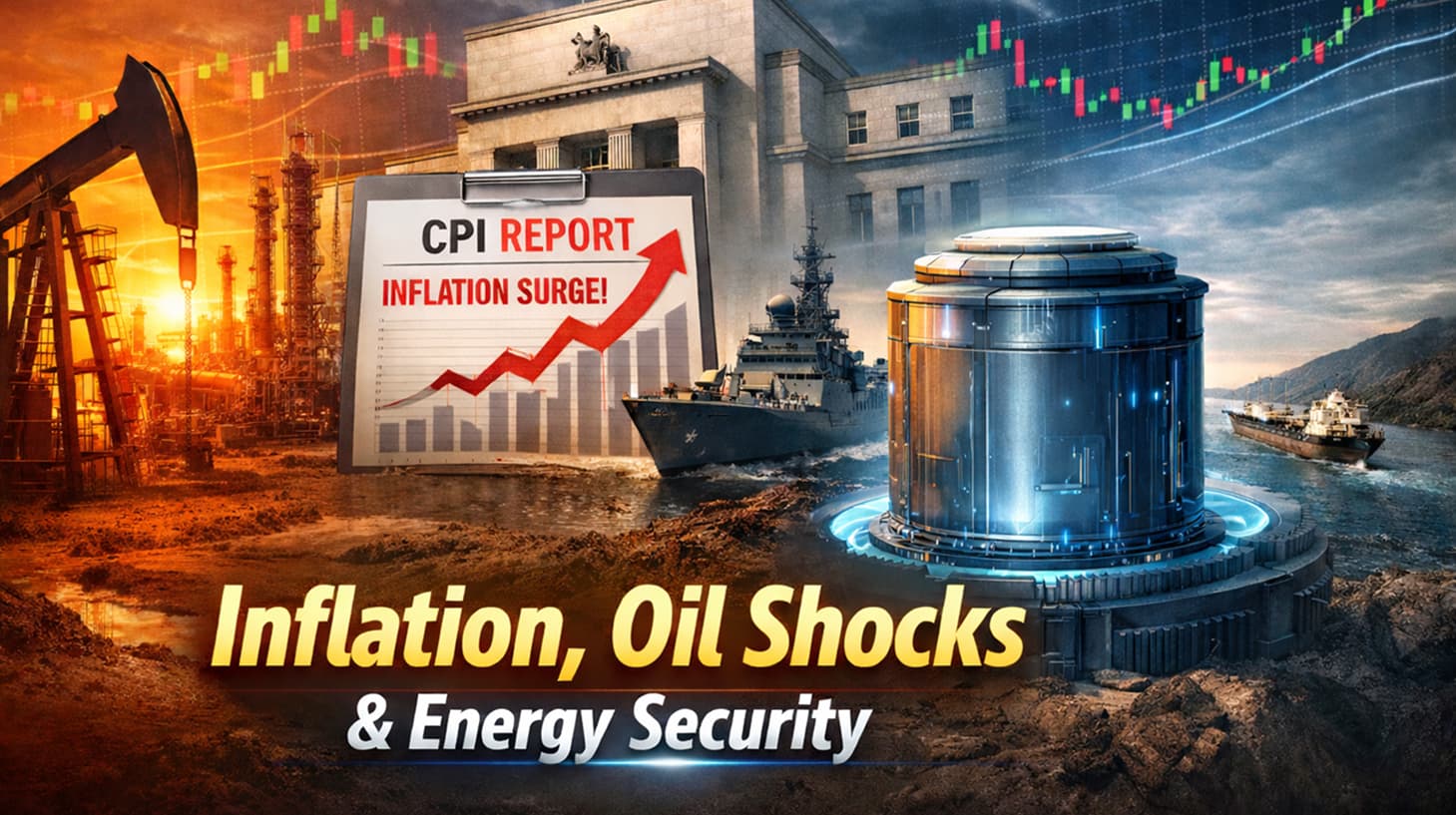
Thursday’s close looked like a vote for cautious optimism. Stocks finished higher for a seventh straight session as investors took some comfort from signs that diplomacy in the Middle East might not be completely dead, with Israel signaling it wanted direct talks with Beirut and the broader U.S.-Iran ceasefire still, at least on paper, intact. By late morning Friday, that optimism had not disappeared, but it had turned far more selective: the broad market was still leaning positive, while traders kept one eye on inflation data and the other on whether the Strait of Hormuz is actually reopening in any meaningful way.
The March CPI report did what markets expected on the surface and what many households feared underneath. Headline inflation jumped sharply as the oil shock finally showed up in the official data, but core inflation came in a touch softer than feared. That combination matters. It tells investors that the first wave of inflation from the war is still mostly an energy story, not yet a broad loss of control across the whole price basket. It also explains why the market reaction after the open has felt restrained rather than panicked.
The problem is that markets are no longer trading just one inflation print. They are trading the possibility that an oil spike becomes something stickier because shipping remains constrained, Saudi infrastructure has been damaged, and the consumer is starting to internalize higher prices. That is why this morning’s tone feels less like relief and more like conditional calm. If energy starts normalizing, today’s CPI can be treated as a bad month. If energy stays tight, it starts to look like the opening chapter of a more persistent inflation problem.
Stock of Interest Today: NANO Nuclear Energy (NNE)
NANO Nuclear is the kind of stock that only makes sense in the current market if you understand what investors are really buying. They are not buying operating results. They are buying optionality around energy security, nuclear policy support, and the possibility that a company positioned across multiple parts of the nuclear value chain ends up owning more of the future than a pure reactor developer would. Reuters describes the company as spanning microreactors, fuel fabrication, fuel transportation, space applications, and consulting, which is exactly why it continues to attract speculative attention despite its early stage profile.
That broader footprint is not trivial. A company trying to build a reactor business from scratch is taking on engineering risk, licensing risk, financing risk, and timeline risk all at once. NANO’s pitch is that it is not only a reactor story. It also wants exposure to the less glamorous but potentially essential parts of the ecosystem, especially fuel handling and transport. In a market increasingly focused on the physical constraints around energy, uranium conversion, HALEU logistics, and regulatory bottlenecks, that wider strategy is part of the reason the name still gets attention.
The bull case, though, still sits several years ahead of the income statement. The company reported cash and cash equivalents of about $577.5 million as of Dec. 31, 2025, which gives it an unusually large runway for a company at this stage, but Reuters also shows it lost about $40 million in fiscal 2025 and it remains pre-revenue in the conventional sense investors usually prefer. The recent Argentina proposal adds intrigue because it suggests management is trying to build real fuel-cycle relevance, not just market a concept stock, but that does not change the fact that this is still a speculative vehicle tied more to execution milestones than operating proof.
What makes NANO interesting today is that it sits at the intersection of two live market themes. One is the AI-power buildout, which has pushed investors toward anything tied to electricity scarcity. The other is the geopolitical realization that energy security is not only about drilling more oil. It is about diversifying the power stack, the fuel chain, and the transport chain. NANO is a high-risk way to express that thesis. It is not a safe haven, and it is not a cash-flow story. It is a bet that the market’s appetite for nuclear-adjacent optionality stays strong long enough for the company to turn strategic ambition into something more concrete.
Current price: $21.11Analyst expectation: $47.00
Five Market Themes to Watch
What makes today more interesting than a routine inflation morning is that the data and the headlines are finally telling the same story. For weeks, markets have tried to separate the oil shock from the broader macro picture, treating war-related price spikes as something temporary and external. That becomes harder to do once those costs start appearing in CPI, in consumer expectations, and in the behavior of rates markets.
At the same time, the market is still showing it wants to believe this is containable. Stocks have held up better than the bond and commodity anxiety might imply, and the reaction after the open suggests investors are still willing to buy the idea that energy inflation is painful without necessarily being permanent. That gap between what equities want to believe and what energy markets are signaling is where the real tension sits.
1) The March CPI report finally captured the war shock
The headline number mattered less because it surprised and more because it confirmed. The Bureau of Labor Statistics said all-items CPI rose 0.9% in March and 3.3% over the prior year, with the energy index up 10.9% on the month and 12.5% over the year. Gasoline was the obvious accelerant. This was the first clean official read on how the post-February oil shock was landing in household inflation.
That matters because the market had been trading assumptions. Now it has evidence. The significance is not only that inflation moved higher, but that it moved higher for a reason investors can map directly onto geopolitics. When inflation is being driven by a visible external shock, markets can still tell themselves it will fade. But once it is in the data, the bar for that comforting narrative gets much higher.
2) Under the hood, inflation was firmer, but not yet out of control
The more reassuring detail was core CPI. Reuters reported that core inflation rose 2.6% year over year, a touch softer than expected, and the BLS release showed shelter continuing to climb modestly while medical care declined on the month. Food at home actually fell month over month, which is an important reminder that this was not a uniform price surge across the whole economy.
That is why the market’s reaction has been relatively disciplined. A hot headline paired with less alarming internals creates room for the Fed to wait rather than panic. It also supports the idea that this is still a relative-price shock more than a full inflation spiral. The risk, of course, is timing. Energy shocks often bleed outward with a lag, first into transport and production costs, then into services, margins, and expectations. What looks contained in March does not necessarily stay contained in May.
3) The real macro variable is still the Strait of Hormuz
Investors can parse CPI all they want, but the market is still trading the Strait. Reuters reported that ADNOC chief Sultan Al Jaber said the waterway is effectively shut, with access “restricted, conditioned and controlled,” while another Reuters report said Iran would allow no more than 15 vessels a day through under the ceasefire arrangement cited by TASS. In other words, this is not a normalized shipping lane. It is a political checkpoint.
That distinction is everything. Markets can handle expensive oil better than they can handle uncertainty around physical flows. A genuinely reopened Strait would encourage traders to price down risk premia. A partially constrained Strait, where transit depends on permission, politics, or leverage, keeps volatility elevated because every headline can change the supply outlook again. That is why today’s inflation report has not settled the debate. The shipping corridor still has more power over next month’s CPI than this morning’s print does over next month’s oil.
4) Saudi attacks made this more than a pure Hormuz story
Even if the Strait reopens cleanly, the energy market now has another problem. Saudi Arabia said attacks on its facilities cut production capacity by about 600,000 barrels per day and reduced East-West Pipeline throughput by roughly 700,000 barrels per day. That pipeline matters more than usual because it has become Saudi Arabia’s main crude export route while Hormuz remains constrained.
This is the key upgrade in the market’s fear function. Earlier in the conflict, traders could still imagine a relatively simple unwind: reopen the chokepoint, let flows resume, and let oil fall. Attacks on Saudi infrastructure complicate that script. They shift the story from chokepoint politics to actual production and logistics damage. That does not guarantee a lasting supply crunch, but it does mean the energy shock is now rooted in both transit risk and infrastructure risk. Those are harder to fix quickly.
5) The consumer and the Fed are both drifting toward higher-for-longer thinking
This morning’s University of Michigan update said consumer sentiment fell 6% in April to its lowest since December 2025, with especially large declines among middle- and higher-income households and stock owners. Earlier this week, the New York Fed’s March Survey of Consumer Expectations showed one-year inflation expectations rising to 3.4%, three-year expectations to 3.1%, and gas-price expectations surging to their highest level since March 2022. That is not a crisis, but it is exactly the kind of expectations shift central banks hate to see.
The bond market has already started to absorb that logic. Reuters reported strategists lifting Treasury yield forecasts and noting that the inflation risk premium still looks subdued relative to the upside risks. Reuters also reported that traders remain positioned for the Fed to stay on hold this year, a notable shift from the rate-cut expectations that existed before the conflict. That is the bigger market consequence of today’s data. The debate is no longer whether the Fed can cut soon. It is whether the next durable move in policy has simply been pushed much further out.
Bottom Line
Today’s CPI report did not tell investors that inflation is solved, and it did not tell them the 2022 playbook is back. What it did show is that the war-driven oil shock is now real enough to register in the data, but not yet broad enough to force a full market panic. That is why stocks can still hold their footing while rates, oil, and consumers all look uneasy.
The more useful takeaway is that markets are no longer debating whether geopolitics matters for inflation. They are debating how long the energy disruption lasts, how much of it seeps into expectations, and whether policymakers can keep treating it as temporary. NANO Nuclear fits that moment perfectly: it is speculative, expensive in narrative terms, and short on proof, but it also speaks directly to the market’s growing belief that energy security is no longer a niche theme. It is becoming a core macro trade.
Sources:
- https://www.reuters.com/business/us-stock-futures-dip-over-shaky-mideast-truce-inflation-focus-2026-04-09/
- https://www.reuters.com/business/us-stock-futures-subdued-ahead-inflation-data-mideast-focus-2026-04-10/
- https://www.bls.gov/news.release/archives/cpi_04102026.htm
- https://www.sca.isr.umich.edu/
- https://www.newyorkfed.org/newsevents/news/research/2026/20260407
- https://www.reuters.com/world/middle-east/strait-hormuz-is-shut-must-reopen-without-conditions-uae-oil-giant-adnocs-ceo-2026-04-09/
- https://www.reuters.com/world/middle-east/iran-let-no-more-than-15-vessels-day-pass-strait-hormuz-tass-cites-senior-2026-04-09/
- https://www.reuters.com/world/middle-east/toll-using-hormuz-would-be-dangerous-precedent-uns-ship-agency-says-2026-04-09/
- https://www.reuters.com/business/energy/operational-activities-halted-several-energy-facilities-saudi-arabia-state-news-2026-04-09/
- https://www.reuters.com/business/us-treasury-yield-forecasts-creep-up-strategists-cling-benign-inflation-view-2026-04-09/
- https://ir.nanonuclearenergy.com/news-releases/news-release-details/nano-nuclear-reports-q1-fy-2026-financial-results-and-provides
- https://www.reuters.com/markets/companies/NNE.O/
- https://www.marketbeat.com/stocks/NASDAQ/NNE/forecast/
- https://www.tradingview.com/news/reuters.com%2C2026%3Anewsml_FWN40Q1G4%3A0-nano-nuclear-energy-inc-submits-proposal-to-dioxitek-for-joint-uf6-facility-in-argentina-sec-filing/
Market Munchies and Mode Mobile communications are for informational purposes only, and are not a recommendation, solicitation, or research report relating to any investment strategy, security, or digital asset. All investments involve risk including the loss of principal and past performance does not guarantee future results.
Any information contained in this commentary does not purport to be a complete description of the securities, markets, or developments referred to in this material. The information has been obtained from sources considered to be reliable, but we do not guarantee that the foregoing material is accurate or complete. There is no guarantee that any statements or opinions provided herein will prove to be correct.