Jobs Cracked. Oil Did Not. The Market Has a Bigger Problem Now.
Right now, the market is trying to absorb two messages that do not play nicely together. The February jobs report was weak enough to raise fresh concern about growth, with nonfarm payrolls down 92,000, unemployment rising to 4.4%, and January payrolls revised down to 126,000.…
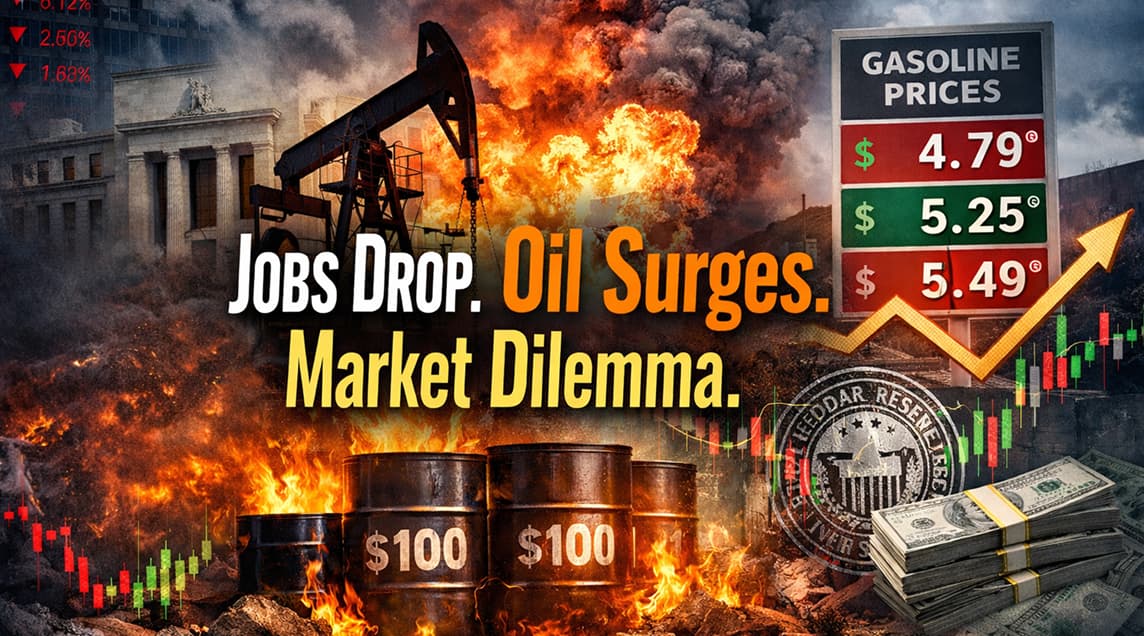
Right now, the market is trying to absorb two messages that do not play nicely together. The February jobs report was weak enough to raise fresh concern about growth, with nonfarm payrolls down 92,000, unemployment rising to 4.4%, and January payrolls revised down to 126,000. On a normal Friday, that would be enough to push investors toward the usual softer-growth playbook: lower yields, higher rate-cut hopes, and at least some relief for beaten-up risk assets.
That is not the setup this time. Average hourly earnings still rose 0.4% month over month, while oil has kept ripping higher as the Iran conflict fuels fears of a longer supply shock. Reuters reported U.S. crude above $86 and Brent near $89 at one point Friday, both the highest since 2024, with crude on track for its biggest weekly jump since 2020. That leaves investors dealing with a labor market wobble and an inflationary energy shock at the same time.
So the market’s problem now is not simply whether the economy is cooling. It is whether cooling growth can coexist with a fresh burst of price pressure, and whether the Federal Reserve can respond cleanly if both risks keep building. Traders did push June cut odds back up to about 49% after the jobs data, from roughly 35% just before the release, but that move looks more like nervous repricing than conviction.
Stock of Interest Today: SentinelOne (S)
SentinelOne heads into its March 12 earnings report as one of the more interesting prove-it names in software. The stock is still trading near depressed levels, which means management does not need to deliver perfection to get investors interested again. It needs to show that the broader platform story is becoming more real, more durable, and more visible in the numbers. SentinelOne’s investor materials say about half of quarterly bookings are now coming from emerging products such as data, AI, cloud, and others, while Purple AI has been growing triple digits with record attach rates.
That matters because SentinelOne is no longer just pitching an endpoint-security story with some AI frosting on top. The company has spent the last stretch broadening its platform through deals like PingSafe in cloud security, Prompt Security in GenAI and agent security, and Observo AI in telemetry, SIEM, and security operations. Taken together, those moves give management a credible argument that the business is expanding into a more complete AI-native security platform.
The question for next week is whether investors believe the expansion is translating into cleaner execution and a stronger growth profile beyond the legacy core. In a tape like this one, that matters even more than usual. When macro gets messy, the market tends to reward companies that can prove their story is getting stronger even if the backdrop is not.
Current price: $13.97Analyst target: $20.10
Five Market Themes
The broad market is not trading a single headline today. It is trading an oil shock, a weaker labor report, sticky wage growth, and the possibility that nobody gets the clean macro outcome they were hoping for. That is why the most useful way to read the tape right now is through the themes that are actually driving positioning.
1) The quick-resolution trade is losing believers
For much of the week, investors seemed willing to assume the Iran conflict would stay dangerous but contained. That assumption is looking less comfortable now. Reuters reported that global stocks were heading for their biggest weekly drop since March 2025 as oil surged and growth worries intensified. The market is no longer acting like this is just a scary headline that will fade harmlessly into next week.
If that mood holds, it suggests investors are starting to price second-order damage, not just the initial geopolitical shock. That means more attention on margins, transport costs, inflation expectations, and demand sensitivity across the market. That is a very different mindset from simply betting on a quick off-ramp. This is an inference based on the oil move, weekly equity weakness, and the shift toward safer assets.
2) The jobs report changed the Fed debate, but it did not settle it
The labor data clearly weakened the growth side of the story. Payrolls fell by 92,000, unemployment rose to 4.4%, and the labor report came in materially below consensus. That was enough to push traders toward higher odds of a June rate cut.
But the report did not give the market a clean dovish handoff because wages were still firm and oil is still doing inflation’s job for it. San Francisco Fed President Mary Daly said the jobs report underscores labor-market concern, but does not mean the Fed should immediately cut because risks remain “two-sided” given still-high inflation and the runup in oil prices. That is about as clear a summary of the current bind as you could ask for.
3) Stagflation risk moved a little closer to the center
The Census Bureau’s latest retail report did not exactly ride to the rescue. January retail and food-services sales fell 0.2% month over month, while sales excluding motor vehicles and parts were flat. That is not a collapse, but it is also not the kind of consumer backdrop that makes investors feel relaxed when payrolls are weakening and fuel costs are moving sharply higher.
That is why stagflation risk looks less like a dramatic buzzword and more like a scenario the market has to take seriously. No one report proves it, but slower growth plus higher energy costs plus sticky wages is exactly the mix that makes investors more selective. If that framing keeps gaining traction, quality balance sheets, defensive earnings, and selective real-asset exposure are likely to keep looking more attractive than broad cyclical optimism. This is an inference grounded in the jobs, wage, retail-sales, and oil data.
4) Oil is the market story now, not just the energy story
Once crude moves this fast, it stops being a sector-specific headline. Reuters reported that U.S. crude jumped above $86 and Brent approached $89, while another Reuters report noted oil prices are up more than 27% this week because of the war. That kind of move touches inflation expectations, rate pricing, transport costs, freight, consumer spending, and corporate margins all at once.
There is already evidence that the pressure is spreading beyond oil producers. Reuters reported that United Airlines expects a meaningful hit to first-quarter results from higher fuel costs, with jet fuel prices up 15% in the past week and TD Cowen estimates now far below the airline’s January profit outlook. If crude keeps extending, the market may respond by leaning harder into energy and defensives while further punishing fuel-sensitive and margin-sensitive names. That scenario is an inference, but it lines up with how this cost shock is already showing up at the company level.
5) Weekend risk premium is back
Friday trading is always partly about what investors are willing to carry into a headline-heavy weekend, and this is not a relaxed setup. Reuters reported the dollar is on course for its steepest weekly gain in more than a year as the conflict boosts haven demand. That is not what confidence looks like. It is what hedging looks like.
The implication is straightforward. If geopolitical headlines worsen, oil extends, or the market decides the jobs miss was more than a weather-and-strike distortion, investors may keep rotating toward safety rather than trying to force a dip-buying rebound. If crude stabilizes and yields stay contained, the market could still try to lean into the softer-growth-means-earlier-cuts story. But right now the safer interpretation is that traders are paying up for optionality, not certainty. That is an inference based on the shift in rate-cut odds, haven demand for the dollar, and the broader risk-off tone in global markets.
Bottom Line
The market’s problem right now is not just that the jobs report was weak. It is that the jobs report was weak while oil stayed hot and wages stayed firm. That makes it much harder to slot today into a simple bullish or bearish narrative.
The cleanest read is also the most uncomfortable one: investors are being forced to think about slowdown risk and inflation risk at the same time. That does not guarantee a breakdown from here, but it does make the next move far more dependent on whether oil calms down, whether the weekend headlines cooperate, and whether the market decides Fed relief can arrive fast enough to matter. Until then, selective risk still looks smarter than broad enthusiasm.
Sources:
- https://www.reuters.com/world/us/us-nonfarm-payrolls-decline-february-unemployment-rate-rises-44-2026-03-06/
- https://investors.sentinelone.com/files/doc_financials/2026/q2/S-Q2-FY26-Earnings-Presentation.pdf
- https://www.reuters.com/business/wall-st-futures-slip-middle-east-conflict-rages-jobs-data-focus-2026-03-06/
- https://www.reuters.com/world/china/global-markets-global-markets-2026-03-06/
- https://www.reuters.com/business/fed-rate-cut-bets-rise-after-weak-jobs-data-2026-03-06/
- https://www.census.gov/retail/marts/www/marts_current.pdf
- https://www.reuters.com/business/energy/oil-falls-us-may-intervene-futures-market-issues-waiver-russian-purchases-2026-03-06/
- https://www.reuters.com/world/asia-pacific/dollar-set-steepest-weekly-gain-year-iran-crisis-boosts-haven-bid-2026-03-06/
- https://www.reuters.com/business/wall-st-week-ahead-middle-east-developments-set-sway-us-stocks-inflation-data-2026-03-05/
Market Munchies and Mode Mobile communications are for informational purposes only, and are not a recommendation, solicitation, or research report relating to any investment strategy, security, or digital asset. All investments involve risk including the loss of principal and past performance does not guarantee future results.
Any information contained in this commentary does not purport to be a complete description of the securities, markets, or developments referred to in this material. The information has been obtained from sources considered to be reliable, but we do not guarantee that the foregoing material is accurate or complete. There is no guarantee that any statements or opinions provided herein will prove to be correct.