JPMorgan Backs Trump, Then Gets Slapped With $5 Billion Lawsuit
💸 Political Donor Turned Defendant In Washington, political gratitude has an expiration date. Weeks after JPMorgan Chase reportedly contributed millions to a pro-Trump political action committee, President Donald Trump repaid the gesture by filing a $5 billion lawsuit against…
💸 Political Donor Turned Defendant
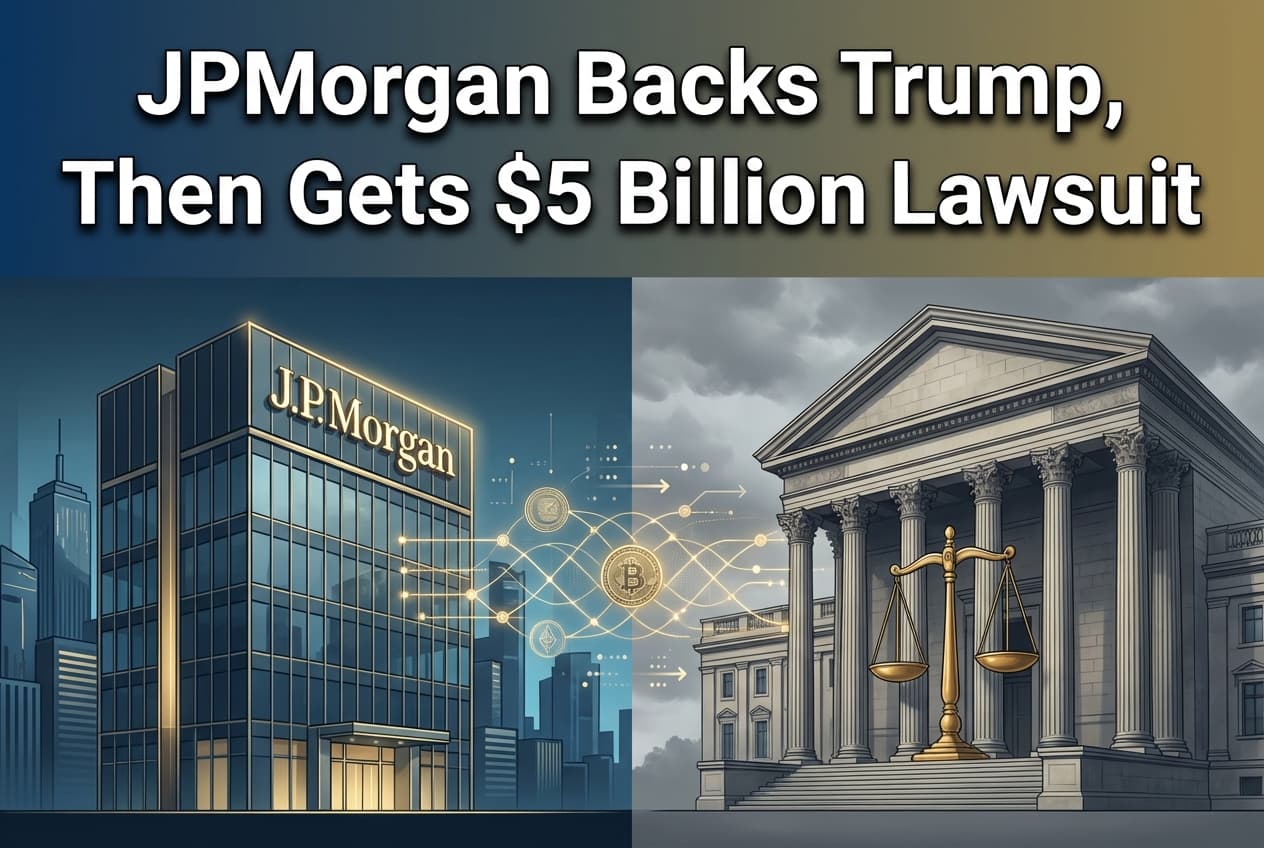
In Washington, political gratitude has an expiration date. Weeks after JPMorgan Chase reportedly contributed millions to a pro-Trump political action committee, President Donald Trump repaid the gesture by filing a $5 billion lawsuit against the banking giant and its CEO, Jamie Dimon. The lawsuit, filed Jan. 22, 2026, in Miami-Dade County state court, alleges that JPMorgan improperly severed a decades-long banking relationship following the Jan. 6, 2021, U.S. Capitol riot and Trump's departure from the White House. According to Al Jazeera, the complaint argues the move was driven by partisan views rather than financial or regulatory risk. The timing has raised eyebrows among industry observers. Just weeks earlier, The Street reported that JPMorgan, along with crypto exchanges Gemini and Crypto.com, infused millions into a pro-Trump PAC ahead of the Nov. 3, 2026, midterm elections. For investors watching the crypto-traditional finance convergence, this lawsuit underscores how quickly political winds can shift, even when institutions attempt to hedge their bets.
🏦 Debanking Takes Center Stage in Washington
Debanking occurs when a bank closes customer accounts or refuses to extend services such as loans without citing clear financial or regulatory justification. Once a relatively obscure issue in banking circles, debanking has become a politically charged flashpoint in recent years. Conservative politicians argue that banks have improperly adopted political positions and discriminated against certain industries, including firearms, fossil fuels, and, increasingly, politically affiliated individuals. The issue first gained national attention during the Obama administration when conservatives accused the government of pressuring banks to stop serving gun stores and payday lenders under Operation Choke Point. Now, debanking has intensified during Trump's second term, with the Republican president claiming in interviews that some banks refused to provide services to him and other conservatives. Associated Press reported that a U.S. banking regulator said last month the nine largest U.S. banks had placed restrictions on providing financial services to some controversial industries. For traders and investors, this regulatory scrutiny could reshape how banks approach politically sensitive accounts and industries, potentially impacting access to capital markets.
🔄 From Bitcoin Skeptic to Crypto Advocate
Trump and Dimon once shared common ground in their skepticism of digital assets. Trump previously dismissed bitcoin as a scam, while Dimon has been among Wall Street's most vocal crypto critics. However, both have shifted their positions considerably. Trump now accepts campaign donations in digital assets, praises U.S. crypto miners, and has signaled support for clearer regulation, including backing legislation such as the GENIUS Act. Dimon, too, has softened his anti-crypto stance in the months following the 2024 election cycle. Trump's warm embrace of the crypto industry marked a turning point in political spending by the digital-asset sector, with firms increasingly aligning themselves with candidates seen as friendlier to crypto. Big banks responded in kind. JPMorgan moved its digital dollar, the JPM Coin, onto a public blockchain and launched a new tokenized money market fund on Ethereum with $100 million in internal capital, targeting institutional treasury clients. For crypto investors, this evolution demonstrates how institutions are hedging political and technological shifts simultaneously, positioning themselves for a future where digital assets play a larger role in financial infrastructure.
⚖️ The Legal Claims and JPMorgan's Defense
Trump's lawsuit seeks at least $5 billion in damages and alleges that Dimon ordered a blacklist to warn other banks about doing business with the Trump Organization, Trump family members, and Trump himself. The complaint characterizes the blacklist as an intentional and malicious falsehood, arguing that JPMorgan acted in bad faith. The lawsuit claims that JPMorgan closed Trump's accounts because the bank believed the political tide at the moment favored doing so, according to Reuters. JPMorgan swiftly rejected the claims. In a statement, the bank said it believes the suit has no merit and denied closing accounts for political or religious reasons. A bank spokesperson said JPMorgan closes accounts only when they create legal or regulatory risk for the company. The White House stated it will refer the matter to the president's outside counsel. For investors, this legal clash highlights the tension between banks attempting to manage regulatory and reputational risk and accusations of political bias, a dynamic that could influence how financial institutions approach high-profile clients in the future.
🌍 Davos Drama and Public Friction
The lawsuit follows fresh public friction between Trump and Dimon at the World Economic Forum in Davos. On Jan. 21, 2026, Dimon criticized Trump's proposal to cap credit card interest rates at 10 percent, calling it an economic disaster that would remove credit access for roughly 80 percent of Americans. Dimon also warned that the U.S. had become a less reliable economic partner under Trump's leadership, according to The Hill. The public criticism came just weeks after JPMorgan's reported multimillion-dollar contribution to the pro-Trump PAC, creating an unusual optics problem for the bank. For market participants, Dimon's willingness to publicly criticize policy proposals signals that traditional finance institutions are navigating a delicate balance between political engagement and maintaining independence. Investors should note that Dimon has run JPMorgan for two decades and is one of the most influential figures in corporate America, making his public statements significant indicators of Wall Street sentiment toward Trump's economic policies. The friction underscores the complexity of political relationships in modern finance, where financial support doesn't guarantee friendly terms.
🎯 Conclusion: Institutional Crypto Adoption Amid Political Theater
The JPMorgan-Trump lawsuit reveals a broader truth about the intersection of politics, traditional finance, and digital assets. While political theater dominates headlines, institutional crypto adoption continues unabated. JPMorgan estimates that nearly $130 billion flowed into digital assets in 2025, about a third more than in 2024, with institutions expected to lead the next leg higher in 2026 as regulation improves. Strategy (formerly MicroStrategy) accounted for roughly $23 billion of corporate treasury purchases, while other companies increased buying to around $45 billion from just $8 billion a year earlier. For traders and investors, the key takeaway is that despite political volatility and legal battles, the fundamental trend toward institutional crypto adoption remains intact. Banks like JPMorgan are simultaneously navigating political relationships while building blockchain infrastructure, tokenizing assets, and preparing for a future where digital assets are core to financial markets. The lawsuit may generate headlines, but the structural shift toward crypto integration continues regardless of the political noise. Investors should focus on regulatory clarity, institutional product launches, and capital flows rather than getting distracted by courtroom drama.
Sources
https://crypto.news/from-donor-to-defendant-jpmorgan-backs-trump-then-gets-a-5-billion-lawsuit/ https://www.aljazeera.com/economy/2026/1/22/trump-sues-jpmorgan-and-ceo-dimon-over-alleged-debanking https://apnews.com/article/trump-jpmorgan-debanking-jamie-dimon-a976813384a942e5152f17659fdebd16 https://www.reuters.com/business/finance/trump-sues-jpmorgan-chase-ceo-dimon-over-alleged-political-debanking-fox-2026-01-22/ https://www.coindesk.com/markets/2026/01/15/jpmorgan-sees-2026-crypto-inflows-topping-the-usd130-billion-hit-in-2025
Market Munchies and Mode Mobile communications are for informational purposes only, and are not a recommendation, solicitation, or research report relating to any investment strategy, security, or digital asset. All investments involve risk including the loss of principal and past performance does not guarantee future results.
Any information contained in this commentary does not purport to be a complete description of the securities, markets, or developments referred to in this material. The information has been obtained from sources considered to be reliable, but we do not guarantee that the foregoing material is accurate or complete. There is no guarantee that any statements or opinions provided herein will prove to be correct.
Get fresh insights, breaking news, and hidden gems in the world of crypto—delivered straight to your inbox with our Crypto Cookies newsletter. Don't miss out—sign up now and get your first bite of insider knowledge!