March PCE Just Came In at 3.5%. It's the Number That Determines When the Fed Can Move — and the Answer Isn't Good.
The Federal Reserve held rates steady on Wednesday and said almost nothing about what comes next. On Thursday, the Bureau of Economic Analysis told them exactly what comes next. March PCE inflation landed at 3.5% year over year (YoY) — the highest reading since May 2023, up…
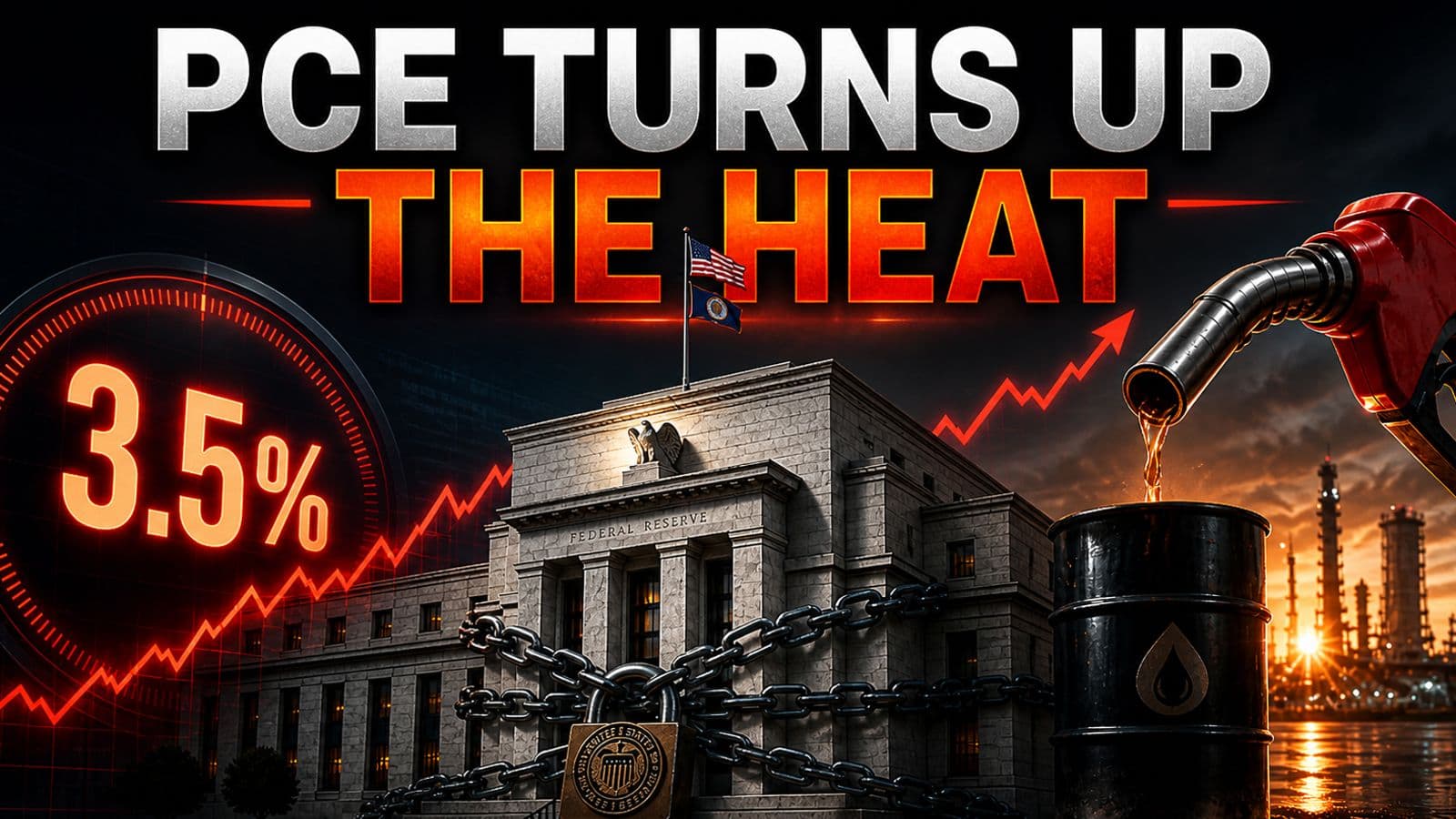
The Federal Reserve held rates steady on Wednesday and said almost nothing about what comes next. On Thursday, the Bureau of Economic Analysis told them exactly what comes next.
March PCE inflation landed at 3.5% year over year (YoY) — the highest reading since May 2023, up sharply from 2.8% YoY in February, and the first print to fully capture the Iran war's energy price pass-through. Core PCE, the Fed's actual policy gauge, came in at 3.2% YoY — in line with estimates, moving in the wrong direction, and running 120 basis points above the Fed's 2% target.
Both numbers matched consensus. That is not the comfort it might appear to be. When inflation accelerates to a three-year high and the reaction is "at least it wasn't a surprise," the situation has already moved past the point where good news is available.
What Drove the Numbers
The March report is the first to capture a full month of the Iran war's energy price shock, and the composition of the data tells you something important about where the inflation story goes from here.
Headline inflation at 3.5% YoY was driven overwhelmingly by energy. Consumer spending on gasoline and other energy goods accounted for approximately 42% of March's entire spending increase. Goods prices jumped 1.4% month over month (MoM). That is the Iran war showing up directly in the data.
The more important number for the Fed's forward policy path is not the headline. It is core PCE at 3.2% YoY, which strips out food and energy and is designed to show the underlying, persistent inflation trend rather than the commodity-price noise. Core came in at 0.3% MoM — a slight deceleration from February's 0.4% MoM, which will generate some cautiously optimistic commentary. That optimism is premature.
The services component of core PCE rose 0.3% MoM and 2.8% YoY. Services inflation — driven by wages, rents, and healthcare costs — does not move with oil prices. It moves with labor market conditions, housing costs, and the second-order pass-through of energy costs into the price of everything that requires transportation, heating, or cooling to produce and deliver. The fact that services inflation is running at 2.8% before the full downstream pass-through from $100-plus oil has even begun to show up in the data is the detail the Fed's hawks are focused on. Energy raises the cost of making things and moving things. Those costs eventually become somebody's services bill.
The Quarterly Numbers Are More Alarming Than the Monthly
The March monthly PCE is the number getting the headlines. The quarterly PCE data embedded in Thursday's GDP advance estimate is the number investors should actually be focused on.
The gross domestic purchases price index rose 3.6% in Q1 as a whole. The headline PCE price index jumped to 4.5% on a quarterly annualized basis — up from 2.9% in Q4. Core PCE on a quarterly annualized basis accelerated to 4.3%, up from 2.7% in Q4. That is the strongest quarterly core reading in over a year.
The Fed's 2% inflation target refers to the YoY figure, not the quarterly annualized rate. But the quarterly numbers are what policymakers watch when they are trying to assess momentum — whether inflation is accelerating or decelerating. A core PCE that moved from 2.7% to 4.3% on an annualized quarterly basis in a single quarter is not decelerating. It is running hot, and the pipeline of energy cost pass-through into services and goods prices has not fully cleared yet.
What It Means for the Consumer
The spending and income data accompanying the PCE print adds another layer to the picture.
Nominal consumer spending rose 0.9% MoM in March. Real spending — adjusted for inflation — rose just 0.2% MoM. The gap between those two numbers is the inflation tax the Iran war is applying to household budgets. Americans are spending considerably more dollars to acquire roughly the same volume of goods and services.
Disposable income rose 0.6% MoM in nominal terms, but fell 0.1% in real terms — the second consecutive monthly decline in real purchasing power. The personal saving rate dropped to 3.6%, its lowest level in four years, down from 3.9% in February and 4.5% in January.
The savings rate trajectory is the most actionable consumer signal in the report. When households are drawing down savings to maintain spending as real incomes fall, two things are true simultaneously: present consumption looks more resilient than it actually is, and the consumer's capacity to absorb further price increases is shrinking. The savings buffer that cushioned households through the 2022-2023 inflation surge has largely been spent. There is less room to absorb the next leg of energy pass-through.
As Bret Kenwell, U.S. investment analyst at eToro, put it: "Headline PCE was in-line with expectations, but that doesn't soften the blow very much. It still marked the highest year-over-year reading in almost three years, while goods inflation remains a clear pressure point. Durable goods inflation has gone from deflationary to inflationary since May 2025 and continues to accelerate, while non-durable goods inflation jumped as rising energy costs worked their way through the report."
What the Fed Does With This — and What FedWatch Is Now Saying
The Fed's predicament after Thursday's data is considerably sharper than it was after Wednesday's press conference.
Powell closed his final press conference by acknowledging core inflation is "moving, albeit just a little bit, in the wrong direction." The March PCE confirmed the direction and suggested the speed may be increasing. The quarterly core PCE acceleration from 2.7% to 4.3% is not "just a little bit."
The FOMC's Wednesday statement kept an easing bias — signaling that the next move, when it comes, is more likely to be a cut than a hike. Three members dissented against that language on the grounds that the current inflation environment does not justify it. After Thursday's data, their position looks considerably more defensible.
CME FedWatch moved the probability of a 2026 rate hike to 9.1% immediately after the FOMC decision — up from 0% the day before. After Thursday's PCE print, rate traders pushed that probability higher still: hike odds for December climbed to approximately 15%, according to updated FedWatch data, while the probability of any cut at the June meeting fell to roughly 28% — down from where it stood before the PCE release. The market is not yet pricing a hike as a base case. But it is pricing one as a scenario that cannot be dismissed.
Kevin Warsh is poised to arrive at the Fed with the hawks already making noise and the data moving in their favor. The scenario in which his first act as chair is to raise rates rather than cut them — which would have seemed implausible as recently as February — is now a live tail risk rather than a theoretical exercise.
What to Watch
The next PCE print — covering April data — releases May 28. That report will capture the first full month in which oil prices were consistently above $120 per barrel, the blockade was fully in place, and the downstream pass-through into transportation, services, and non-energy goods was beginning in earnest. Based on the pipeline currently visible in commodity markets, it will almost certainly show further acceleration.
The April nonfarm payrolls report drops May 8. A labor market that remains tight — initial claims just hit 57-year lows — limits the Fed's ability to justify rate cuts even if growth softens, because the combination of low unemployment and high inflation is the definitional stagflation trap. If jobs stay strong and PCE keeps climbing, the Fed has no room in either direction.
The Strait of Hormuz remains closed. That is the variable that determines how long this inflation episode lasts. If a deal emerges, the energy pass-through stops at roughly its current level, and the question becomes whether the services inflation already embedded in the data is enough on its own to force a response. If the blockade extends through Q2 — which Trump's rejection of Iran's Hormuz proposal this week makes more likely — Q2 PCE is going to be considerably more uncomfortable than Q1.
The numbers are telling the Fed something specific: the window for rate cuts has not just narrowed. It may have closed entirely for 2026. Whether Warsh agrees is the question that will define the next twelve months of monetary policy.
Sources
- BEA — "Personal Income and Outlays, March 2026": https://www.bea.gov/news/2026/personal-income-and-outlays-march-2026
- CNBC — "PCE inflation rate March 2026": https://www.cnbc.com/2026/04/30/pce-inflation-rate-march-2026.html
- CNN Business — "Fed's key inflation gauge hits 3.5% as Iran war pushes up gas prices": https://www.cnn.com/2026/04/30/economy/us-pce-fed-inflation-spending-march
- Fox Business — "March PCE: Inflation remained elevated amid Iran war": https://www.foxbusiness.com/economy/march-2026-pce-inflation
- Benzinga — "Q1 GDP Rises 2.0%, Core PCE Inflation Jumps 3.2% In March": https://www.benzinga.com/markets/macro-economic-events/26/04/52168494/us-gdp-q1-pce-inflation-march-2026
- UPI — "PCE: Fed's choice inflation gauge rises to 3.2% for March": https://www.upi.com/Top_News/US/2026/04/30/march-inflation-highest-since-2023-slow-gdp/9451777561686/
- Federal Reserve — FOMC Statement, April 29, 2026: https://www.federalreserve.gov/newsevents/pressreleases/monetary20260429a.htm
- CNBC — "Fed meeting recap: Powell to stay on board": https://www.cnbc.com/2026/04/29/fed-meeting-today-live-updates-warsh-powell.html
- CME Group — FedWatch Tool: https://www.cmegroup.com/markets/interest-rates/cme-fedwatch-tool.html
- PrimeRates — "Fed Rate Forecast 2026: How Many Cuts?": https://primerates.com/primerate/fed-rate-forecast-2026/
Market Munchies and Mode Mobile communications are for informational purposes only, and are not a recommendation, solicitation, or research report relating to any investment strategy, security, or digital asset. All investments involve risk including the loss of principal and past performance does not guarantee future results.
Any information contained in this commentary does not purport to be a complete description of the securities, markets, or developments referred to in this material. The information has been obtained from sources considered to be reliable, but we do not guarantee that the foregoing material is accurate or complete. There is no guarantee that any statements or opinions provided herein will prove to be correct.