Markets Are Perking Up on Diplomacy Hopes. Don't Pop the Champagne Yet.
Monday's wobble didn't snowball into a full meltdown. By Tuesday morning, U.S. stocks were climbing back, with tech and AI companies leading the charge, some decent earnings reports giving investors actual reasons to buy, oil prices stepping back from their most dramatic…
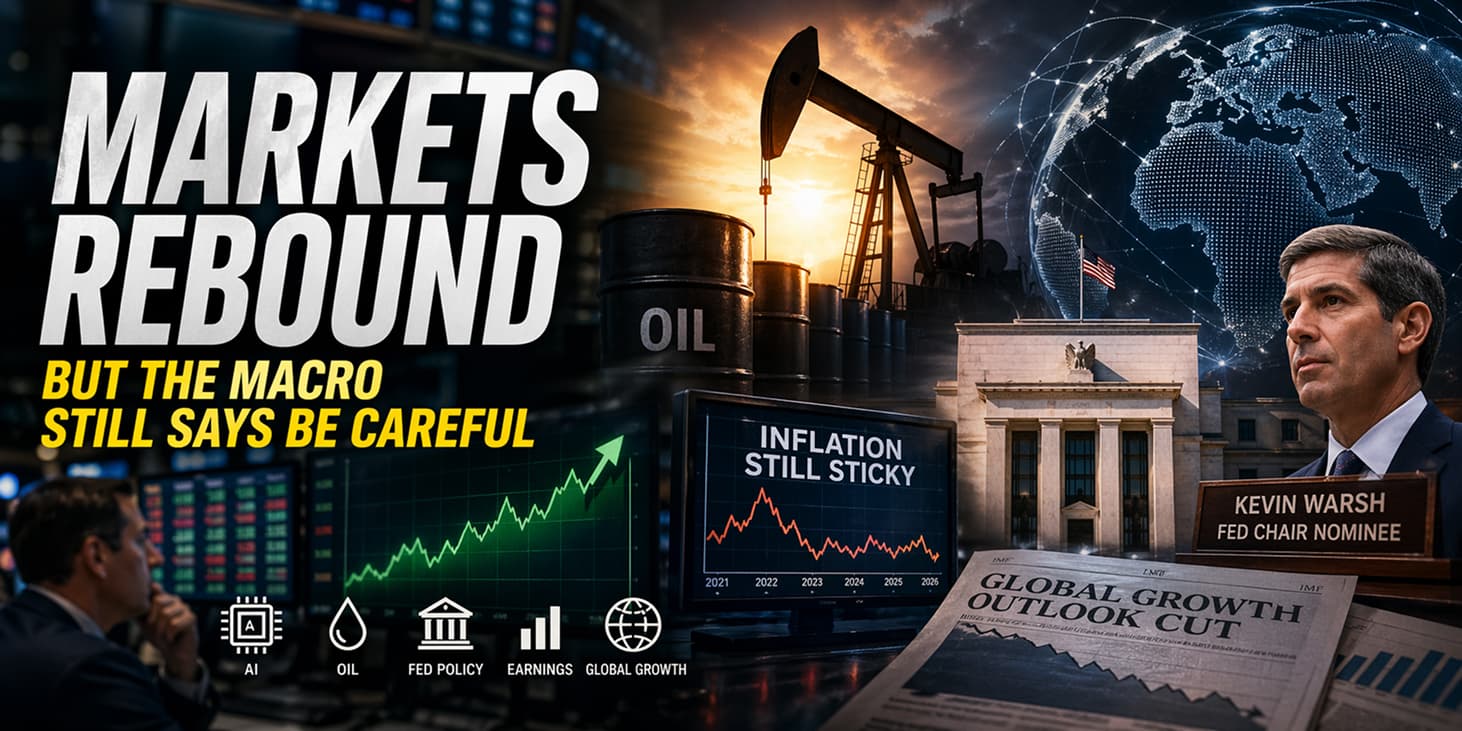
Monday's wobble didn't snowball into a full meltdown. By Tuesday morning, U.S. stocks were climbing back, with tech and AI companies leading the charge, some decent earnings reports giving investors actual reasons to buy, oil prices stepping back from their most dramatic levels, and the dollar still behaving like someone who just survived a scare but hasn't quite calmed down. In plain terms: Tuesday's open looked like a sigh of relief, not a victory parade.
That difference matters more than it sounds. Investors are clearly willing to bet that diplomatic chatter around Iran could buy some time and keep the nastiest energy scenarios from becoming tomorrow's problem. But zoom out a bit and the bigger picture still looks rougher than the stock market wants to admit. The IMF — basically the world's report card writer for economies — still expects slower global growth and stubbornly higher inflation this year as the Middle East conflict ripples through oil prices, trade, and the general vibe of doing business.
So the real question isn't whether markets can rally. They obviously can — they just did. The better question is what kind of rally this actually is. Tuesday's action suggests investors are still happy to pile into strong earnings, AI storylines, and any hint that geopolitical drama might take a breather. They're doing all this, though, in a world where energy is still a headache, interest rate cuts keep getting pushed back, and the next head of the Federal Reserve might turn monetary policy into something resembling a political football.
Stock of Interest Today: Grab Holdings (GRAB)
Grab gets dismissed too easily as "the Uber of Southeast Asia" when it's really more like if Uber, DoorDash, your bank, and your grocery app all merged and decided to take over eight countries at once. The company covers ride-hailing, food delivery, groceries, digital banking, and lending across Southeast Asia — and its 2025 results finally delivered what investors had been waiting years to see: actual profit. Not "almost profit." Not "profit if you squint." Real, reported net profit, plus strong growth in its on-demand business, plus a massive cash cushion that means it doesn't have to go hat-in-hand to investors every time it wants to try something new.
That cash pile — roughly $5.4 billion — is a central part of the story. Management has made clear it's aiming AI, financial services, and newer categories like groceries squarely at the next growth phase. Reuters reported in February that the company is targeting more than 20% annual revenue growth over the next three years and $1.5 billion in EBITDA by 2028. That's not a modest "steady as she goes" plan. That's Grab telling investors it wants to be seen as a long-term regional powerhouse, not just a delivery app with ambitions.
The counterargument is sitting right there, though. Grab's 2026 guidance came in softer than Wall Street wanted, and Reuters flagged that sluggish consumer spending and persistent inflation in Southeast Asia are real drags on the business. So the optimistic case requires more than just adding users — Grab has to prove its superapp model can convert everyday engagement into genuinely durable, high-quality earnings, particularly in financial services, without endlessly dangling discounts to keep people from wandering off to competitors.
Current price: $4.19
Analyst expectation: $6.56
Five Market Signals Worth Watching Today
The easiest mistake to make today is to see a stronger open and conclude that the scary stuff is behind us. The smarter read is that investors are still willing to lean into good stories — they just need the bad news to stop getting worse. That's a subtle but crucial distinction, because it means markets can keep climbing while still being one bad headline away from a rough afternoon.
Here are five signals that, taken together, paint a picture of surface-level relief sitting on top of some genuinely unresolved problems.
1) The market is buying more time, not a happy ending
This morning's optimism isn't because the Middle East situation got solved over the weekend. It's because investors think the next escalation might be a few weeks away rather than a few days. Reuters reported that stocks were rising on hopes for renewed U.S.-Iran talks, even though nobody's sure Iran will actually show up to those talks, or what a real breakthrough would even look like. That's enough to improve the mood in the short run — markets don't always need certainty, they just need the immediate deadline to feel less terrifying.
Here's the catch: buying "more time" is very different from buying "good news." Relief trades are fragile. Every new headline can instantly revive the same anxiety that just briefly faded. That's why Tuesday's open felt better without feeling truly confident. Investors are betting the crisis doesn't get dramatically worse right now. They're not betting the crisis is over.
2) Oil backed off, but the damage to the economy is still quietly happening
Oil retreating from its panic highs gave the whole market some breathing room — less inflation fear, more willingness to buy stocks, fewer people muttering about a worst-case energy-driven crash. Even so, Reuters reported that shipping through the Strait of Hormuz (a crucial oil chokepoint) remains disrupted, Russia has cut production following infrastructure attacks, and a major European pipeline is facing fresh trouble. This isn't a fixed market. It's a stressed market having a slightly better day.
Why does that still matter? Because you don't need oil prices spiking every single day for it to quietly drag on the economy. The IMF's latest forecasts still assume slower growth and higher inflation this year because elevated commodity prices have a way of spreading outward — into what you pay for imported goods, how cautious businesses get about spending, and how central banks respond. It's less like a sudden punch and more like a slow squeeze.
3) The next Fed chair could make interest rates a lot harder to predict
Kevin Warsh's appearance before the Senate matters because it isn't really about one person's resume — it's about what kind of Federal Reserve might be coming. In his prepared remarks, reported by Reuters, Warsh pledged to protect monetary policy independence while also suggesting the Fed's authority shouldn't extend as far into areas like regulation and government spending. For everyday investors, the translation is: he'd run a more narrowly focused, potentially more politically charged central bank than we've been used to.
Reuters also described Warsh's vision as favoring lower rates, a smaller balance sheet, and — his own words — "regime change" at the Fed. Even if any of that is years away from materializing, the mere uncertainty changes the calculus. Interest rates are already hard to predict because of inflation and energy costs. Throw in genuine questions about how the next Fed chair would operate, and one of the market's usual stabilizers becomes yet another question mark.
4) The economy is still too sturdy for the Fed to rescue investors anytime soon
Here's the paradox: a surprisingly resilient economy is actually bad news for people hoping for interest rate cuts. March retail sales came in stronger than expected — people kept spending, particularly on gas and cars, and a closely watched measure of underlying spending also rose. The economy isn't booming, but it's also not stumbling badly enough to force the Fed into cutting rates quickly.
That matters because this isn't the kind of economic softness that makes central bankers reach for the rate-cut lever. Energy costs are still muddying the inflation picture, making the Fed cautious about cutting into a commodity-driven price squeeze. And this isn't uniquely American — Reuters reported that South Korea's new central bank chief is also preaching caution, because oil-linked inflation is clashing with weaker growth there too. The "higher for longer" interest rate story has an international cast.
5) The rally is real — but it's basically being held up by two hands
To be fair, the market does have genuine support. Reuters reported that Tuesday's recovery was fueled by AI optimism and solid corporate earnings, while Amazon's deepened commitment to Anthropic reminded everyone that the biggest tech companies are still writing enormous checks to stay at the front of the AI race. That kind of mega-spending functions almost like its own economic force — it keeps a core group of companies growing even when the broader backdrop is messy.
But "a handful of companies are doing great" is not the same thing as "the market is healthy." J.P. Morgan raised its year-end S&P 500 target on Tuesday, explicitly crediting AI-driven earnings and improved geopolitical sentiment — which tells you exactly which two storylines are doing the heavy lifting right now. That support is real, but it's concentrated. If AI enthusiasm cools or geopolitical tensions flare back up, the market will need to find something more broadly sturdy to stand on.
Bottom Line
Tuesday's market mood improved for legitimate reasons. Softer oil prices, solid earnings, and renewed AI excitement gave investors just enough good news to treat Monday's sell-off as a speed bump rather than a warning sign. That's a fair read of what's happening on the surface.
The part underneath the surface, though, still looks complicated. Global growth forecasts have been trimmed, inflation isn't going away quietly, energy markets are still under stress even on calmer days, and a potential leadership change at the Fed could scramble the policy outlook in ways markets are only just starting to think about. So yes — the market is bouncing back on diplomacy hopes. It's doing it, though, in a world where the cost of being wrong is still very much on the table.
Sources:
- https://www.reuters.com/world/asia-pacific/us-stock-futures-climb-ai-optimism-tempers-middle-east-concerns-2026-04-21/
- https://www.reuters.com/world/china/global-markets-wrapup-1-2026-04-21/
- https://www.reuters.com/business/dollar-subdued-markets-eye-ceasefire-talks-yen-pressured-by-boj-delay-2026-04-21/
- https://www.reuters.com/business/energy/us-crude-futures-fall-investors-reassess-us-iran-risks-ahead-ceasefire-deadline-2026-04-20/
- https://www.imf.org/en/publications/weo/issues/2026/04/14/world-economic-outlook-april-2026
- https://www.imf.org/-/media/files/publications/weo/2026/april/english/execsum.pdf
- https://www.grab.com/sg/press/others/grab-reports-fourth-quarter-and-2025-results-with-first-full-year-net-profit/
- https://www.reuters.com/business/finance/singapores-grab-bets-ai-new-services-triple-profit-by-2028-2026-02-26/
- https://www.reuters.com/business/autos-transportation/grab-holdings-forecasts-annual-revenue-below-estimates-platform-momentum-slows-2026-02-11/
- https://www.marketbeat.com/stocks/NASDAQ/GRAB/forecast/
- https://www.census.gov/retail/marts/www/marts_current.pdf
- https://www.reuters.com/world/asia-pacific/bank-koreas-new-chief-says-monetary-policy-has-be-cautious-flexible-2026-04-21/
- https://www.reuters.com/business/energy/russia-cuts-oil-output-april-sources-say-2026-04-21/
- https://www.reuters.com/world/us/fed-chair-nominee-warsh-commits-independence-with-limits-2026-04-20/
- https://www.reuters.com/business/finance/fed-nominee-warsh-prepares-monetary-policy-road-test-before-senate-panel-2026-04-20/
- https://www.reuters.com/business/fed-chair-nominee-warsh-has-big-ideas-here-are-some-his-own-words-2026-04-20/
- https://www.reuters.com/business/warshs-path-top-fed-job-entangled-ahead-senate-confirmation-hearing-2026-04-21/
- https://www.reuters.com/business/jp-morgan-lifts-sp-500-year-end-target-7600-ai-driven-earnings-2026-04-21/
Market Munchies and Mode Mobile communications are for informational purposes only, and are not a recommendation, solicitation, or research report relating to any investment strategy, security, or digital asset. All investments involve risk including the loss of principal and past performance does not guarantee future results.
Any information contained in this commentary does not purport to be a complete description of the securities, markets, or developments referred to in this material. The information has been obtained from sources considered to be reliable, but we do not guarantee that the foregoing material is accurate or complete. There is no guarantee that any statements or opinions provided herein will prove to be correct.