Markets Are Shifting Quietly — Oil Oversupply, Asia’s Rise, and Crypto’s Reset Explain Why
🌏 A New Market Mix Is Emerging—And Investors Are Finally Taking Notice Markets rarely announce their turning points with fireworks. More often, they murmur. A rise in inventories here, a shift in investor asset-allocation trends there, and a sudden crypto-market correction…
🌏 A New Market Mix Is Emerging—And Investors Are Finally Taking Notice
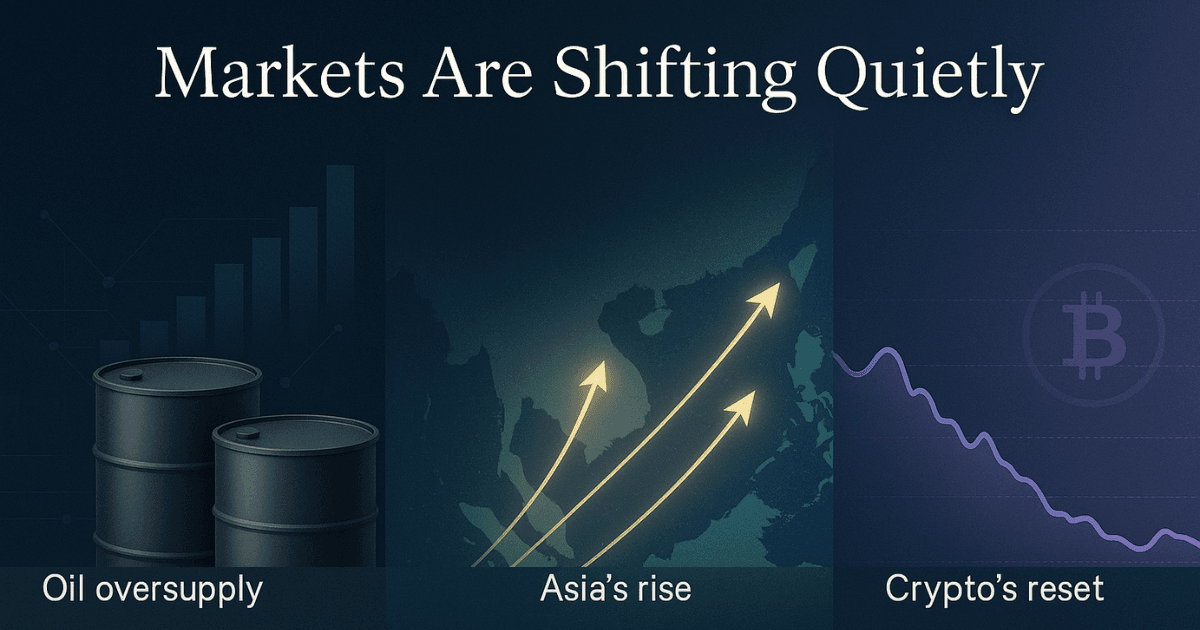
Markets rarely announce their turning points with fireworks. More often, they murmur. A rise in inventories here, a shift in investor asset-allocation trends there, and a sudden crypto-market correction that wipes out speculative appetite faster than a bad earnings call. Across the global economy, three subtle but powerful forces are now shaping how capital behaves:
- A growing oil oversupply risk that continues to pressure energy valuations
- Strong ASEAN export momentum supported by real Southeast Asia manufacturing growth
- A broad crypto sentiment reset, prompting a quiet alternative assets rotation
Individually, these stories look familiar. Collectively, they’re creating a new landscape for export-driven emerging markets, commodities, and alternative asset strategies. Let’s break it all down—calmly, clearly, and with just enough personality to keep your coffee from going cold.
🛢️ Oil Oversupply Is Building—And Prices Can Feel It
The world is producing oil at a rate that demand cannot match. The International Energy Agency projects global supply rising by 3.1 million barrels per day, even as demand growth stalls under 0.8 mb/d. That’s textbook global oil supply surplus—the kind that quietly chips away at price floors. Other institutions echo the same caution:
- IEA warns of an implied surplus above 4 mb/d under current policy trends
- Goldman Sachs sees Brent drifting to the mid-$50s
- U.S. inventories have jumped sharply, reinforcing the imbalance
For many producers beyond the Gulf and U.S. shale, the math is uncomfortable. Only low-cost oil producers and companies aligned with energy transition investment themes appear positioned to withstand prolonged price softness. Smart Capital Signal: Investors are rotating toward firms that thrive on efficiency rather than expansion. When a global oil supply surplus builds, high-capex models falter, while low-carbon oil producers and disciplined operators quietly outperform. The upside? More selective opportunities, less hype. It’s the kind of environment where “boring” balance sheets suddenly look quite attractive.
🚀 Southeast Asia’s Industrial Engines Are Still Running Hot
As commodities hit structural headwinds, another region is enjoying its moment. Export-driven emerging markets across ASEAN—Vietnam, Malaysia, Indonesia, and Thailand—continue to gain from stronger global demand and supply-chain rerouting. Research from BNP Paribas highlights the region’s consistent emerging market export strength, driven by:
- Robust Southeast Asia manufacturing growth
- Competitively priced labor
- Investor preference for diversified Asia supply chains
- Expanding capacity in electronics, autos, machinery, and intermediate goods
Simply put, export-oriented Asia equities are benefiting from real, structural shifts rather than short-term cycles. And investors who focus only on China and India may be missing one of the market’s more attractive middle lanes. Investor Radar: ASEAN economies combine momentum and diversification—a rare mix. As global portfolios rebalance away from pure commodities, funds continue discovering ASEAN export momentum and the resilience it brings. Think of it as the region’s quiet rise—no noise, no splash, just consistent performance.
📉 Crypto’s Reset Isn’t Doom—It’s a Market Detox
The crypto universe recently experienced a serious vibe check. A trillion-dollar drawdown, a cascade of liquidations, and a notable retreat in sentiment triggered what many analysts now call a full-scale crypto sentiment reset. Major coins fell roughly 25%, and altcoins absorbed the harshest blows. What emerged from the pullback? A healthier, more realistic market. Key dynamics shifting beneath the surface:
- Institutional allocations remain modest but stable
- Retail enthusiasm cooled after months of overextension.
- Many investors turned toward a broader rotation into alternative assets.
- Long-tail speculation thinned out as liquidity tightened.
This isn’t the end of crypto—it’s more of a palate cleanser, removing leverage and speculation from the system. Tactical Insight: The next wave won’t be driven by hype but by fundamentals. Investors increasingly seek assets that complement their commodity diversification strategy, stabilize volatility, or provide differentiated returns. Crypto remains in the mix—just with less noise and more discipline. Sometimes markets need a reset before clarity emerges.
🧭 Where the Signals Point From Here
Put the pieces together—the oil oversupply risk, the strength of emerging markets' export strength, the crypto market correction, and the rising demand for resilience—and a quiet but unavoidable rotation emerges. Across commodities, emerging markets, and alternative assets, investors are gravitating toward:
- Efficiency
- Structural growth
- Risk-adjusted returns
- And portfolios that don’t fall apart when one macro theme breaks
In other words, fundamentals are back in fashion. A calm rotation may not dominate headlines, but it often builds the next big market cycle. And the investors who listen to the quiet signals—not the loud narratives—tend to arrive early.
📚 Sources
🔗 IEA global oil supply/demand outlook — Reuters
🔗 Oil oversupply & prices forecast — Goldman Sachs
🔗 Crypto market decline — Financial Times
🔗 Hedge fund crypto allocations — Reuters
Market Munchies and Mode Mobile communications are for informational purposes only, and are not a recommendation, solicitation, or research report relating to any investment strategy, security, or digital asset. All investments involve risk including the loss of principal and past performance does not guarantee future results.
Any information contained in this commentary does not purport to be a complete description of the securities, markets, or developments referred to in this material. The information has been obtained from sources considered to be reliable, but we do not guarantee that the foregoing material is accurate or complete. There is no guarantee that any statements or opinions provided herein will prove to be correct.