Markets Calm Down, But Oil Still Runs the Show
Tuesday’s close looked relatively mild compared with the chaos underneath it. The Dow slipped 0.2%, the S&P 500 lost 0.1%, and the Nasdaq finished down 0.1%, but those small index moves masked a far more dramatic story in energy. U.S. crude settled down 11.9% on Tuesday,…
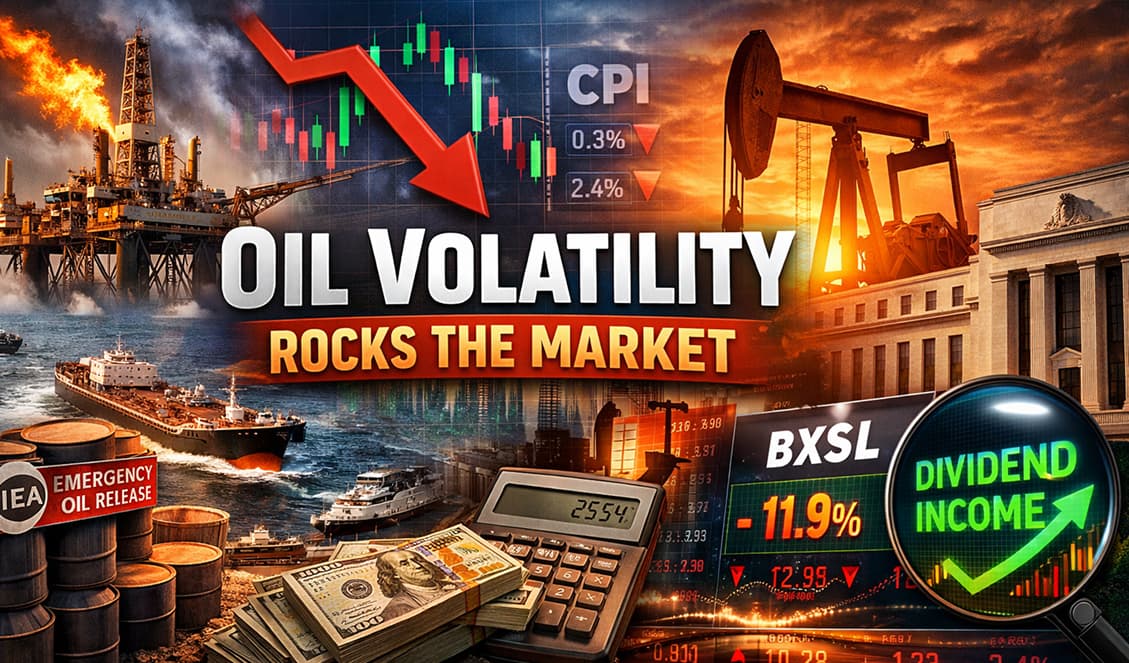
Tuesday’s close looked relatively mild compared with the chaos underneath it. The Dow slipped 0.2%, the S&P 500 lost 0.1%, and the Nasdaq finished down 0.1%, but those small index moves masked a far more dramatic story in energy. U.S. crude settled down 11.9% on Tuesday, its steepest one-day percentage drop since 2022, after a frenzied stretch of trading tied to shifting expectations around the war involving Iran, Israel, and the United States. That reversal briefly suggested the market might finally be getting a handle on the oil shock. It was a tempting conclusion, and probably the wrong one.
By Wednesday morning, it was already clear that oil was not done driving the tape. Reuters reported that Brent climbed back to about $91.11 a barrel and WTI to roughly $86.58 as traders questioned whether the International Energy Agency’s proposed record reserve release would be enough to offset real supply risks. That mattered because the market was trying to process an in-line February CPI report at the same time. Consumer prices rose 0.3% month over month and 2.4% year over year, while core CPI rose 0.2% on the month and 2.5% on the year. Those numbers were not alarming on their own, but they also did not capture the full March oil shock now hanging over the inflation outlook.
At the market open, the mood stayed cautious rather than relieved. Just after 9:00 a.m. ET, the DIA ETF was down about 0.05%, SPY was off 0.18%, and QQQ was essentially flat, while the United States Oil Fund was up roughly 1.5%. In other words, equities opened with a defensive posture even after CPI came in as expected. The market’s message was pretty clear: February inflation may have behaved, but traders are now more interested in what higher oil does to March, April, and the Federal Reserve’s patience.
Stock of Interest Today: Blackstone Secured Lending Fund (BXSL)
Blackstone Secured Lending is not a clean growth story right now. It is a discount-to-book, income-heavy private credit story wearing the clothes of a public stock. The company’s fourth-quarter 2025 results were solid in the ways that matter for this kind of name. Net investment income came in at $0.80 per share, comfortably covering the regular $0.77 dividend. Net asset value finished the quarter at $26.92 per share. The portfolio remained heavily defensive, with 97.6% of investments in first-lien senior secured debt and just 0.6% on non-accrual. That is not the profile of a lender already showing cracks. It is the profile of a lender built to absorb a tougher tape.
The reason the stock works as a value setup is that the market is still pricing it like investors do not quite trust the durability of those fundamentals. With BXSL trading around $23.96 on Wednesday morning, the stock sits at roughly an 11% discount to its last reported NAV. Management also approved a discretionary repurchase plan for up to $250 million of stock below NAV, which is exactly the kind of signal you want to see when a lender believes the market has become too pessimistic about its book. Add in the regular $0.77 quarterly dividend, which works out to an annualized yield of about 12.9% at the current share price, and the setup starts to look less like a turnaround story and more like a paid-to-wait value trade.
The second reason investors are still paying attention is that BXSL offers a pretty specific kind of defense at a moment when the macro picture is getting noisier again. If oil volatility keeps inflation sticky and pushes out rate-cut expectations, investors are likely to keep rewarding cash-generating businesses with hard asset coverage, seniority in the capital structure, and visible income streams. BXSL checks those boxes. The obvious risk is that private credit sentiment can weaken quickly if recession fears start to overwhelm everything else, but the company’s consensus analyst target still sits at about $28.13, which suggests Wall Street sees material upside if the current discount starts to narrow.
Current price: $23.96
Analyst target: $28.13
Five Market Themes
The market is still trading through one big chain reaction. Oil volatility affects inflation expectations. Inflation expectations affect rate expectations. Rate expectations affect equity leadership, valuation, and risk appetite. Wednesday’s open did not break that chain. It reinforced it. The five themes below are the clearest places where that pressure is showing up right now.
1) Conflicting government messaging is amplifying oil volatility
One reason the crude market remains so jumpy is that traders are trying to separate official policy from noise in real time. Reuters reported that Energy Secretary Chris Wright’s account posted, then deleted, a claim that the U.S. Navy had escorted an oil tanker through the Strait of Hormuz. Officials later clarified that there is no current escort program for commercial shipping. In a market this sensitive, that kind of confusion is not just embarrassing. It changes pricing. When investors cannot tell whether a security response is real, temporary, or imaginary, they add a volatility premium and ask questions later.
2) The IEA’s proposed reserve release is enormous, but not necessarily decisive
The International Energy Agency is expected to recommend a 400 million barrel release, which would be the largest such move in its history and more than double the 182 million barrels released in 2022 after Russia invaded Ukraine. That is a meaningful number, but markets are already signaling skepticism. Oil rebounded even as the proposal became public, which suggests traders think the release can soften the blow without fully neutralizing it. The bigger point is that emergency reserves can buy time, but they cannot instantly restore normal shipping flows through one of the world’s most important oil chokepoints.
3) Tuesday’s crude collapse did not end the oil shock
The temptation after Tuesday’s 11.9% drop in WTI was to say the worst had passed. Wednesday’s action argues otherwise. Reuters reported that U.S. crude was back up 3.8% to $86.58 by late morning in London, and even noted that prices had jumped 5% at the U.S. market open earlier in the session before some of that move faded. That kind of back-and-forth is usually what you see when the market is trying to price a geopolitical event that has not actually been resolved. It is less a sign of stabilization than a sign that participants keep having to reprice the same risk over and over.
4) Saudi rerouting shows adaptation, not normalization
Saudi Arabia has been moving more crude exports to the Red Sea port of Yanbu through its East-West pipeline to reduce dependence on the Strait of Hormuz. That is an important development because it shows how quickly major producers are trying to reroute around the chokepoint. But it also has limits. Reuters reported that Yanbu loadings rose sharply in early March, yet the available pipeline export capacity still does not fully replace the scale of normal Hormuz traffic. The market takeaway is that workarounds exist, but they are partial. Adaptation is helping. It is not the same thing as normal supply conditions returning.
5) CPI was fine, but the real inflation question has shifted into March
February CPI did not give the market a shock. It gave it a complication. The report came in broadly on target, but Reuters noted that gasoline prices were already a key driver of the monthly increase, and the market is now looking ahead to how March energy prices flow through to the next round of inflation data. That is why futures stayed negative even after an in-line print. The Fed can probably look through one report. It gets harder to do that if oil stays elevated long enough to reshape headline inflation again.
Bottom Line
The market opened Wednesday with the same basic problem it had at Tuesday’s close, just with a few more data points. Inflation was not bad enough to scare investors on its own, but oil is still volatile enough to keep everyone from relaxing. That leaves the market stuck between a soft macro reading and a hard geopolitical risk.
In that kind of tape, the most interesting stocks are not always the loudest ones. They are often the names where valuation, income, and balance-sheet protection do most of the work. BXSL fits that bill. More broadly, the market still looks like it wants proof before it gives anyone the benefit of the doubt, whether that is on oil, inflation, or risk assets. Right now, resilience is still screening better than excitement.
Sources:
- https://www.reuters.com/business/energy/oil-falls-over-6-trump-predicts-middle-east-de-escalation-2026-03-10/
- https://www.reuters.com/business/wall-st-futures-rise-hopes-early-end-middle-east-conflict-2026-03-10/
- https://www.reuters.com/business/energy/us-oil-prices-up-nearly-3-middle-east-crisis-constrains-supply-2026-03-10/
- https://www.reuters.com/business/us-consumer-prices-increase-expected-february-2026-03-11/
- https://www.bls.gov/news.release/pdf/cpi.pdf
- https://www.bxsl.com/press-releases/article/blackstone-secured-lending-fund-reports-fourth-quarter-and-full-year-2025-results/
- https://www.sec.gov/Archives/edgar/data/1736035/000121390026020083/ea0277994-01_ex991.htm
- https://www.marketbeat.com/stocks/NYSE/BXSL/forecast/
- https://www.reuters.com/markets/companies/BXSL.N/profile/
Market Munchies and Mode Mobile communications are for informational purposes only, and are not a recommendation, solicitation, or research report relating to any investment strategy, security, or digital asset. All investments involve risk including the loss of principal and past performance does not guarantee future results.
Any information contained in this commentary does not purport to be a complete description of the securities, markets, or developments referred to in this material. The information has been obtained from sources considered to be reliable, but we do not guarantee that the foregoing material is accurate or complete. There is no guarantee that any statements or opinions provided herein will prove to be correct.