Match Group Is Recovering. Bumble Is Collapsing. The Dating App Industry Is Splitting in Two.
Two Companies, Same Industry, Very Different Quarters. Here's What It Means. Two dating app companies reported earnings Tuesday. They are in the same industry, chasing the same users, selling roughly the same product. One beat expectations and rose 4% after hours. The other…
Two Companies, Same Industry, Very Different Quarters. Here's What It Means.
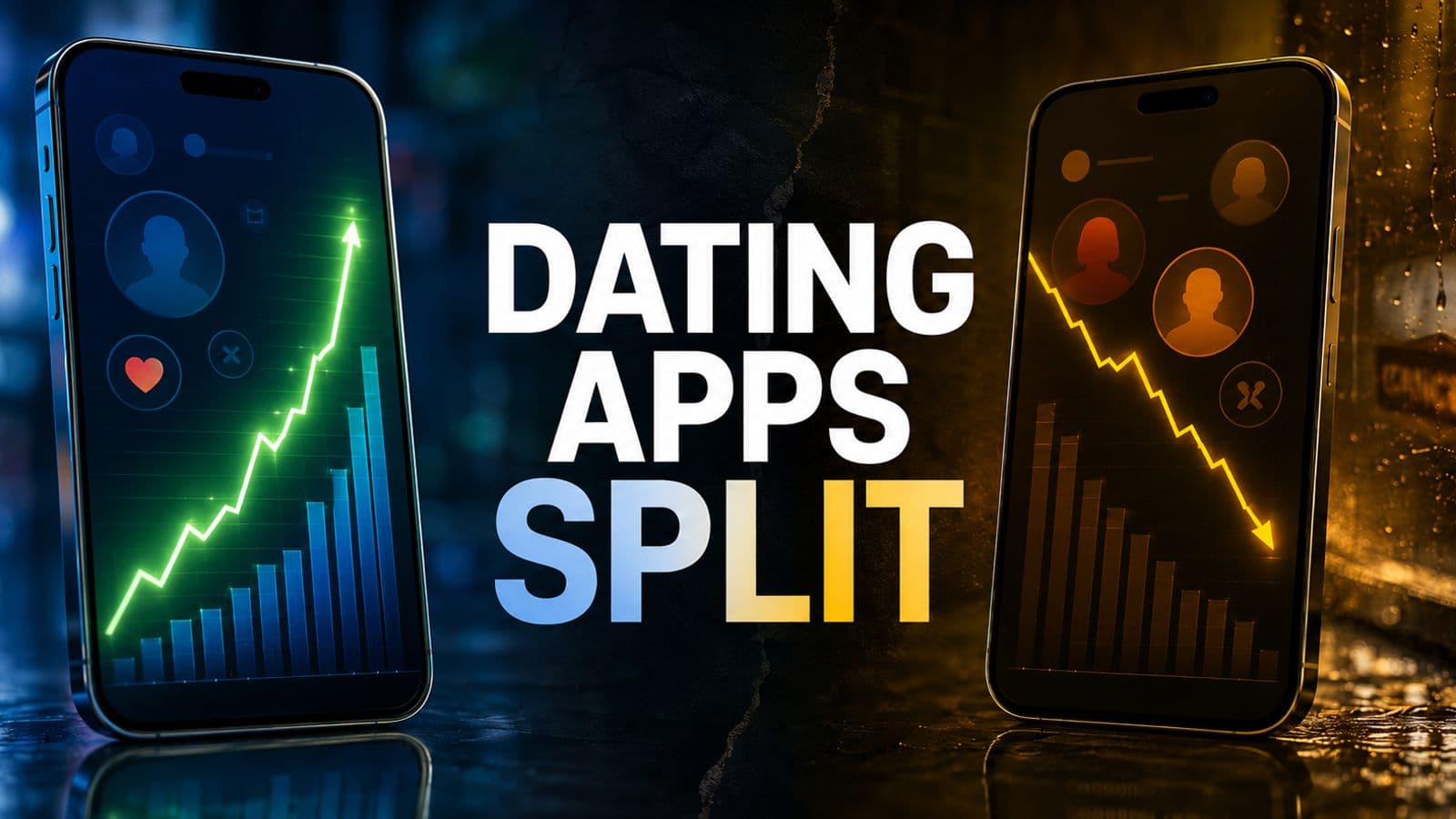
Two dating app companies reported earnings Tuesday. They are in the same industry, chasing the same users, selling roughly the same product. One beat expectations and rose 4% after hours. The other reported a 14% revenue decline and a 21% collapse in paying users.
The divergence between Match Group and Bumble is one of the sharpest within-industry splits in this earnings season — and it tells you something important about where consumer subscription spending is going in 2026.
📊 Match Group: The Numbers That Matter
Revenue reached $864 million, up 4% year over year, surpassing estimates of $854 million. Adjusted EPS of $0.68 beat the $0.61 consensus. Adjusted EBITDA reached $343 million, up 25% year over year, representing a 40% margin.
The two headline numbers inside those results:
Hinge: up 28%. Hinge revenue grew 28% to $194.5 million, supported by more payers and higher revenue per payer, especially in Europe. Hinge is Match Group's growth engine and is on track to become a $1 billion business by 2027. It is winning with younger users, expanding internationally, and introducing features — Date Ideas, Signals — that are genuinely differentiating it from the generic swipe format.
Tinder: not dead yet. Global monthly active user registrations returned to year-over-year growth in March for the first time in nearly two years. That is a small number with large symbolic weight. Tinder's user decline has been the single biggest overhang on Match Group's stock for years. One month of positive registrations does not declare victory, but it is the first concrete evidence that the turnaround strategy — new features, Gen Z-focused product changes, astrology and music integrations — is doing something.
The catch: overall payers declined 5% to 13.5 million, while revenue per payer increased 10% to $20.90. Match Group has fewer paying customers than a year ago. It is making more money from each of them. That is a viable strategy — until it isn't.
📉 Meanwhile, at Bumble HQ
Bumble's quarter was a different document entirely.
Total revenue decreased 14.1% to $212.4 million. Total paying users decreased 21.1% to 3.2 million, down from 4.0 million a year ago.
Bumble has framed this as a deliberate shift toward higher-quality, more intentional users. The company's average revenue per paying user did rise 8.9% — so the users who stayed are spending more. But losing 800,000 paying customers in a single quarter is a hard number to spin, regardless of how much each remaining customer pays.
The company is betting its future on a major product overhaul designed to win back Gen Z, which has been drifting away from dating apps broadly. That overhaul has not launched yet. Until it does, Bumble is reporting the results of a strategy that hasn't arrived while the damage from the old one compounds.
🔍 Why Are They Diverging So Dramatically?
Three things separate Match Group's trajectory from Bumble's right now.
Portfolio vs. single app. Match Group owns Tinder, Hinge, OkCupid, Plenty of Fish, and others. When Tinder weakens, Hinge covers. When one demographic drifts, another app catches them. Bumble has the Bumble app, Badoo, and not much else. When the core product struggles, there is nowhere to hide.
The Gen Z problem hits everyone — but not equally. Gen Z is pretty over dating apps right now. That is a structural headwind for the entire sector. But Hinge has been winning disproportionately with the younger end of the millennial cohort and is making inroads with Gen Z through product differentiation. Bumble built its entire brand identity around a single insight — women message first — that has been replicated or rendered less distinctive as competing apps improved safety features across the board.
Execution. Match Group CEO Spencer Rascoff has a restructuring plan with named milestones. Hinge is hitting them. Tinder is showing early signs of hitting them. Bumble's overhaul is still a promise. Markets tend to reward demonstrated execution over anticipated execution, especially when the sector is under pressure.
⛽ The Macro Layer Nobody Is Mentioning
Here is the context most earnings coverage is skipping: subscription fatigue is real, and the Iran war is making it worse.
When household discretionary budgets tighten — higher gas prices, higher energy bills, higher grocery costs — subscriptions get cut. Not first, but eventually. The consumer who is spending an extra $60 a month on gas is the same consumer who is looking at their monthly subscriptions and asking which ones to keep.
Dating app subscriptions occupy an awkward position in that calculus. They are not utilities. They are not entertainment platforms with broad household appeal. They are a very personal product with a success condition: the user stops needing the app. In a stressed consumer environment, the app that cannot demonstrate near-term value — dates, connections, a relationship — is one of the easier cuts to make.
Bumble's 21% paying user decline did not happen in a vacuum. It happened against the backdrop of a consumer who is more financially stressed than at any point since 2022, and who is less willing to maintain subscriptions that do not deliver clear, immediate value.
👀 What Investors Should Watch
For Match Group (MTCH): The Q2 guide of $850 to $860 million came in slightly below analyst expectations. That modest miss is worth watching — it suggests Tinder's recovery is early and fragile, not confirmed. Management expects to land in the lower half of the full-year revenue guidance range given Azar weakness and the potential full utilization of the $45 million user investment budget. Hinge remains the story. If Hinge hits $1 billion in revenue by 2027, the stock re-rates significantly. If Tinder slips back into decline before Hinge is large enough to compensate, the portfolio math gets harder.
One honest caveat on Hinge specifically: the $1 billion by 2027 target assumes the Gen Z problem does not catch up to it. Hinge markets itself as "designed to be deleted" — the app for people who want a real relationship, not endless swiping. That positioning has worked. But if the economic stress, geopolitical anxiety, and general exhaustion driving Gen Z away from dating apps broadly accelerates, Hinge is not immune. Gen Z might just delete it without finding the relationship first. The brand promise only holds if users believe the app can actually deliver on it — and in a world where everything feels more precarious, that belief is harder to sustain.
For Bumble (BMBL): The product overhaul is the only thing that matters. If the Gen Z-targeted redesign generates measurable paying user growth within two quarters of launch, Bumble has a story. If it launches and paying users keep declining, the company faces a structural question about whether its core value proposition — women message first, in an era where every app has copied the safety features that made that valuable — is still differentiated enough to sustain a standalone business.
The dating app industry is not dying. People are still looking for relationships and the apps are still the primary infrastructure for finding them. But the market is consolidating around the apps that can demonstrate clear value quickly, and the ones that cannot are going to keep losing users to the ones that can — and to the option of just not subscribing at all.
Sources
- Investing.com — "Match Group beats Q1 estimates as Tinder shows improvement": https://www.investing.com/news/earnings/match-group-beats-q1-estimates-as-tinder-shows-improvement-93CH-4661178
- Sherwood News — "Match Group earnings beat Wall Street's expectations": https://sherwood.news/markets/match-groups-q1-earnings-tuesday/
- The Motley Fool — "Match Group (MTCH) Q1 2026 Earnings Transcript": https://www.fool.com/earnings/call-transcripts/2026/05/05/match-group-mtch-q1-2026-earnings-transcript/
- StockTitan — "Match Group (MTCH) boosts Q1 2026 profit as Hinge grows": https://www.stocktitan.net/sec-filings/MTCH/10-q-match-group-inc-quarterly-earnings-report-35b84e2bd789.html
- Global Dating Insights — "Match Group Beats Q1 Estimates, Hinge and Tinder Grow": https://www.globaldatinginsights.com/featured/match-group-beats-q1-estimates-hinge-and-tinder-grow/
- TechCrunch — "Bumble's paying users are slipping as it bets on an overhaul later this year": https://techcrunch.com/2026/05/05/bumbles-paying-users-are-slipping-as-it-bets-on-an-overhaul-later-this-year/
- SEC EDGAR — Bumble Inc. Form 8-K Q1 2026 Earnings Release: https://www.sec.gov/Archives/edgar/data/0001830043/000183004326000046/bmbl-ex991prxq12026.htm
- Benzinga — "Match Group Q1 2026 Earnings Call Transcript": https://www.benzinga.com/insights/news/26/05/52308884/match-group-q1-2026-earnings-call-transcript
- Yahoo Finance — "Match Group Inc Q1 2026 Earnings Call Summary": https://finance.yahoo.com/markets/stocks/articles/match-group-inc-q1-2026-001649485.html
- ChartMill — "Match Group Inc (NASDAQ:MTCH) Surges After-Hours on Q1 2026 Earnings Beat": https://www.chartmill.com/news/MTCH/Chartmill-47137-Match-Group-Inc-NASDAQMTCH-Surges-After-Hours-on-Q1-2026-Earnings-Beat-and-Tinder-Return-to-Growth
Market Munchies and Mode Mobile communications are for informational purposes only, and are not a recommendation, solicitation, or research report relating to any investment strategy, security, or digital asset. All investments involve risk including the loss of principal and past performance does not guarantee future results.
Any information contained in this commentary does not purport to be a complete description of the securities, markets, or developments referred to in this material. The information has been obtained from sources considered to be reliable, but we do not guarantee that the foregoing material is accurate or complete. There is no guarantee that any statements or opinions provided herein will prove to be correct.