May Day Protests Are Circling the Globe. The Iran War Is What They're Really About.
May Day protests happen every year. This year's are different. Demonstrations are underway from Seoul to Jakarta to Istanbul to Paris to Manila to cities across the United States — hundreds of thousands of workers in the streets on International Workers' Day. The traditional…
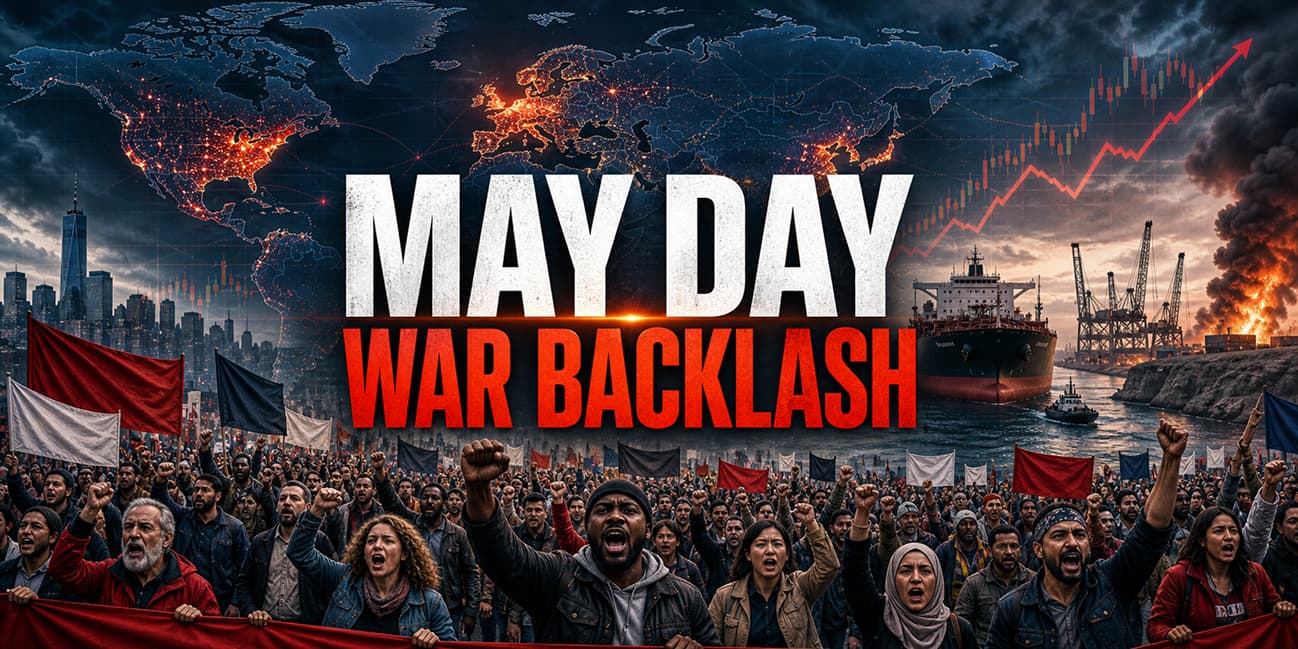
May Day protests happen every year. This year's are different.
Demonstrations are underway from Seoul to Jakarta to Istanbul to Paris to Manila to cities across the United States — hundreds of thousands of workers in the streets on International Workers' Day. The traditional demands are present: higher wages, better conditions, pension protections. But this year a new thread runs through virtually every major rally on every continent: the Iran war, the energy shock it produced, and the question of who is paying for it.
The short answer, as far as the world's workers are concerned, is them.
What Workers Are Actually Saying
The European Trade Union Confederation, which represents 93 trade union organizations across 41 European countries, issued a statement that captures the mood: "Working people refuse to pay the price for Donald Trump's war in the Middle East."
The protests today span every time zone:
- France: Unions marched in Paris and elsewhere under the slogan "bread, peace and freedom," linking workers' daily cost-of-living crisis directly to the conflict.
- Philippines: Marchers held banners reading "no troops, no bases, no war games, resist U.S.-led wars," and protesters clashed with police near the U.S. Embassy in Manila.
- Pakistan: May Day is a public holiday marked by rallies, but many daily wage earners told reporters they cannot afford to take the day off.
- Indonesia: President Prabowo Subianto joined a rally in Jakarta greeting tens of thousands of workers, as unions called for government protection from rising prices and shortages of raw materials.
In each country, the specifics differ. The underlying complaint is the same: energy costs have surged, purchasing power has fallen, and the workers at the bottom of the economic stack are absorbing the impact of a conflict they did not choose and cannot escape.
The Seafarers Nobody Is Talking About
The human cost of the Hormuz closure has a specific face that most May Day coverage is not finding: the 20,000 seafarers stranded on roughly 2,000 ships in the Persian Gulf, unable to cross the Strait of Hormuz, some of them now in their eighth week aboard.
The International Maritime Organization confirmed this week that the stranded crews are "facing mental strain, fatigue and decreasing supplies." The UN's shipping agency has called for a safe corridor for commercial vessels. Dozens of ships have been attacked since the war started. At least 10 seafarers have been killed. Hundreds more are watching weapons exchanges from their decks.
German shipping giant Hapag-Lloyd has had around 150 sailors stranded near the strait on six vessels. Spokesman Nils Haupt told the AP: "These are difficult days and weeks. We've been able to rotate some of them in the meantime, but you can easily imagine that after such a long time, monotony naturally sets in on board."
Indian Captain Rahul Dhar, stranded for eight weeks on his tanker, told reporters the crew's morale is holding but the strain is beginning to show. "Day to day, we try to keep things normal with open conversations and small team activities that help lift everyone's spirits." The crew has sighted drones and missile interceptions several times, some near the ship and some along the horizon during their watches.
India alone has more than 20,000 nationals working on foreign-flagged ships in the region. Manoj Kumar Yadav of the Forward Seamen's Union of India told reporters his union has been fielding daily distress calls from crews and their families. "Many of them were on board a ship for the first time, and you can imagine what mental state they have gone through."
The seafarers are not in the streets today. They cannot be. They are 60 miles offshore in the Persian Gulf, watching the horizon for missiles.
The Dockworkers Who Have Been Here Before
Today's protests did not emerge from nowhere. In February, dockworkers across at least 21 Mediterranean ports — including Bilbao, Genoa, Livorno, Mersin, Marseille, Hamburg, and Piraeus — staged coordinated walkouts under the slogan "Dockworkers do not work for war." The action explicitly targeted the use of civilian port infrastructure for military purposes and arms shipments, and was the first coordinated transnational maritime labor action of its scale since the Iraq war protests of 2003.
That February action caused limited operational disruption but demonstrated something significant: the workers who move the world's goods have a strategic chokepoint of their own. Dockworkers who refuse to load or unload cargo can impose costs on governments and shipping companies that no government statement or diplomatic note can easily reverse.
Whether coordinated port actions recur in the coming weeks depends largely on union leadership and the political tradition it operates from. The LSE Business Review noted that many of the unions involved tend to work within national political structures rather than building transnational solidarity — which historically limits how far such actions develop in practice. The mood on the ground, from Paris to Manila, suggests the appetite for something more sustained is building. Whether the organizational infrastructure follows is a different question entirely.
The Supply Chain Layer Investors Should Be Watching
While the human toll is the primary tragedy of the Hormuz closure, the secondary effect is a compounding supply chain crisis that markets are currently underpricing.
The math of the blockade requires one clarification that most coverage has glossed over. Transit has dropped from approximately 130 ships per day before the war to roughly 80 per week in mid-April — a collapse of more than 95%. The trickle of traffic still moving through is almost exclusively vessels from countries Iran has designated "friendly" and granted explicit exemptions: Chinese-flagged tankers, Indian LPG carriers, Pakistani vessels, Russian commercial ships, and a handful of others from nations that have maintained diplomatic neutrality or struck bilateral arrangements with Tehran. These are not Western-owned vessels carrying European or American cargo. They are specifically the ships that Iran has chosen not to stop.
The 2,000 vessels whose crews are stranded are there because they fly the flags of countries Iran considers hostile or has not cleared — including ships serving the EU, the UK, Japan, South Korea, and the Gulf states. Those vessels cannot transit regardless of whether they pay Iran's toll, because the U.S. naval blockade simultaneously targets ships entering or exiting Iranian ports. The result is a "dual blockade" in which commercial vessels face threats from both directions: Iran on one side, the U.S. on the other. IMO Secretary General Arsenio Dominguez put it plainly: "There is no safe transit anywhere in the Strait of Hormuz."
Overall, traffic through Hormuz in the last two months has run at roughly 5% of the pre-war average, according to Kpler. And even that 5% is geopolitically selected rather than market-determined.
For investors, the crew shortage dimension adds a second compounding risk layer. The 20,000 mariners currently stranded represent a significant portion of the skilled labor force that moves global commodities. The longer they remain aboard ships they cannot leave or sail, the larger the qualified crew shortage becomes once the strait reopens. Shipping companies will not be able to restore full transit capacity the day a deal is reached — they will need to crew, reposition, and certify vessels that have been sitting idle for weeks or months.
The port labor angle adds a third layer. If European dockworker unions escalate beyond symbolic one-day actions toward sustained work stoppages, the supply chain implications extend well beyond the Hormuz corridor into European receiving ports. Rotterdam, Antwerp, Hamburg, and Piraeus are the intake valves for European goods trade. A coordinated multi-day action at any of them would ripple through automotive supply chains, retail inventory cycles, and the energy terminal networks already operating under extraordinary pressure from the oil price spike.
The Bigger Picture
May Day 2026 is a global snapshot of what the Iran war looks like from the ground up. Not from the perspective of oil futures or central bank policy frameworks or corporate earnings calls — but from the perspective of the cook on the tanker in the Gulf watching drones, the dock worker in Genoa who refuses to load the munitions ship, the construction worker in Islamabad who cannot afford to take the day off, and the Filipino factory worker who cannot afford the fuel to get to the factory.
The economic consequences of the Hormuz crisis have been extensively documented in the financial press. The human consequences have received considerably less attention. Today, on the one day of the year when workers have a formal claim to the world's attention, they are describing those consequences in terms that no earnings transcript or GDP release will ever capture.
Whether markets price that in is a different question. Historically, they do not — until the disruption shows up in a port backlog, a crew shortage, or a work stoppage that somebody has to model. The conditions for all three are currently in place.
Sources
- AP / Washington Post — "What to know about May Day demonstrations as workers face rising energy costs due to Iran war": https://www.washingtonpost.com/world/2026/04/30/may-day-international-workers-rallies-demonstrations/57b3a6c6-44fa-11f1-b19d-32431046b5b4_story.html
- Times of Israel / AP — "20,000 seafarers stranded in Persian Gulf as Strait of Hormuz stays shut despite ceasefire": https://www.timesofisrael.com/around-20000-seafarers-stranded-in-persian-gulf-as-hormuz-stays-shut-despite-ceasefire/
- Washington Post / AP — "Tired and worried, seafarers have been stranded in the Persian Gulf for weeks": https://www.washingtonpost.com/business/2026/04/27/stranded-ships-iran-war-hormuz/5f0aef60-41ee-11f1-b19d-32431046b5b4_story.html
- Euronews / AP — "Strait of Hormuz standoff leaves 20,000 seafarers stranded on cargo ships": https://www.euronews.com/2026/04/27/strait-of-hormuz-standoff-leaves-20000-seafarers-stranded-on-cargo-ships
- NPR — "Thousands of seafarers stranded by ongoing U.S. blockade on Strait of Hormuz": https://www.npr.org/2026/04/24/nx-s1-5797793/thousands-of-seafarers-stranded-by-ongoing-us-blockade-on-strait-of-hormuz
- ABC News — "UN says 20,000 seafarers stranded due to Strait of Hormuz closure, despite Iran claiming it's open": https://abcnews.com/International/20000-seafarers-stranded-due-strait-hormuz-closure-despite/story?id=131395709
- LSE Business Review — "Mediterranean dockworkers are striking to protest against war": https://blogs.lse.ac.uk/businessreview/2026/03/03/mediterranean-dockworkers-are-striking-to-protest-against-war/
- CNBC — "Traffic is trickling through Strait of Hormuz: Who's moving and who's stranded": https://www.cnbc.com/2026/03/18/hormuz-bottleneck-vessel-tanker-tracker-shipping-strait-of-hormuz.html
- CNN — "Visualizing shipping through the Strait of Hormuz since war began": https://www.cnn.com/2026/04/29/world/iran-war-gulf-hormuz-shipping-maps-intl-vis
- Newsweek — "Strait of Hormuz: Which Countries Are Able to Travel Through It?": https://www.newsweek.com/countries-transiting-strait-hormuz-passage-11783702
- Al Jazeera — "Sanctioned tankers transit Strait of Hormuz amid US blockade": https://www.aljazeera.com/news/2026/4/14/sanctioned-tankers-transit-strait-of-hormuz-despite-blockade
- Wikipedia — "2026 Strait of Hormuz crisis": https://en.wikipedia.org/wiki/2026_Strait_of_Hormuz_crisis
Market Munchies and Mode Mobile communications are for informational purposes only, and are not a recommendation, solicitation, or research report relating to any investment strategy, security, or digital asset. All investments involve risk including the loss of principal and past performance does not guarantee future results.
Any information contained in this commentary does not purport to be a complete description of the securities, markets, or developments referred to in this material. The information has been obtained from sources considered to be reliable, but we do not guarantee that the foregoing material is accurate or complete. There is no guarantee that any statements or opinions provided herein will prove to be correct.