Mexico Is Going After Samsung for $16 Billion. That's Not an Isolated Case.
When Mexico's tax authority came for Samsung, it did not send a polite letter. It sent a bill for $16.2 billion. The case, which has been working through Mexican courts and negotiation channels since 2025, centers on Samsung's alleged misuse of Mexico's IMMEX program — a…
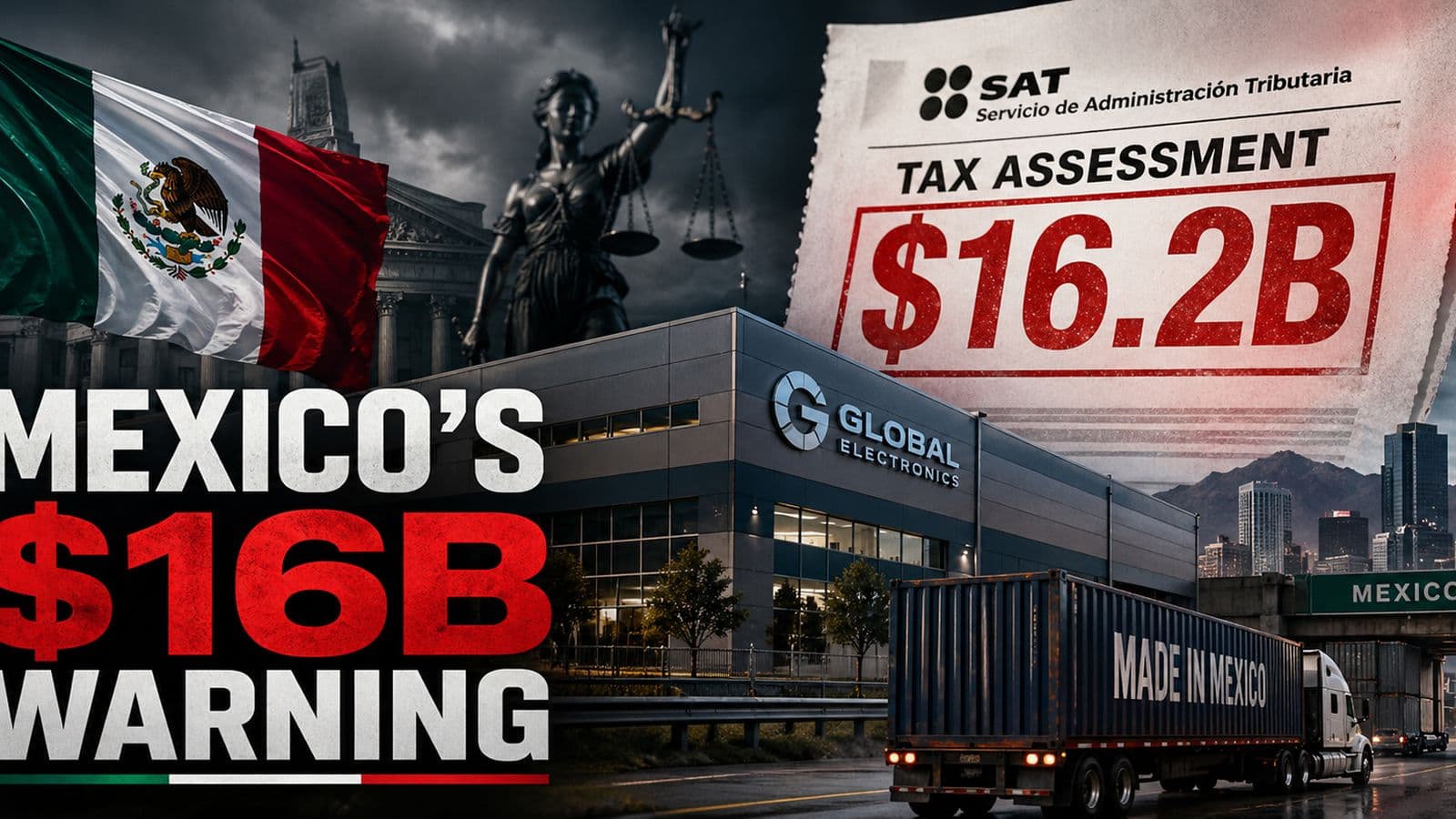
When Mexico's tax authority came for Samsung, it did not send a polite letter. It sent a bill for $16.2 billion.
The case, which has been working through Mexican courts and negotiation channels since 2025, centers on Samsung's alleged misuse of Mexico's IMMEX program — a manufacturing and export incentive scheme that allows companies to temporarily import inputs, machinery, and equipment without immediate tax payment, provided finished goods are subsequently exported. Mexico's Tax Administration Service (SAT) alleges Samsung exploited the program's "virtual import" mechanism in ways that constituted tax evasion between 2014 and 2016.
Samsung has denied wrongdoing, emphasized its "commitment to Mexican laws," and sought a negotiated settlement. None has been reached. The company is one of Mexico's largest foreign employers, with significant manufacturing operations producing televisions, home appliances, and electronics components for the North American market.
This Is Not About One Company
The Samsung case would be notable in isolation. It is not in isolation.
Mexico's SAT has been on an aggressive enforcement campaign for years — one that has steadily expanded in scope, retroactive reach, and target size under President Claudia Sheinbaum. Since 2019, SAT has launched dozens of audits against major international and domestic corporations, resulting in hundreds of millions of dollars in new assessments, penalties, and late fees. Several multinational manufacturers reported VAT refund delays exceeding 12 months in 2024. Retroactive audits going back up to five years have increased in frequency since mid-2023, according to industry groups INDEX and CONCAMIN.
The Sheinbaum administration has framed the tax campaign as a matter of fiscal responsibility and social justice: the government needs revenue to fund an expanding slate of social programs, and rich companies — both domestic and foreign — should pay what they owe. The domestic side of that campaign has generated its own drama, including a $4 billion battle with Mexican media billionaire Ricardo Salinas Pliego that culminated in Mexico's Supreme Court unanimously upholding $2.5 billion in tax claims in under two months of the newly-elected judiciary taking office.
Why the Court Case Should Alarm Foreign Investors
The Salinas ruling is not merely an interesting political subplot. It is a direct warning to every multinational operating in Mexico with a tax dispute.
Mexico's judicial overhaul replaced the country's appointed judiciary with nine elected judges in 2024 — all supported by the ruling Morena party. The Supreme Court's unanimous ruling against Salinas, delivered in under two months of those judges taking the bench, raises a question that foreign corporate counsel are now asking explicitly: if Mexico's most powerful and politically connected domestic billionaire could not find a single sympathetic vote on the highest court in the land, what protection does a foreign corporation realistically have in a dispute with SAT?
Salinas had resources, lawyers, political connections, and a national media platform. He offered $400 million in settlement — nearly five times what the government's own original assessment described as the liability — and was rejected. The Supreme Court ruled unanimously and quickly. The message to the foreign business community, whether intended or not, is that the judicial firewall between aggressive tax enforcement and corporate due process has been materially weakened.
This is not fear-mongering. The U.S. State Department documented these concerns in its 2025 Investment Climate Statement for Mexico, and the U.S. Chamber of Commerce has formally accused Mexico's tax authority of "aggressive and inconsistent tax enforcement practices." CSIS described the dynamic plainly this month: "Uncertainty feeds a self-reinforcing loop in which higher perceived risk leads to lower investment, weaker growth, and even greater hesitation from capital."
The IMMEX Problem
The specific mechanism at the center of the Samsung case matters for any multinational operating a manufacturing or export operation in Mexico.
IMMEX is one of Mexico's most important investment incentives. More than 5,000 companies operate under it, including the majority of the automotive, electronics, and aerospace multinationals that have built supply chains in Mexico's northern industrial corridors. The program is the backbone of the nearshoring model: companies can bring in components, assemble finished goods, and export them to the U.S. without paying Mexican import duties on the inputs, because the inputs are considered temporary.
SAT has been reclassifying certain IMMEX transactions — particularly "virtual imports" involving cross-border transfers without physical movement of goods — as ineligible for the program's benefits. That reclassification, applied retroactively, converts what companies believed were compliant operations into multi-year tax liabilities. The U.S. State Department's 2025 Investment Climate Statement for Mexico documented this concern explicitly, noting that changes to the IMMEX program have "reduced the perceived value and legal certainty of the program."
The IMMEX uncertainty is also arriving at the worst possible moment for the U.S.-Mexico trade relationship. The digital services taxes Mexico passed in its 2026 fiscal package — including expanded VAT withholding requirements targeting U.S. tech platforms — have drawn a formal complaint from the Americans for Tax Reform, which accused the measures of "discriminatorily targeting foreign companies." These are exactly the kinds of bilateral friction points that U.S. trade negotiators will be carrying into the July 2026 USMCA review. A Mexico that is simultaneously retroactively auditing IMMEX participants, pursuing $16 billion from Samsung, and imposing new digital platform taxes on American companies is not arriving at that review from a position of institutional goodwill.
The Investment Climate Paradox
Here is the tension that makes this story genuinely complicated for investors: Mexico's nearshoring fundamentals remain structurally undeniable, while its institutional deterioration is simultaneously causing a pullback.
On the structural case, the numbers speak for themselves:
- Surging FDI: Mexico attracted $40.9 billion in FDI through the first three quarters of 2025, a 15% year-on-year increase, as nearshoring continued drawing manufacturers diversifying away from China.
- Labor arbitrage: Manufacturing wages at roughly $4.90 per hour remain 25% below China's $6.50 per hour — a gap that compounds when U.S. tariffs on Chinese goods are factored in.
- USMCA integration: Compliance rates surged from 45% to 89% in 2025, insulating compliant exporters from tariff exposure.
- Rising investor confidence: Mexico climbed from 25th to 19th in Kearney's 2026 FDI Confidence Index, one of the largest gains globally.
And yet, despite those advantages, the institutional decay is causing concrete pullbacks. BYD halted plans for a Mexican EV factory. DSV paused a logistics investment near the U.S.-Mexico border. Mexico's economy grew just 0.6% in 2025 — its weakest performance since the pandemic. Manufacturing employment fell by 127,200 jobs, the worst result since 2008. Investment as a share of GDP slipped from 24.8% to 22%.
Morgan Stanley noted in a recent report that Mexico's long-term investment outlook "hinges increasingly on domestic economic reforms and private investment growth" — a careful way of saying the structural case is real but the institutional case is moving in the wrong direction.
What This Means for Investors
For any multinational with manufacturing operations in Mexico — or considering them — the current environment requires a specific set of questions that were not necessary five years ago.
The IMMEX program's legal certainty has materially weakened. Companies that structured operations around virtual import mechanisms are now carrying retroactive tax exposure that may not be fully priced into their Mexico operating cost models. Legal counsel with specific Mexican tax expertise, and a clear-eyed assessment of SAT audit risk across the supply chain, are now table stakes rather than optional due diligence.
The judicial overhaul is the structural risk that sits beneath all of this. For foreign companies evaluating commercial disputes, contract enforcement, and regulatory challenges, a Supreme Court that acts as a rapid-fire rubber stamp for the administration's revenue targets is a materially different operating environment than the one they originally underwrote.
The July 2026 USMCA review is the most important near-term catalyst. If it produces a clean extension through 2042, it removes the single largest source of trade policy uncertainty for companies operating in Mexico. If it produces renegotiation — particularly around rules of origin for Chinese-content inputs, which would affect a significant share of electronics and automotive supply chains — the cost structures currently underpinning nearshoring investment become materially more uncertain.
Mexico remains one of the most structurally compelling nearshoring destinations in the world. The Samsung case is a reminder that structural competitiveness and institutional reliability are two different things — and that right now, one of them is moving in the wrong direction.
Sources
- U.S. News / AP — "Showdown With Mexican Billionaire Salinas Tests Sheinbaum's Power": https://www.usnews.com/news/world/articles/2025-11-28/showdown-with-mexican-billionaire-salinas-tests-sheinbaums-power
- Mexico Business News — "Samsung Seeks Dialogue with SAT Over IMMEX Tax Dispute": https://mexicobusiness.news/tech/news/samsung-seeks-dialogue-sat-over-immex-tax-dispute
- CSIS — "Nearshoring Without Growth: Why Investment Uncertainty Is Holding Mexico Back": https://www.csis.org/analysis/nearshoring-without-growth-why-investment-uncertainty-holding-mexico-back
- Americans for Tax Reform — "Mexico's 2026 Tax Reform Targets U.S. Businesses with Discriminatory Taxes and Compliance Hurdles": https://atr.org/mexicos-2026-tax-reform-targets-u-s-businesses-with-discriminatory-taxes-and-compliance-hurdles/
- Bloomberg — "Mexican Billionaire Salinas Battles Debt, Taxes and Feuds With Sheinbaum": https://www.bloomberg.com/news/features/2026-04-09/billionaire-salinas-fights-mexico-s-sheinbaum-taxes-in-nod-to-trump
- U.S. State Department — "2025 Investment Climate Statements: Mexico": https://www.state.gov/reports/2025-investment-climate-statements/mexico
- RioTimes — "Mexico Economy 2026: GDP, Nearshoring Boom, Banxico Rates and Peso Outlook": https://www.riotimesonline.com/mexico-economy-2026-outlook/
- RioTimes — "Nearshoring Mexico 2026: USMCA, Tariffs and Key Sectors": https://www.riotimesonline.com/nearshoring-mexico-2026-guide/
- FreightWaves — "Mexico FDI ranking jumps in 2026 as nearshoring boosts investment": https://www.freightwaves.com/news/mexico-fdi-ranking-jumps-in-2026-as-nearshoring-boosts-investment
- OPPORTIMES — "2026 USMCA Review: The Future of Nearshoring in Mexico and Three Key Scenarios": https://www.opportimes.com/en/2026-usmca-review-the-future-of-nearshoring-in-mexico-and-three-key-scenarios/
- International Bar Association — "The future of Mexico's nearshoring boom": https://www.ibanet.org/The-future-of-Mexicos-nearshoring-boom
Market Munchies and Mode Mobile communications are for informational purposes only, and are not a recommendation, solicitation, or research report relating to any investment strategy, security, or digital asset. All investments involve risk including the loss of principal and past performance does not guarantee future results.
Any information contained in this commentary does not purport to be a complete description of the securities, markets, or developments referred to in this material. The information has been obtained from sources considered to be reliable, but we do not guarantee that the foregoing material is accurate or complete. There is no guarantee that any statements or opinions provided herein will prove to be correct.