Modi Just Won West Bengal for the First Time in BJP History. Here's What It Means for Investors.
The results landing from India's state elections this morning amount to the most significant reshaping of the country's political landscape in years, and the one with the most direct consequences for international investors is one that most Western financial media will…
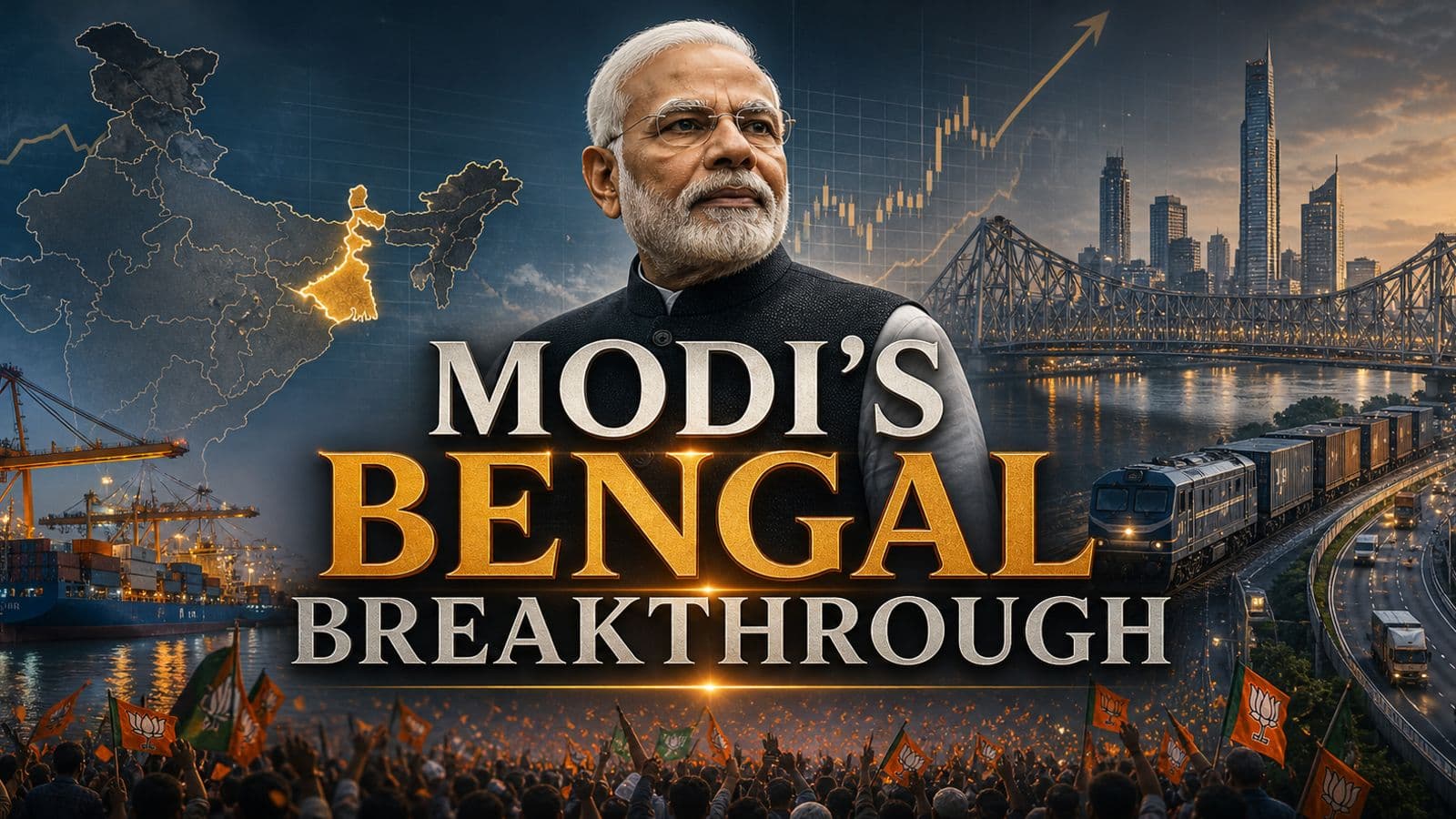
The results landing from India's state elections this morning amount to the most significant reshaping of the country's political landscape in years, and the one with the most direct consequences for international investors is one that most Western financial media will underreport.
Modi's Bharatiya Janata Party on Monday wrested control of West Bengal, an opposition stronghold, in a historic election. The Election Commission of India released partial results showing the BJP won at least 124 seats in the 294-member West Bengal assembly and was leading in 83 others. The BJP has never governed West Bengal. It has now.
Across the four major state contests of West Bengal, Assam, Tamil Nadu, and Kerala, Modi's party was set to win two of four crucial state elections, expand its influence and weaken its key rivals halfway into his third term.
In Tamil Nadu, movie star Joseph Vijay's new Tamilaga Vettri Kazhagam party looked on course to oust the ruling DMK, a political earthquake in a state where Dravidian parties have dominated for six decades. For investors, Vijay's economic platform matters as much as his electoral success. TVK has positioned itself as broadly pro-development and anti-corruption, with Vijay explicitly distancing his party from both caste-based populism and the heavy state intervention that characterized previous Dravidian governments. Tamil Nadu is India's second-largest state economy, a manufacturing hub for automobiles, electronics, and textiles, and home to a significant share of the country's foreign direct investment in manufacturing. A TVK government that delivers on its pro-development framing would be a meaningful positive for the state's investment climate, though Vijay's lack of governing experience and the populist pressures inherent in Tamil politics mean that framing should be treated as an aspiration rather than a forecast until his first budget.
In Kerala, the Left Democratic Front suffered its worst defeat in years, with the Congress-led alliance surging to 102 seats. Out of 11 state elections since 2024, the BJP and its allies have retained power in four states and gained power in two others, reflecting a pattern of consolidation that is now beginning to matter for how India is governed economically.
Why West Bengal Is the Most Important Result
West Bengal is not just symbolically significant. It is structurally important for India's economic reform agenda in ways that the celebration in New Delhi obscures.
West Bengal is India's fourth most populous state, with 100 million people and a GDP of approximately $180 billion. It is India's primary gateway to Bangladesh and Southeast Asia, and its port city of Kolkata handles a significant share of the country's northeastern trade flows. Under Chief Minister Mamata Banerjee, who has governed the state since 2011, West Bengal maintained an adversarial relationship with the central government in New Delhi, blocking federal infrastructure projects, resisting central regulatory initiatives, and operating essentially as an independent economic unit in ways that frustrated both domestic and foreign investors trying to enter the state.
"The win certainly strengthens the government politically to take tough decisions in a time of economic crisis caused by the Middle East war," said Ashok Malik, partner at public policy think tank The Asia Group. Malik specifically noted the government will now have room to undertake energy price rationalization, a politically sensitive reform that requires state-level cooperation to implement, and to pare back some of the populist welfare spending that has constrained India's fiscal position.
For foreign investors, the West Bengal result removes one of the most stubborn regulatory friction points in the country's largest manufacturing corridor. The state's labor market, infrastructure permitting process, and land acquisition framework have all been cited in foreign direct investment surveys as barriers to entry. A BJP government in Kolkata, aligned with New Delhi, changes that calculus.
The Investment Climate Problem That One Election Cannot Fix
The optimism surrounding the results needs to be balanced against a set of investment climate data points that the BJP's victory does not immediately address.
Morgan Stanley, in an April 22 report, said that India's net foreign direct investment flows are "near all-time lows of $0.5 billion" in the 12 months ending January 2026, and that the trend is likely to continue. Foreign portfolio investors have been exiting India's equity markets in record numbers. The Iran war has widened India's current account deficit, as higher energy prices (India imports the overwhelming majority of its crude oil) have increased the import bill while disrupting some export logistics.
More needs to be done to speed up reforms addressing the economy's underlying weaknesses, as prolonged delays are pushing foreign investors toward alternative markets, according to experts. The specific reforms most cited by institutional investors, including labor market flexibility, land acquisition simplification, goods and services tax rationalization, and financial sector deregulation, require not just political will but parliamentary supermajorities that the BJP still does not have.
It is also worth being direct about the hierarchy of factors currently driving foreign capital decisions on India. The Morgan Stanley FDI data reflects decisions made primarily in response to the Iran war's energy shock, the widening current account deficit, and the global risk-off environment. These are forces that dwarf any single state election result in their immediate impact on capital allocation. A BJP win in West Bengal is a multi-year structural improvement to India's investment climate. It is not a near-term catalyst for the foreign capital that left when oil crossed $100 per barrel. Geopolitics is currently trumping domestic politics in the eyes of institutional investors, and that ordering will not reverse until the Hormuz closure ends.
The election victory gives the BJP and its allies close to a two-thirds majority in the Rajya Sabha, India's upper house, where state legislative compositions feed into membership over time. But that gain is largely symbolic for the reform agenda. The binding constraint remains the Lok Sabha, the lower house, where the 2024 national election left the BJP dependent on coalition partners whose own constituents have different economic priorities, and that arithmetic is fixed until the 2029 general election. No state result changes it.
The Electoral Integrity Question
Any honest assessment of Monday's results must address a dimension that several analysts raised explicitly.
Before the polling in West Bengal, the Election Commission of India carried out a revision of its electoral rolls that controversially removed more than nine million people, nearly 12 percent of the state's 76 million voters, from the voting list. Government authorities described the exercise as the removal of ineligible voters. Critics, including multiple academics who spoke to Al Jazeera, said the removals were skewed against marginalized and minority communities.
Uday Chandra, a professor at Ashoka University, warned that the vote did not represent "free and fair elections." "Over nine million voters were excluded. Most of those were Hindus of unprivileged backgrounds and Muslims," he told Al Jazeera.
This matters for investors not as a moral judgment but as a political risk assessment. A governing party that consolidates power through contested electoral processes faces a different set of institutional stability risks than one that wins through broad popular mandate. The legitimacy of India's democratic institutions, historically one of its strongest competitive advantages over China as a destination for long-term foreign capital, is a variable that institutional investors are increasingly watching alongside the headline economic data.
What Modi's Strengthened Position Actually Enables
Setting aside the contested elements, the net political outcome for Modi is a genuine consolidation of power at a moment when India needs centralized policy coordination to navigate the Iran war's economic disruption.
The most actionable near-term consequence for investors is energy policy. India has been subsidizing fuel prices domestically to cushion households from the Hormuz closure's impact, a fiscally costly approach that has widened the deficit. With stronger state-level cooperation from BJP-aligned governments in West Bengal and Assam, the central government now has the political cover to begin rationalizing those subsidies, particularly in states where it controls both the central and state governments simultaneously. That rationalization, if it occurs, reduces India's fiscal drag and improves the sovereign debt picture.
The second consequence is infrastructure. India's National Infrastructure Pipeline, a $1.4 trillion program covering roads, railways, ports, and digital infrastructure, has consistently underperformed its targets in states where central and state governments are politically misaligned. West Bengal's conversion from adversarial to aligned changes the implementation trajectory for projects in the state's port and logistics corridors that are directly relevant to India's nearshoring ambitions.
The third consequence is the 2029 general election horizon. Modi is expected to run for a record fourth term in 2029. A BJP that has consolidated state-level power across more of the country is a BJP that is harder to dislodge, and a policy environment that is more predictable over the medium term for foreign investors making five-to-ten year commitments.
What This Means for Investors
Citi noted that "markets would hope that a strong political mandate and easier coordination with state governments will facilitate better implementation of various policy and process reforms."
For investors with India exposure, through the iShares MSCI India ETF, the WisdomTree India Earnings ETF, or direct positions in Indian equities, Monday's results are modestly positive as a policy enablement signal. They do not resolve the FDI drought, the current account deficit, or the legislative arithmetic that constrains major reform. But they reduce one category of political friction that has historically made India's reform promises more durable in rhetoric than in execution.
The valuation context is relevant here. India's equity market currently trades at approximately 22x forward earnings, a premium of roughly 40% to the broader MSCI Emerging Markets index, which trades closer to 13x. That premium reflects the growth narrative, the demographic dividend, and the nearshoring opportunity. It also means there is limited margin for error. A market priced for reform delivery that fails to deliver will reprice sharply — which is precisely why the gap between Monday's political momentum and the legislative constraints that remain in place matters so much for anyone holding Indian equities at current multiples.
For investors evaluating India versus China as an emerging market allocation, the BJP's consolidation reinforces the thesis that India offers greater political continuity and institutional alignment for foreign capital than it did two years ago — with one important caveat. Political continuity built partly through contested electoral processes, including the removal of nine million voters from the West Bengal rolls, carries its own category of institutional risk. Civil unrest in response to perceived democratic erosion is a material consideration for fixed-asset investors making decade-long infrastructure or manufacturing commitments. The question of whether India's democratic institutions remain a durable competitive advantage over China — or whether they are being quietly hollowed out in ways that will eventually produce instability — is one that honest investors need to hold alongside the more optimistic reform narrative.
India is the most compelling large emerging market story of the decade. It is also, in the current moment, a market where the gap between narrative and execution remains wide enough to reward patience over enthusiasm.
Sources
- NPR — "Modi's party takes control of India's West Bengal in key state election": https://www.npr.org/2026/05/04/g-s1-120053/modis-party-takes-control-of-indias-west-bengal-in-key-state-election
- Al Jazeera — "Modi's party poised for big wins in Indian state elections": https://www.aljazeera.com/news/2026/5/4/modis-party-poised-for-big-wins-in-indian-state-elections
- Al Jazeera — "Hegemonic power: How Modi's BJP won India's Bengal for the first time": https://www.aljazeera.com/features/2026/5/4/hegemonic-power-how-modis-bjp-won-indias-bengal-for-the-first-time
- Washington Post — "Modi's party wins control of India's West Bengal in a key state election": https://www.washingtonpost.com/world/2026/05/04/india-state-elections-west-bengal-joseph-vija/bc32fcbc-47a4-11f1-a119-857cd2bf4fd4_story.html
- CNBC — "India's Modi tightens political grip with historic state victory, but can it usher in reforms and draw investors?": https://www.cnbc.com/2026/05/05/modi-wins-in-west-bengal-for-the-first-time.html
- IBTimes India — "Elections 2026 round-up: Mamata Banerjee loses Bengal to Modi-Shah duo": https://www.ibtimes.co.in/elections-2026-round-vijays-victory-aligns-trishas-birthday-mamata-banerjee-loses-bengal-901779
- Morgan Stanley — India FDI report cited via CNBC (April 22, 2026): https://www.cnbc.com/2026/05/05/modi-wins-in-west-bengal-for-the-first-time.html
- The Asia Group — Ashok Malik commentary cited via CNBC: https://www.cnbc.com/2026/05/05/modi-wins-in-west-bengal-for-the-first-time.html
- iShares — MSCI India ETF (INDA) product page: https://www.ishares.com/us/products/239659/ISHARES-MSCI-INDIA-ETF
- Citi Research — India election note (cited via CNBC): https://www.cnbc.com/2026/05/05/modi-wins-in-west-bengal-for-the-first-time.html
Market Munchies and Mode Mobile communications are for informational purposes only, and are not a recommendation, solicitation, or research report relating to any investment strategy, security, or digital asset. All investments involve risk including the loss of principal and past performance does not guarantee future results.
Any information contained in this commentary does not purport to be a complete description of the securities, markets, or developments referred to in this material. The information has been obtained from sources considered to be reliable, but we do not guarantee that the foregoing material is accurate or complete. There is no guarantee that any statements or opinions provided herein will prove to be correct.