Musk vs. Altman Is Now in Front of a Jury. The Verdict Could Reshape the Entire AI Industry.
Opening arguments began this morning in Elon Musk's lawsuit against Sam Altman and OpenAI, the most consequential technology trial in years — one that could, depending on how it goes, unwind a near-trillion-dollar company, derail two of the most anticipated IPOs of the decade,…
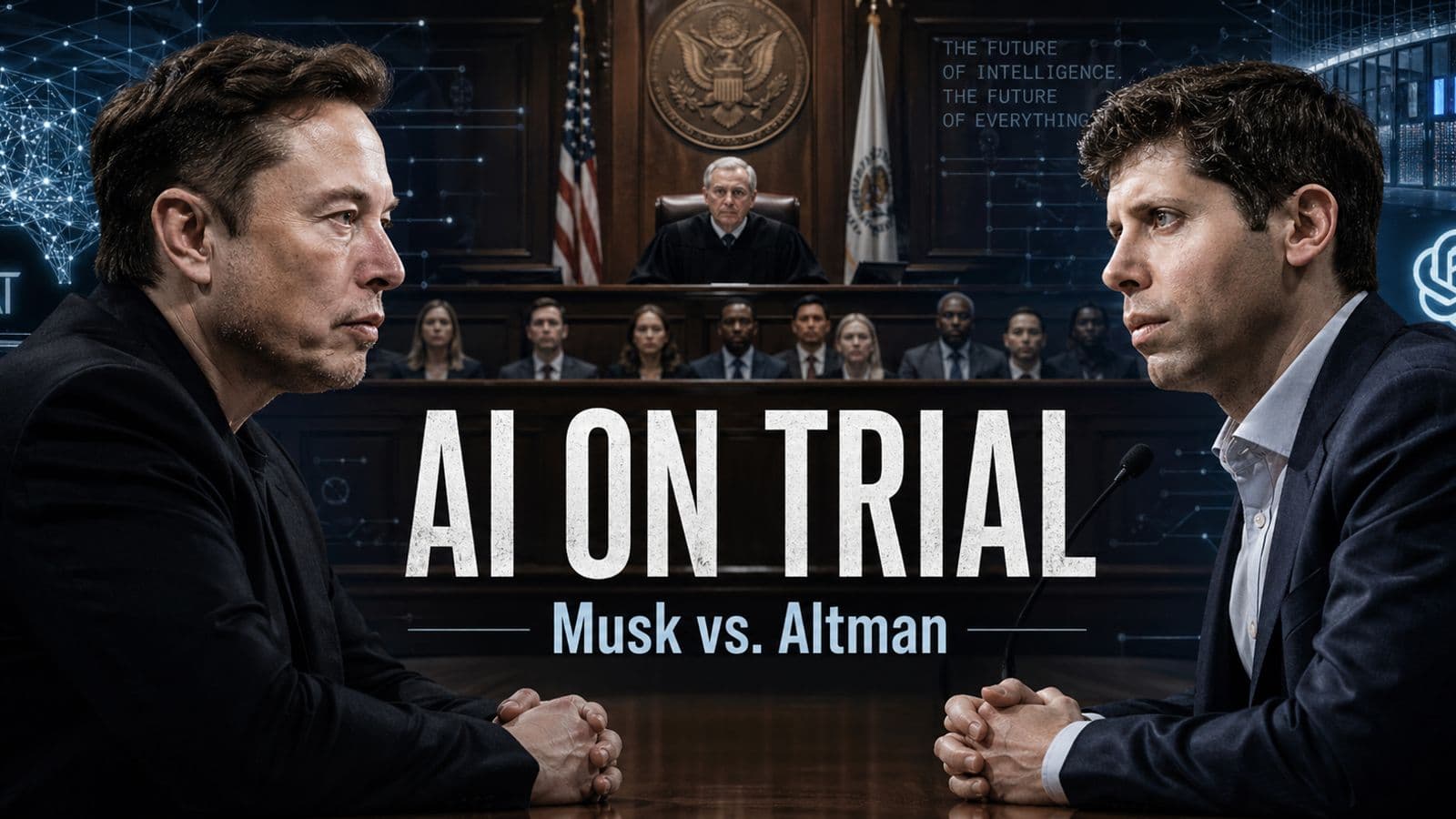
Opening arguments began this morning in Elon Musk's lawsuit against Sam Altman and OpenAI, the most consequential technology trial in years — one that could, depending on how it goes, unwind a near-trillion-dollar company, derail two of the most anticipated IPOs of the decade, and force a reckoning over who actually gets to decide how artificial intelligence is built and governed.
The nine-person jury was seated Monday at the U.S. District Court in Oakland, California. Judge Yvonne Gonzalez Rogers is presiding. Both Musk and Altman are expected to testify. Microsoft CEO Satya Nadella is also on the witness list.
What the Case Is Actually About
The story starts in 2015, when Musk, Altman, Greg Brockman, and a handful of others co-founded OpenAI as a nonprofit. The founding premise was deliberate: artificial intelligence was too consequential to be developed under the pressures of profit and shareholder returns, so the organization would be structured as a charity, with its research open and its mission explicitly to benefit humanity rather than enrich investors.
Musk contributed more than $44 million in early funding — money that, by most accounts, was critical to getting the operation off the ground.
By 2018, Musk had left the board after a bitter internal power struggle with Altman over who would lead the company. By 2019, OpenAI had established a for-profit subsidiary to attract the capital it said it needed to build competitive AI systems at scale. By 2024, that subsidiary was valued at $852 billion. And by the time Musk filed his lawsuit, OpenAI had nearly a billion weekly active users and had restructured itself as a nonprofit with a controlling stake in its for-profit business — a structure that, as Musk's lawyers put it, made "a wealth machine" out of what was supposed to be a public charity.
Musk's central allegation is that he was deceived. He claims Altman and Brockman told him they were committed to keeping OpenAI a nonprofit even as they privately pursued the for-profit pivot. OpenAI's response is equally direct: Musk knew. The company says he was part of discussions about the need for a for-profit structure, even proposed merging OpenAI with Tesla, and launched his own competing AI company, xAI, after losing a leadership battle — making this lawsuit, in OpenAI's framing, a "baseless and jealous bid to derail a competitor."
What Has Already Been Stripped Away — and the Legal Problem That Hasn't
Before assessing what this trial could mean, it is worth understanding how much has already been whittled away — and why the case's foundational legal theory remains genuinely contested.
Musk originally filed 26 claims in 2024. Of those, 24 have been dismissed or dropped, including a fraud allegation thrown out just last Friday. Two remain: unjust enrichment and breach of charitable trust. His original ask was up to $134 billion in damages from OpenAI and Microsoft. He has since abandoned the personal damages claim entirely, instead asking that any money awarded be funneled back into OpenAI's charitable arm.
But the more fundamental problem is standing. Musk is bringing this case as a former donor and board member — not as a current shareholder, employee, or beneficiary of the charity. Whether he has the legal right to sue at all over OpenAI's nonprofit obligations is a question that has troubled legal scholars since he filed.
"The idea that Elon Musk can sue because he was a donor or used to be on the board is pretty puzzling," said Jill Horwitz, a law professor who studies nonprofit law at Northwestern University. California's attorney general declined to join the lawsuit, saying the office did not see how it serves the public interest. Some legal experts have suggested the case is being argued under the wrong body of law entirely.
This matters enormously for investors trying to assess the trial's actual risk to OpenAI. If Musk's standing collapses — if the jury or a subsequent appellate court finds that he simply does not have the legal right to bring these claims — the entire proceeding evaporates regardless of what the internal documents show. The drama of the testimony becomes legally irrelevant. A Musk loss on standing grounds would be the most anticlimactic possible ending to the most heavily covered AI lawsuit in history, and it remains a live possibility.
The Evidence
The case has generated a trove of internal documents that provide an unusually candid view of how OpenAI's leadership actually operated in its formative years.
Central to Musk's argument is a diary entry from Greg Brockman, written in 2017 during discussions about the company's future structure. "This is the only chance we have to get out from Elon," Brockman wrote. OpenAI will argue the entry reflects personal frustration during a difficult period, not evidence of a coordinated plan to deceive a co-founder.
Other evidence includes private communications between Musk and Altman and internal records of discussions about the 2019 for-profit transition. Some conversations are alleged to have occurred at Burning Man 2017 — a detail Altman's side has used to question the reliability of Musk's recollections. Judge Gonzalez Rogers has set limits on how far those particular claims can be taken, citing the risk of unfairly prejudicing the jury.
The more legally consequential evidence is likely to be the contemporaneous corporate documentation: board minutes, internal memos, and email chains that speak directly to what Musk was told, and when. Both sides agree that conversations about a potential for-profit structure took place while Musk was still on the board. The dispute is over what he was told, what he agreed to, and whether the eventual restructuring violated whatever commitments were made.
What the Verdict Could Mean for Investors
This is not purely a legal dispute between two billionaires. The stakes for investors across the AI sector are significant and concrete.
OpenAI is planning an IPO expected in Q4 2026 at a valuation approaching $1 trillion. If Musk wins and the court orders a structural unwinding of OpenAI's for-profit conversion — or removes Altman and Brockman from leadership — that IPO timeline becomes immediately and materially uncertain. The company's entire investor pitch, from the $122 billion fundraising round to the billions committed by Amazon, SoftBank, and Nvidia, is built on the current corporate structure. A court order to dismantle it would be an event with no modern precedent.
Even a partial victory for Musk — a finding of unjust enrichment without full structural remedy — introduces governance risk into OpenAI's pre-IPO period that institutional investors will price. Companies heading toward a public offering do not need a federal judge ordering remedies from their board.
Musk, meanwhile, is preparing to take SpaceX public in what is expected to be a record IPO. His credibility as a witness and his conduct throughout this trial will be scrutinized by the same institutional investor community he is simultaneously trying to court as a SpaceX IPO buyer.
Microsoft is also named as a defendant, accused of aiding and abetting the breach of charitable trust. Should the jury find in Musk's favor on that count, Microsoft's position as OpenAI's primary commercial partner and largest outside investor faces its own complications — though legal experts have been broadly skeptical that Musk's Microsoft claims survive the full trial.
For investors in the broader AI infrastructure trade — data center REITs, power utilities, and chipmakers whose valuations have been partially underwritten by the assumption of continued OpenAI growth — any outcome that materially disrupts OpenAI's operational trajectory is worth monitoring closely.
What to Watch
The remedies phase, if Musk prevails, is scheduled to begin May 18. That timeline puts a potential structural ruling on OpenAI squarely in the middle of the company's pre-IPO preparation window and the same period when Microsoft will be reporting AI revenue guidance.
The testimony of Altman and Musk themselves will be the week's most closely watched moments. The standing question is the one to track most carefully: if Judge Gonzalez Rogers signals during proceedings that she is skeptical of Musk's right to bring these remaining claims, the trial's headline drama will be a poor guide to its actual legal trajectory.
Sources
- CNBC — "Judge in Musk v. Altman seats nine-person jury. Opening arguments start Tuesday": https://www.cnbc.com/2026/04/27/musk-altman-trial-openai-jury-selection.html
- CNBC — "Musk v. Altman heads to court next week. Here's what's at stake": https://www.cnbc.com/2026/04/24/musk-v-altman-trial-openai-lawsuit-xai.html
- NPR — "Musk vs. Altman: Tech CEOs head to court over the fate of OpenAI": https://www.npr.org/2026/04/27/nx-s1-5795661/trial-openai-elon-musk-sam-altman
- Al Jazeera — "Elon Musk trial against Sam Altman to reveal OpenAI power struggle": https://www.aljazeera.com/economy/2026/4/27/elon-musk-trial-against-sam-altman-to-reveal-openai-power-struggle
- MIT Technology Review — "Elon Musk and Sam Altman are going to court over OpenAI's future": https://www.technologyreview.com/2026/04/27/1136466/elon-musk-and-sam-altman-are-going-to-court-over-openais-future/
- ABC7 San Francisco — "Elon Musk v. Sam Altman live updates: Week 1 of trial could alter the direction of artificial intelligence": https://abc7news.com/live-updates/elon-musk-sam-altman-live-updates-week-1-trial-could-alter-direction-artificial-intelligence/18968485/
- Washington Post — "Elon Musk's court battle with Sam Altman exposes Silicon Valley secrets": https://www.washingtonpost.com/technology/2026/04/23/musk-altman-lawsuit-trial-openai/
- India TV News — "Elon Musk-Sam Altman court battle turns messy as OpenAI lawsuit reveals new details": https://www.indiatvnews.com/technology/news/elon-musk-sam-altman-court-battle-turns-messy-as-openai-lawsuit-reveals-new-details-2026-04-28-1039161
- Northwestern University / MIT Technology Review — Jill Horwitz nonprofit law commentary on Musk's standing: https://www.technologyreview.com/2026/04/27/1136466/elon-musk-and-sam-altman-are-going-to-court-over-openais-future/
- Platformer / NPR — Casey Newton on what a Musk victory would mean for AI industry: https://www.npr.org/2026/04/27/nx-s1-5795661/trial-openai-elon-musk-sam-altman
Market Munchies and Mode Mobile communications are for informational purposes only, and are not a recommendation, solicitation, or research report relating to any investment strategy, security, or digital asset. All investments involve risk including the loss of principal and past performance does not guarantee future results.
Any information contained in this commentary does not purport to be a complete description of the securities, markets, or developments referred to in this material. The information has been obtained from sources considered to be reliable, but we do not guarantee that the foregoing material is accurate or complete. There is no guarantee that any statements or opinions provided herein will prove to be correct.