Oil Above $100 Resets the Week for Markets
This morning’s market setup is being driven by energy first, earnings second. Oil surged after the Iran conflict intensified and Tehran installed Mojtaba Khamenei as the country’s new supreme leader, a move Reuters said appears to narrow the path to any swift diplomatic end to…
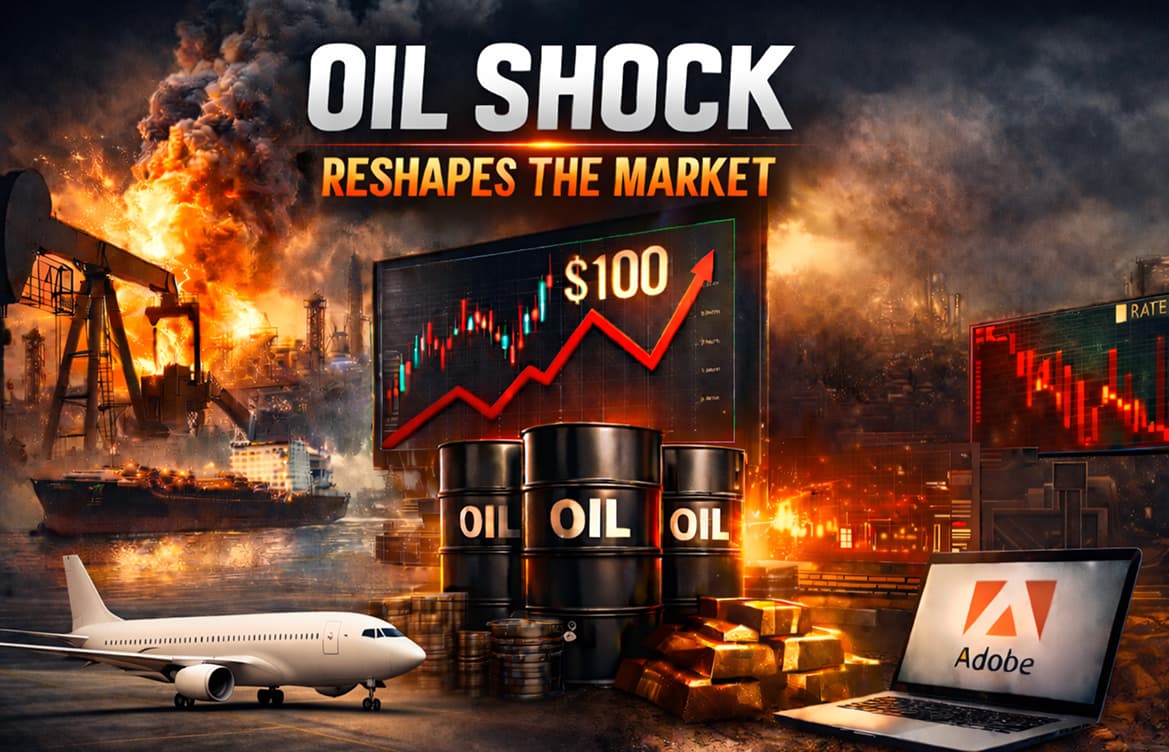
This morning’s market setup is being driven by energy first, earnings second. Oil surged after the Iran conflict intensified and Tehran installed Mojtaba Khamenei as the country’s new supreme leader, a move Reuters said appears to narrow the path to any swift diplomatic end to the war. Brent briefly climbed above $119 a barrel before easing, but it is still trading firmly above $100, which is enough to put inflation risk back at the center of the conversation.
That shift matters because traders are no longer reacting only to the geopolitical shock itself. They are also trying to price what comes next: higher fuel costs, shipping disruptions, tighter financial conditions, and the possibility that a growth scare collides with fresh inflation pressure. Reuters reported this morning that U.S. stock futures were down more than 1% as investors recalibrated around exactly that mix of risks.
Against that backdrop, one of this week’s most interesting company stories is Adobe’s earnings report on Thursday. In a steadier tape, Adobe would be a straightforward AI monetization test. In this tape, it looks more like a stress test for whether high-quality software names can still win back confidence when the macro backdrop is suddenly getting louder.
Stock of Interest Today: Adobe (ADBE)
Adobe heads into its March 12 earnings report as one of the more interesting prove-it names in software. The stock is still trading far below its prior highs, and Reuters has noted that Adobe has been caught up in the broader AI disruption trade that has weighed on software and information-services names this year. That lowers the bar for perfection, but it raises the bar for credibility. Investors do not need Adobe to sound futuristic. They need it to show that the AI story is making the business sturdier, more monetizable, and more visible in the numbers.
The underlying business is not broken. Adobe reported record fiscal 2025 revenue of $23.77 billion and total ARR of $25.2 billion exiting the year, while management said AI-influenced and AI-first ARR accelerated through 2025. The company has also been broadening its AI pitch beyond image generation, including enterprise-focused efforts such as Firefly Foundry and continued Firefly expansion across creative workflows. That gives Adobe a real argument that it is building deeper workflow relevance, not just bolting AI onto legacy products.
The question for Thursday is whether investors hear enough evidence that the monetization arc is becoming more concrete. Investor’s Business Daily reported that Wall Street is looking for roughly $6.27 billion in revenue and about $5.86 in adjusted earnings per share for the quarter, while Adobe has confirmed it will report results on March 12. In a tape like this one, that matters even more than usual. When macro gets messy, the market tends to reward companies that can prove their story is getting stronger even if the backdrop is not.
Current price: $283.62
Analyst target: $389.56.
Five Market Themes
Beyond Adobe, this morning’s setup revolves around five bigger themes that are likely to shape trading today and possibly the rest of the week. None of them stands alone. They all feed the same question: is this just a violent oil spike, or the beginning of a broader inflationary reset that changes how investors think about rates, margins, and risk appetite?
1) Oil above $100 changes the tone immediately
The most obvious story is still the biggest one. Reuters reported that Brent and WTI both surged to their highest levels since 2022, with Brent briefly topping $119 before retreating. Even after that pullback, crude is still high enough to force a rethink across sectors that depend on stable fuel, freight, and input costs. This is no longer just a commodity headline. It is a market-wide pricing event.
What makes it more serious is the scale of the infrastructure now in play. Reuters says more than 20 million barrels of crude, condensate and fuels moved through the Strait of Hormuz each day last year on average. When a chokepoint that large becomes uncertain, markets do not need a full shutdown to reprice risk. They just need enough disruption to believe a new war premium belongs in the barrel price.
2) Mojtaba Khamenei’s appointment points to a harder line
Tehran’s leadership succession matters because it changes the time horizon of the crisis. Reuters described Mojtaba Khamenei as a hardline successor whose appointment appears to close off the path to a quick diplomatic resolution. For markets, that matters because short conflicts can produce fast reversals in oil. Harder political structures are much less forgiving.
This is why the leadership story is not just geopolitical context. It is part of the market thesis. If investors come to believe this conflict is moving into a more durable phase, the energy shock starts to look less like a panic spike and more like a medium-term macro problem.
3) Strategic reserve talk can cap panic, but not solve the core problem
Governments are already trying to slow the market’s worst instincts. Reuters reported that G7 finance ministers are discussing a possible joint release of emergency oil reserves in coordination with the IEA. That matters because it signals policymakers understand this is not a routine move in crude.
Still, reserve releases are better at smoothing panic than replacing lost flows. Even a coordinated action can help cool the most extreme price swings, but it does not change the physical importance of Hormuz or eliminate the risk that supply chains remain strained. Investors should treat reserve headlines as important, but not as a clean all-clear signal.
4) Refined fuels could become the more painful inflation story
Crude gets the attention, but refined products may be where the real economic stress shows up first. Reuters reported that jet fuel spot prices in Singapore hit a record high, while diesel and other product markets have also tightened sharply as exporters prioritize domestic needs and shipping risks rise. That is a reminder that inflation shocks do not stay neatly inside the crude complex. They travel through airlines, freight, logistics, and industrial supply chains.
That is also why the sector damage can spread faster than many investors expect. Airlines are already being hit by the fuel-cost story, but the larger issue is that refined-product stress tends to work its way into everyday pricing more quickly than abstract oil-market commentary does. This is where a geopolitical shock starts becoming a business-margin story.
5) The stagflation concern is no longer theoretical
The final theme is the one that makes markets most uncomfortable. IMF Managing Director Kristalina Georgieva warned today that a sustained 10% increase in oil prices could add 40 basis points to global inflation. Reuters also reported that investors are rethinking the rate path, with oil-driven inflation concerns spilling into currencies, bond markets, and central-bank expectations.
That does not guarantee a full stagflation regime. But it does mean duration-sensitive assets, policy-easing hopes, and richly valued equities all face a tougher test than they did a week ago. In practical terms, this morning’s oil shock is forcing investors to think about inflation before they can think about multiple expansion.
Bottom Line
At 10:00 a.m. this morning, the market’s central question is not whether the headlines are dramatic. It is whether the oil shock is sticky enough to reshape the week. If crude stays above $100 and refined-product stress keeps building, the story quickly moves beyond geopolitics and into inflation, rates, margins, and valuation discipline.
That is why Adobe matters even in a market dominated by oil. This week is likely to reward companies that can prove their growth story is real, monetized, and resilient, not just well packaged. Adobe’s report will be one of the cleanest tests of that, but the bigger message this morning is broader: the market is being forced to price macro again.
Sources:
- https://www.reuters.com/world/middle-east/khameneis-hardline-son-mojtaba-appointed-irans-new-leader-pope-leo-warns-middle-2026-03-09/
- https://www.reuters.com/world/middle-east/iran-names-khameneis-son-mojtaba-new-supreme-leader-state-media-report-2026-03-08/
- https://www.reuters.com/business/energy/us-oil-prices-jump-supply-fears-amid-expanding-us-israeli-war-with-iran-2026-03-08/
- https://www.reuters.com/business/energy/oil-soars-25-gold-drops-iran-war-jolts-global-commodity-markets-2026-03-09/
- https://www.reuters.com/business/wall-st-futures-slump-iran-war-drags-oil-near-120-stokes-inflation-worries-2026-03-09/
- https://www.reuters.com/markets/us/wall-streets-immunity-mideast-oil-shock-will-now-be-tested-2026-03-09/
- https://www.reuters.com/world/middle-east/what-is-strait-hormuz-why-is-it-so-important-oil-2026-02-28/
- https://www.reuters.com/markets/commodities/opec-crude-output-boost-ignored-with-duration-hormuz-disruption-key-2026-03-02/
- https://www.reuters.com/business/energy/g7-discuss-joint-release-emergency-oil-reserves-ft-reports-2026-03-09/
- https://www.reuters.com/business/energy/tokyo-told-national-oil-reserve-site-prepare-release-amid-iran-crisis-japan-2026-03-08/
- https://www.reuters.com/markets/commodities/compounding-errors-narrow-self-interest-threaten-global-fuel-crisis-2026-03-09/
- https://www.reuters.com/business/energy/airline-shares-battered-oil-prices-spike-iran-war-intensifies-2026-03-09/
- https://www.reuters.com/world/middle-east/imfs-georgieva-warns-middle-east-conflict-could-push-global-inflation-higher-2026-03-09/
- https://www.reuters.com/business/energy/iran-war-fuels-central-bank-rate-hike-bets-inflation-fears-2026-03-09/
- https://www.adobe.com/cc-shared/assets/investor-relations/pdfs/01215202/a54gu6y5tegrrf.pdf
- https://www.adobe.com/cc-shared/assets/investor-relations/pdfs/01215202/c54trgt53r4aw.pdf
- https://blog.adobe.com/en/publish/2026/01/22/adobe-partners-artists-power-new-era-media-entertainment-firefly-foundry
- https://www.businesswire.com/news/home/20260302269687/en/Adobe-to-Announce-Q1-FY2026-Earnings-Results-on-March-12-2026
- https://www.investors.com/research/earnings-preview/adobe-stock-jumps-software-sector-earnings-report-3-gold-stocks-to-watch/
- https://www.reuters.com/business/us-software-stocks-slide-after-sap-servicenow-results-fuel-ai-disruption-fears-2026-01-29/
- https://www.reuters.com/business/software-real-estate-us-sectors-under-grip-ai-scare-trade-2026-02-13/
- https://www.marketbeat.com/stocks/NASDAQ/ADBE/forecast/
Market Munchies and Mode Mobile communications are for informational purposes only, and are not a recommendation, solicitation, or research report relating to any investment strategy, security, or digital asset. All investments involve risk including the loss of principal and past performance does not guarantee future results.
Any information contained in this commentary does not purport to be a complete description of the securities, markets, or developments referred to in this material. The information has been obtained from sources considered to be reliable, but we do not guarantee that the foregoing material is accurate or complete. There is no guarantee that any statements or opinions provided herein will prove to be correct.