Oil Shock, IMF Alerts & Capital Flight — Is a Global Liquidity Crunch Already Cooking?
You smell something burning… but can’t quite see the fire yet? You open your market dashboard. Oil is creeping up again. Currencies look a bit shaky. Then—quietly—headlines report that the IMF's emergency funding demand is rising. Nothing feels dramatic on its own. But put it…
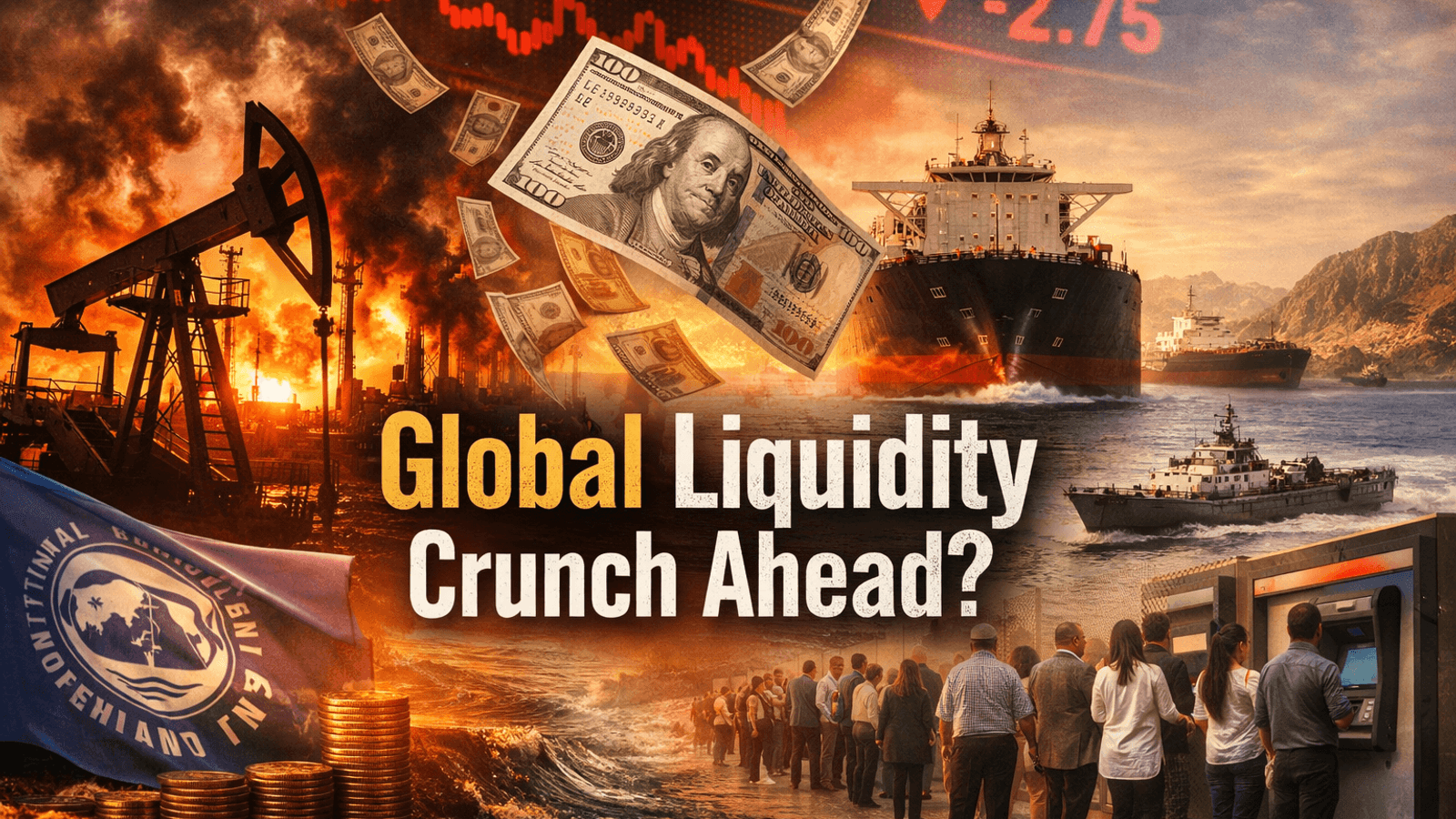
You smell something burning… but can’t quite see the fire yet? You open your market dashboard. Oil is creeping up again. Currencies look a bit shaky. Then—quietly—headlines report that the IMF's emergency funding demand is rising. Nothing feels dramatic on its own. But put it together, and it starts to feel like a slow-cooking stew—heat building under the surface, ingredients reacting in ways that don’t reverse easily. So here’s the real question: Are you looking at isolated macro noise… or the early stages of a global liquidity crisis? Let’s plate it properly.
IMF Funding Demand Is Rising — And That’s a Loud Signal
When the International Monetary Fund (IMF) starts preparing for $20–50 billion in emergency funding, it’s rarely about one country slipping. It’s about system-wide pressure building across multiple economies. Recent data shows:
- Over 80% of countries are feeling secondary effects from energy shocks
- Around $245+ billion has already been committed in global IMF support
- Rising demand from energy-importing and developing economies
What’s driving it?
- The oil price shock in 2026 is pushing import bills higher
- Food inflation is rising due to fertilizer and logistics costs
- Currency pressure in emerging markets
You’re essentially watching the early stages of a global financial stability stress cycle. IMF leadership hinted that “a significant share of countries” may require support as shocks cascade.
Smart Capital Signal
When IMF funding demand rises across regions, it often signals a broader global economic slowdown brewing—not just isolated distress.
Global Debt Crisis = Policymakers With Tied Hands
Here’s where things get interesting—and a bit uncomfortable. Back in 2020, governments flooded the system with stimulus. Now? The room to maneuver looks tight. Global public debt is already elevated, and with inflation and interest rates still sticky, policymakers face a difficult balancing act. Key constraints shaping the global debt crisis's impact on the economy:
- High borrowing costs
- Elevated sovereign debt levels
- Persistent inflation risks
So instead of large-scale bailouts, governments are leaning toward:
- Targeted subsidies (fuel, food)
- Limited fiscal support
- Delayed stimulus decisions
Which raises a subtle but important question: What happens when markets expect help… and don’t get enough of it?
Tactical Insight
Limited fiscal flexibility means markets absorb more volatility directly—a classic setup during periods of global liquidity tightening.
$4 Trillion in Hot Money — And It’s Getting Nervous
Let’s discuss the part most investors underestimate: capital flow behavior. Emerging markets have attracted roughly $4 trillion in portfolio inflows over recent years. Sounds bullish, right? Not quite. Most of that is short-term, yield-chasing capital:
- Hedge funds
- Institutional flows
- Global asset allocators
And here’s the catch—hot money doesn’t stick around for dessert. Triggers for exit are already lining up:
- Rising oil prices
- Stronger US dollar
- Geopolitical risk
If flows reverse, the sequence is almost textbook:
- Currency depreciation
- Bond yield spikes
- Emergency rate hikes
- Growth slowdown
You’ve probably seen this movie before.
Investor Radar
Watch for early signals:
- Emerging market currencies are weakening
- Rising sovereign bond spreads
- Central bank intervention headlines
That’s usually how emerging market crisis cycles begin.
Strait of Hormuz — The World’s Most Expensive Bottleneck
Now, let’s focus on the real pressure point. Roughly 20% of the global oil supply flows through the Strait of Hormuz—a narrow shipping lane with outsized influence. Recent disruptions have:
- Reduced oil output flows significantly
- Pushed prices above $110 per barrel, with spikes toward $120+
- Increased shipping and insurance costs
Which leads to a bigger question: How do oil prices affect inflation, and why is it important for you to care? Because energy touches everything:
- Transportation
- Food production
- Manufacturing
Once oil moves, inflation follows. Central banks react by keeping rates higher. The US dollar strengthens. And suddenly, global liquidity tightening becomes real—not theoretical.
Macro Pulse
An energy-driven liquidity squeeze tends to last longer than expected, especially when supply constraints meet already tight financial conditions.
So… How Does It All Connect?
Individually, each piece looks manageable:
- Rising IMF emergency funding
- Growing capital flight risk
- Persistent inflation and interest rates
- Elevated global debt levels
But together, they form a familiar chain: Oil shock → Inflation → Higher rates → Stronger dollar → Capital flight → IMF intervention It’s not a prediction. It’s a pattern.
Holiday Demand, Hidden Pressures & Market Psychology
Seasonal demand cycles—especially during global holidays—often increase:
- Energy consumption
- Shipping volumes
- Consumer activity
Sounds bullish on the surface. But is this being layered onto an already tight system? It can quietly amplify the following:
- Price pressures
- Supply constraints
- Liquidity stress
So while markets may look stable, underlying conditions feel… tighter.
Portfolio Perspective
Periods like this aren’t about panic. They’re about positioning during pressure-building phases.
Final Bite: The Crunch You Don’t Hear Coming
No single headline will announce a global liquidity crisis. Instead, you’ll notice small shifts:
- Oil creeping higher
- Emerging market stress is building
- IMF quietly stepping in
- Policy responses are looking limited
Individually? Easy to ignore. Together? A different story. A slower burn. A structural shift. A system adjusting under pressure. And if you’re paying attention, one thought keeps coming back: Liquidity isn’t gone. But it’s definitely getting… tighter.
Sources
- IMF emergency funding demand—Reuters
- Global economic shock context - Reuters
- Emerging markets capital flow risks - Reuters
- Debt constraints & inflation pressure—The Guardian
- Emerging market vulnerability analysis - The Guardian
- Strait of Hormuz disruption & oil supply—Reuters
- Oil price surge coverage - The Guardian
Market Munchies and Mode Mobile communications are for informational purposes only, and are not a recommendation, solicitation, or research report relating to any investment strategy, security, or digital asset. All investments involve risk including the loss of principal and past performance does not guarantee future results.
Any information contained in this commentary does not purport to be a complete description of the securities, markets, or developments referred to in this material. The information has been obtained from sources considered to be reliable, but we do not guarantee that the foregoing material is accurate or complete. There is no guarantee that any statements or opinions provided herein will prove to be correct.