Oil Shock Meets Rate Reality: Why Markets Just Repriced Everything at Once
The Calm Was Convincing… Until It Wasn’t You probably felt it too. Inflation looked like it was cooling. Central banks were hinting at relief. Markets were starting to relax—maybe even get a little optimistic. Then oil prices surged. Not gradually. Not politely. Suddenly, the…
The Calm Was Convincing… Until It Wasn’t
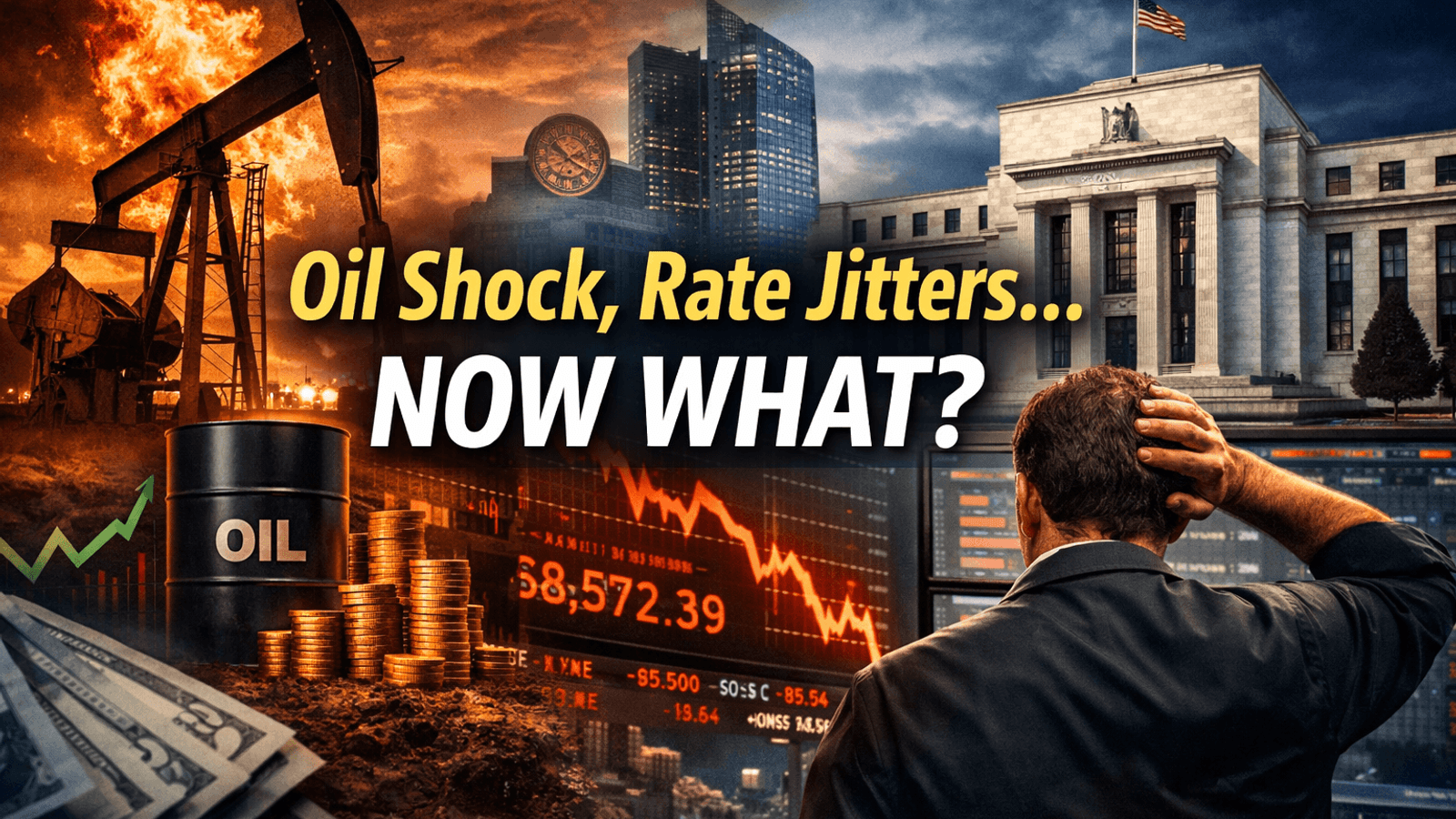
You probably felt it too. Inflation looked like it was cooling. Central banks were hinting at relief. Markets were starting to relax—maybe even get a little optimistic. Then oil prices surged. Not gradually. Not politely. Suddenly, the entire macro narrative flipped. Bond yields jumped. Rate-cut expectations faded. Equities wobble. And investors were forced to rethink a simple question: What happens when inflation comes back before policy has even eased?
Central Banks Hit the Brakes—Rate Cuts Aren’t Guaranteed Anymore
For months, the conversation revolved around when central banks would cut rates. Now, the tone has shifted to something more cautious: should they cut at all? Recent signals from the Federal Reserve, the European Central Bank, and the Bank of England suggest that policymakers are growing uncomfortable. Rising energy prices are feeding directly into inflation expectations. That’s a problem they can’t ignore. Bond markets have already adjusted. Yields climbed as investors priced in fewer cuts—and even entertained the idea of rates staying higher for longer. Smart Capital Signal: When energy-driven inflation returns, central banks don’t rush to ease. They pause. And markets reprice faster than policy can respond.
Oil Isn’t Just Rising—It’s Rewriting Market Assumptions
Oil moving above $100 isn’t just a headline. It’s a macro event. Major institutions, including Goldman Sachs, have warned that a sustained energy shock could push the S&P 500 significantly lower. The logic is simple but brutal:
- Higher oil → higher costs
- Higher costs → lower margins
- Lower margins → lower valuations
That chain reaction hits nearly every sector, especially high-growth companies that rely on cheap capital and stable inputs. Meanwhile, analysts across Wall Street have raised oil forecasts, with some scenarios pointing to extreme upside if supply disruptions continue. Tactical Insight: Oil shocks don’t just increase volatility—they reset valuation frameworks. Growth stocks, in particular, feel the pressure first.
Strategic Oil Reserves: A Temporary Fix to a Structural Problem
Governments aren’t standing still. Discussions around releasing Strategic Petroleum Reserves (SPR)—potentially hundreds of millions of barrels—have gained traction. It sounds like a big number. And it is. But here’s the catch: Releasing reserves can stabilize markets temporarily. It cannot replace sustained supply disruptions, especially when key shipping routes or production hubs are affected. Energy markets aren’t dealing with weak demand. They’re dealing with constrained supply and fragile logistics. Investor Radar: Policy intervention can smooth the spikes. It rarely solves the underlying issue. Markets tend to price that reality quickly.
Asia Feels the Pressure First—And That Matters Globally
Energy shocks don’t hit evenly. Regions that depend heavily on imported fuel—like Japan, China, and South Korea—feel the impact first. Recent market reactions reflect that imbalance. Asian equities have shown sharper declines, while currencies and import costs face additional strain. Why should you care? Asia sits at the center of global manufacturing and trade. When energy costs rise, the ripple effects travel quickly—into supply chains, export prices, and global inflation. Macro Watch: Energy dependence has quietly become one of the most important macro risk indicators. Markets are starting to treat it that way.
The Bigger Risk: Growth Slows While Inflation Sticks
Here’s where things get uncomfortable. Economists are increasingly discussing a familiar but unwelcome scenario: stagflation-lite. Not the extreme version of the 1970s, but enough to matter:
- Growth slows as costs rise
- Inflation remains sticky due to supply shocks
- Central banks lose flexibility
Recent outlook revisions from firms like S&P Global reflect that shift. Growth expectations are being trimmed, while inflation projections are nudging higher. Markets have noticed. Equities are softer. Bonds are unstable. Even traditional safe havens aren’t behaving cleanly. Portfolio Lens: When both growth and inflation move in the wrong direction, diversification becomes harder. Cash, energy exposure, and defensive positioning start to look more attractive.
The Market Isn’t Panicking—It’s Adjusting
What’s unfolding isn’t chaos. It’s recalibration. The old narrative—cooling inflation, rate cuts, smooth growth—no longer holds. A new one is forming:
- Energy volatility is back
- Rate cuts are uncertain
- Growth is fragile
Markets are adjusting accordingly. Quietly in some places. Sharply in others.
The Real Takeaway: A Subtle but Serious Regime Shift
The shift happening beneath the surface isn’t loud, but it’s meaningful. Investors are moving from a liquidity-driven environment—where central banks support growth—to a constraint-driven one, where supply shocks and geopolitics dictate outcomes. That changes how assets behave. It changes how risks are priced. And it changes what “safe” even means.
Final Thought — Read the Kitchen, Not Just the Menu
Markets rarely send clear invitations. They leave clues. Right now, the clues point to a more complex environment—one where energy, policy, and growth are tightly intertwined. You don’t need to predict every move. But you do need to recognize the shift. Because when the ingredients change, the recipe always follows.
Sources
- Reuters — Central bank and market reactions
- Reuters — Goldman Sachs oil shock warning
- Reuters — Global markets and oil surge
- Reuters — Oil forecast upgrades
- S&P Global — Economic outlook
- TheStreet — Strategic oil reserve discussion
Market Munchies and Mode Mobile communications are for informational purposes only, and are not a recommendation, solicitation, or research report relating to any investment strategy, security, or digital asset. All investments involve risk including the loss of principal and past performance does not guarantee future results.
Any information contained in this commentary does not purport to be a complete description of the securities, markets, or developments referred to in this material. The information has been obtained from sources considered to be reliable, but we do not guarantee that the foregoing material is accurate or complete. There is no guarantee that any statements or opinions provided herein will prove to be correct.